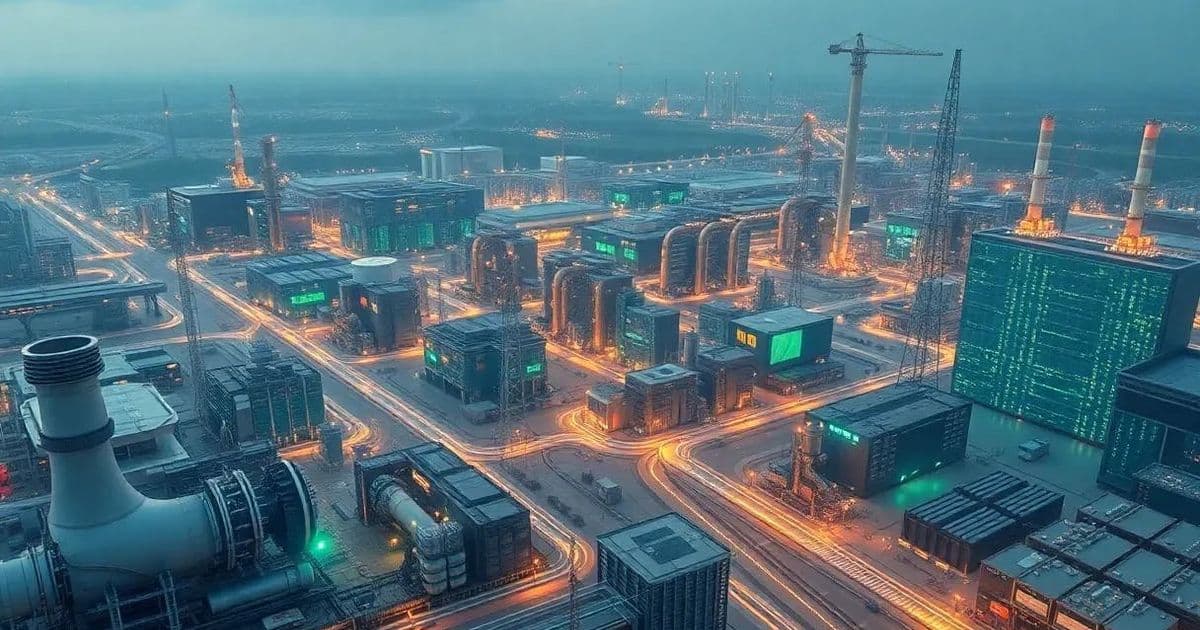
A week‑long investigation reveals how a single ChatGPT request triggers a hidden supply chain that stretches from Caterpillar factories in the Midwest to TSMC fabs in Taiwan, through massive gas‑turbine farms in Mississippi, and onto Wall Street bond markets, exposing the true cost of AI compute.
The Query That Set Off a Chain Reaction
When I typed a simple question into ChatGPT on a Tuesday afternoon, I expected a text reply in a few seconds. What I didn’t expect was a cascade of physical processes that began far away in the Mississippi Delta and ended up on the balance sheets of global banks. The story started with a news alert about 46 mobile gas turbines parked on flatbed trailers outside a new xAI data center. The turbines were operating without the air‑quality permits normally required for stationary power plants, prompting a lawsuit from the NAACP. The headline was an environmental story, but the deeper investigation uncovered a sprawling AI‑infrastructure supply chain that touches almost every corner of the modern economy.
1. The Turbines – Raw Power for AI
What they are
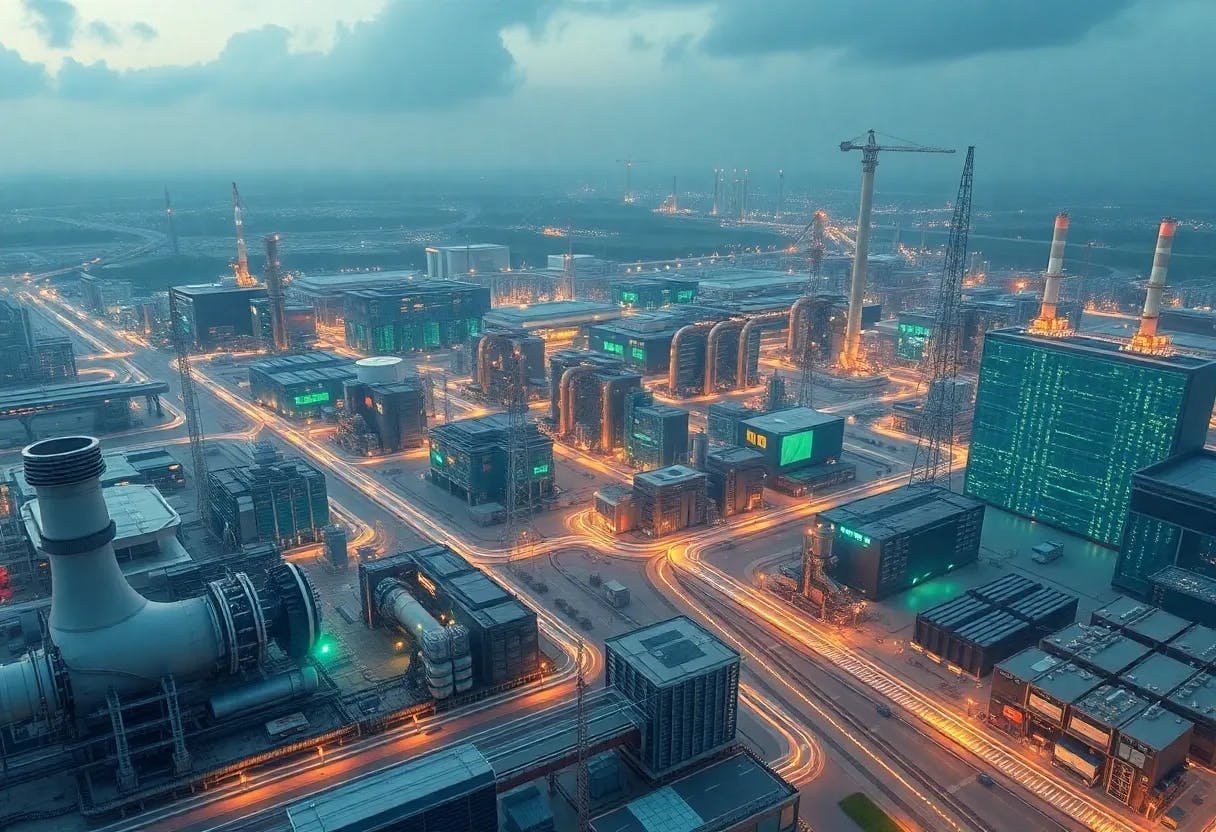
Industrial gas turbines rated at 2–3 MW each are far more than backup generators. At 46 units the farm produces 120 MW, roughly the output of a small municipal power plant. The primary manufacturers are Caterpillar, Cummins, and MTU (Rolls‑Royce). A single turbine costs $0.5 M–$1.5 M, so the hardware alone represents a $30 M–$70 M capital outlay.
Fuel and logistics
Running the turbines requires a steady supply of natural gas, which pulls in:
- Extraction firms in the Permian and Marcellus basins
- Interstate pipelines operated by Kinder Morgan, Williams, and Enbridge
- Storage facilities that buffer daily demand spikes
- Long‑term contracts that lock in price and volume for years
Every kilogram of gas shipped to Mississippi is a line item on a contract that ultimately ties back to commodity traders on the NYMEX.
2. Building the Data Center – Four Construction Layers
Layer 1: Civil Engineering
Mississippi’s land is roughly 90 % cheaper than the Bay Area, which explains Musk’s location choice. Still, the site required:
- Grading and earthworks from regional contractors
- Reinforced concrete foundations sourced from Lafarge
- Steel framing fabricated in U.S. Steel plants in Indiana
Each of these sub‑contracts creates local jobs but also adds to the total project cost, typically $200 – $300 M for a 100‑MW AI facility.
Layer 2: Power Systems
Beyond the turbines, the center needs:
- UPS (Uninterruptible Power Supply) arrays – often lithium‑ion batteries from Tesla or LG Chem, each costing several million dollars.
- Switchgear, transformers, and cable trays – supplied by ABB and Siemens.
- Redundant feeds (N+1 architecture) to meet the “five‑nines” availability target demanded by AI workloads.
Layer 3: Cooling Infrastructure
A single NVIDIA H100 GPU dissipates 700 W; the newer B200 can exceed 1 kW. Packing thousands of these chips into racks forces data centers to adopt liquid‑cooling solutions:
- Cold‑plate manufacturers such as CoolIT and Motivair
- Specialty coolants (e.g., 3M Novec, Dow Fluorinert)
- Large‑scale cooling towers and chilled‑water loops
Cooling can account for 15 %–25 % of total construction spend.
Layer 4: Optical Networking
Training large language models requires 800 Gb/s–1.6 Tb/s optical links per GPU. The optical modules are sourced from a handful of suppliers:
- Cisco and Arista for the switch chassis
- Zhongji Innolight and Lumentum for the transceiver modules
- Finisar for the fiber‑optic components
A 10 k‑GPU cluster can trigger $100 M+ in optical‑module procurement, a figure that dwarfs the cost of the GPUs themselves.
3. The Chip Chain – From Silicon to AI
Design → Fabrication → Integration
- NVIDIA designs the H100/B200 GPUs and licenses the silicon to TSMC.
- TSMC uses ASML’s EUV lithography machines (each priced near €300 M) to etch the 5‑nm and 4‑nm nodes required for AI accelerators.
- Finished wafers travel to assembly & test facilities in Taiwan and Singapore before being shipped to server OEMs like Dell, HP, and Supermicro.
The entire ecosystem—design tools, wafer fab, packaging, and test—represents a global network of over 10 k specialized firms. Disruptions in any one node (e.g., a shortage of EUV lenses) ripple through the whole AI supply chain.
4. The Energy Chain – Powering the Query
According to a Goldman Sachs estimate, a single ChatGPT request consumes 10× the electricity of a typical Google search. Training a GPT‑4‑scale model uses as much energy as 1,000 U.S. homes over a year. The implications are tangible:
- Natural‑gas prices have risen 40 % from 2024 to 2026, driven by demand from Amazon, Google, Microsoft, and now xAI.
- Data‑center‑grade diesel generators, Tesla Megapack battery systems, and flywheel storage are now standard backup solutions, each adding millions to the cap‑ex budget.
- Regional grids feel the strain. PJM’s wholesale electricity price jumped 76 % in a single year, and NV Energy in Nevada has received 22 GW of data‑center power requests—far exceeding the state’s residential peak demand.
The hidden cost shows up on the utility bills of ordinary consumers, as illustrated by the Lake Tahoe case where residents may need to switch providers because the grid is being re‑prioritized for AI workloads.
5. The Financial Chain – From Bonds to Insurance
The capital required to build and operate an AI data center is now being raised through a mix of high‑yield bonds, equity offerings, and syndicated loans. In 2026 the four biggest cloud providers are projected to spend $650 B–$700 B on infrastructure, a figure expected to cross $1 trillion in 2027.
Key players in the financing ecosystem include:
- Investment banks that underwrite AI‑infrastructure bonds (often 10‑year, 5 %‑6 % coupons).
- Asset managers launching “AI compute funds” that target REITs like Equinix and Digital Realty.
- Lloyd’s of London syndicates now underwriting a new class of compute‑interruption insurance, covering losses from turbine failures or grid outages.
These financial instruments lock in long‑term cash flows that flow back to the same investors who fund the turbines, the copper wires, and the software stack.
6. What This Means for the Everyday User
When you press Enter on a ChatGPT prompt, a chain of events unfolds that you never see:
- A turbine spins, burning natural gas extracted thousands of miles away.
- The generated electricity powers a rack of GPUs that heat up and are cooled by a liquid‑loop system.
- An optical module shuttles data at terabit speeds across a global fiber network.
- A bond payment is triggered to service the debt that financed the turbine.
- The cost of that electricity is reflected in the next utility bill for a household in Nevada.
The benefits—instant answers, code generation, creative assistance—are concentrated in the hands of a few tech giants and their investors. The costs—environmental impact, higher energy prices, regulatory strain—are diffused across communities that often have little say in the matter.
7. Closing Thoughts
The investigation started with a legal filing about air‑permit violations and ended with a view of the global AI‑infrastructure economy. The supply chain that makes a single AI query possible is massive, capital‑intensive, and tightly interwoven with traditional energy and financial markets. Understanding this chain is the first step toward a more transparent conversation about the true price of AI.
If you’re interested in digging deeper, the original sources are linked throughout the article, and the full set of data‑center specifications can be found in the public filings of Equinix and Digital Realty.

Comments
Please log in or register to join the discussion