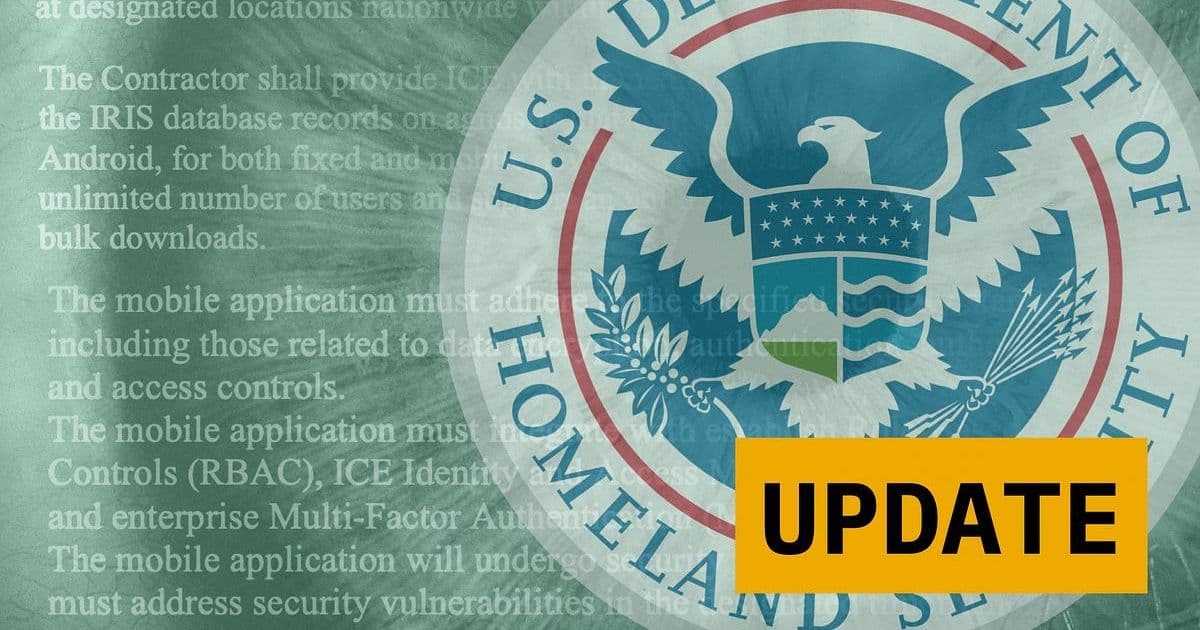
Immigration and Customs Enforcement has awarded a $25.1 million no-bid contract to Bi2 Technologies for iris scanning technology, a fivefold increase from their previous agreement, raising questions about oversight and privacy implications.
Immigration and Customs Enforcement (ICE) has finalized a $25.1 million no-bid contract with Massachusetts-based Bi2 Technologies for iris scanning technology, according to a contract award posted to SAM.gov. The agreement, finalized on May 22, 2026, represents a significant expansion of biometric surveillance capabilities within federal law enforcement, with devices expected to be deployed to ICE locations by late June.
The procurement covers iris biometric recognition technology and access to Bi2's biometric information system, which ICE states will "allow agents to quickly authenticate the identity of subjects during field operations." The contract also provides ICE's Enforcement and Removal Operations division with continuous access to Bi2's database containing more than five million booking records.
This contract represents a substantial increase from ICE's previous agreement with Bi2, which cost $4.6 million in September 2025. The new contract is more than five times larger and includes nearly eight times as many devices—1,570 units compared to the previous 200.
Technology and Implementation
Iris scanning technology works by capturing high-resolution images of the intricate patterns in the iris, which are unique to each individual and remain stable throughout a person's life. Biometric systems convert these patterns into mathematical representations that can be compared against stored records for identification purposes.
The Bi2 system appears to be designed for field use, allowing ICE agents to authenticate identities during operations without requiring subjects to be transported to processing facilities. This capability could expedite identification processes but also raises questions about accuracy and potential misidentification in non-controlled environments.
Oversight Concerns
Notably, the procurement did not require the system to clear FedRAMP, the government's security review process for cloud systems handling sensitive data. The contract description also indicates no independent audit, congressional notification, or outside review of how the system would be used.
The lack of these standard security and oversight measures is particularly concerning given the sensitive nature of biometric data and the potential implications for civil liberties. Biometric information, unlike passwords or PINs, cannot be changed if compromised, making its protection paramount.
Privacy Implications
The contract's inclusion of access to Bi2's database of more than five million booking records raises significant privacy considerations. This database likely contains biometric information linked to personal identifiers, creating a comprehensive repository of individuals' biometric data.
Civil liberties advocates have raised concerns about the expansion of biometric surveillance without corresponding privacy protections. The collection and storage of biometric data, particularly when obtained during immigration enforcement activities, may disproportionately impact vulnerable populations.
Market Context
Bi2 Technologies appears to be a relatively small company given the rapid expansion of its government contracts. The company's first ICE contract was awarded less than a year ago, yet it has already become a major supplier of biometric technology to federal agencies.
The no-bid nature of this contract suggests either specialized capabilities or continued reliance on established relationships with the vendor. Federal procurement processes typically require competitive bidding unless specific justifications exist for sole-source contracts.
Technical Limitations
Despite the significant investment, iris scanning technology has known limitations that may affect its reliability in field conditions. Factors such as lighting conditions, subject cooperation, occlusion by glasses or contacts, and changes in pupil size due to medications or medical conditions can impact accuracy.
Studies have shown that while iris recognition can achieve high accuracy rates in controlled environments, performance may decrease in real-world conditions where subjects may not be cooperative or environmental factors are less than optimal.
The deployment of this technology without independent validation of its accuracy and reliability in field conditions represents a significant risk, particularly given the potential consequences of misidentification in immigration enforcement contexts.
As biometric technologies continue to proliferate in government applications, questions remain about appropriate oversight, privacy protections, and technical validation. This ICE contract expansion highlights the tension between technological capability and the safeguards necessary to protect civil liberties in an increasingly digital surveillance environment.
Comments
Please log in or register to join the discussion