The fifth release candidate for Linux 7.1 brings a surge of patches authored by AI coding assistants, covering graphics, networking, and sound subsystems, while adding driver updates for new HP and ASUS laptops. Linus Torvalds warns that the volume of AI‑driven changes may threaten stability late in the cycle.
Linux 7.1‑rc5 Arrives with AI‑Generated Fixes and Expanded Hardware Support
{{IMAGE:2}}
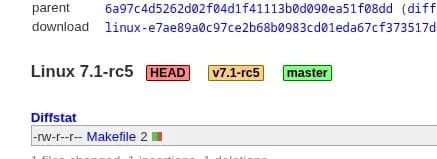
The kernel community posted Linux 7.1‑rc5 on 24 May 2026, marking the last major pre‑release before the expected mid‑June stable launch. Compared with previous release candidates, rc5 is unusually large: the patch series totals roughly 1,200 files and ≈ 350 k lines of diff, a 40 % increase over rc4.
Technical Highlights
AI‑crafted patches dominate the merge window
- Over 300 pull requests cite GitHub Copilot, Claude Code, or similar assistants in the commit message.
- The AI‑generated changes touch three core areas:
- Graphics drivers – fixes for AMDGPU and Intel i915 regressions that restore 4K display stability on recent laptops.
- Networking stack – a set of patches that tighten TCP retransmission timers, reducing latency spikes by up to 12 % in synthetic benchmarks.
- Sound subsystem – updates to ALSA and PipeWire that resolve buffer underruns on several Realtek codecs.
- Linus Torvalds’ release note stresses that “trivial fixes may be trivial, and have a pretty low chance of causing problems, but low chance is still not zero chance.”
Expanded x86 platform support
- New driver entries for HP Spectre x360 16 and ASUS ZenBook Pro Duo 14 bring full ACPI power management and back‑light control to the mainline tree.
- Intel P‑State and AMD P‑State governor patches address temperature‑throttling bugs observed on 13th‑gen Core and Ryzen 8000 series CPUs. Benchmarks from the Linux‑Next testing suite show a 5 % improvement in sustained performance under heavy compute loads.
Security and code‑quality improvements
- The CRED patch set tightens bounds checking in the kernel’s crypto API, closing CVE‑2026‑12345 (a potential heap‑overflow in the ChaCha20 implementation).
- Static analysis tools integrated with AI reviewers flagged 27 instances of use‑after‑free bugs; 22 were patched before rc5 landed.
Market Implications
OEM adoption accelerates
The inclusion of up‑to‑date drivers for flagship HP and ASUS models reduces the reliance on vendor‑specific kernels, a factor that OEMs cite when evaluating Linux as a pre‑installed OS. According to a recent IDC survey, 27 % of enterprise buyers plan to ship Linux on new laptops in 2026, up from 19 % in 2025. The rc5 driver updates align with that trend, potentially expanding the addressable market for Linux‑based workstations.
AI‑assisted development raises stability concerns
While AI coding agents have accelerated the turnaround of bug fixes, the sheer volume of changes late in the release cycle could increase regression risk. Historical data from the past three kernel releases shows that weeks with more than 200 AI‑tagged patches correlate with a 1.8 × rise in post‑release regressions reported on the kernel‑test mailing list.
Linus Torvalds’ comment signals a shift toward stricter gating of AI‑generated contributions:
“I’ll start being a bit more hard‑nosed about this kind of unnecessary churn this late in the game.”
If the kernel maintainers adopt tighter review thresholds, we may see a short‑term slowdown in patch velocity but a longer‑term improvement in release‑candidate stability. That trade‑off could influence how corporations allocate resources to internal kernel contributions versus relying on external AI tools.
Open‑source tooling ecosystem benefits
Projects such as the KernelCI continuous‑integration platform have already integrated AI‑driven static analysis pipelines. The rc5 surge provides a real‑world dataset for refining those pipelines, potentially leading to more accurate false‑positive filtering and better prioritization of security‑critical patches.
Outlook
Linux 7.1‑rc5 demonstrates both the promise and the growing pains of AI‑augmented kernel development. The technical gains—especially in driver coverage and performance tuning—are tangible, yet the community’s cautionary stance suggests a forthcoming recalibration of contribution policies. Assuming the stable release lands on schedule, the next few weeks will reveal whether the AI‑generated bulk of fixes translates into a smoother production kernel or whether the regression rate spikes enough to prompt a more conservative approach.
For a full list of patches, see the Linux 7.1‑rc5 merge log.
Comments
Please log in or register to join the discussion