A detailed look at why backend services move from Go to Rust, the concrete differences in language features, and a step‑by‑step strategy for incremental migration.
Migrating from Go to Rust – A Practical Guide for Backend Teams
Published: 2026‑05‑21
Author: Matthias Endler
Editor: Simon Brüggen
Why the move matters
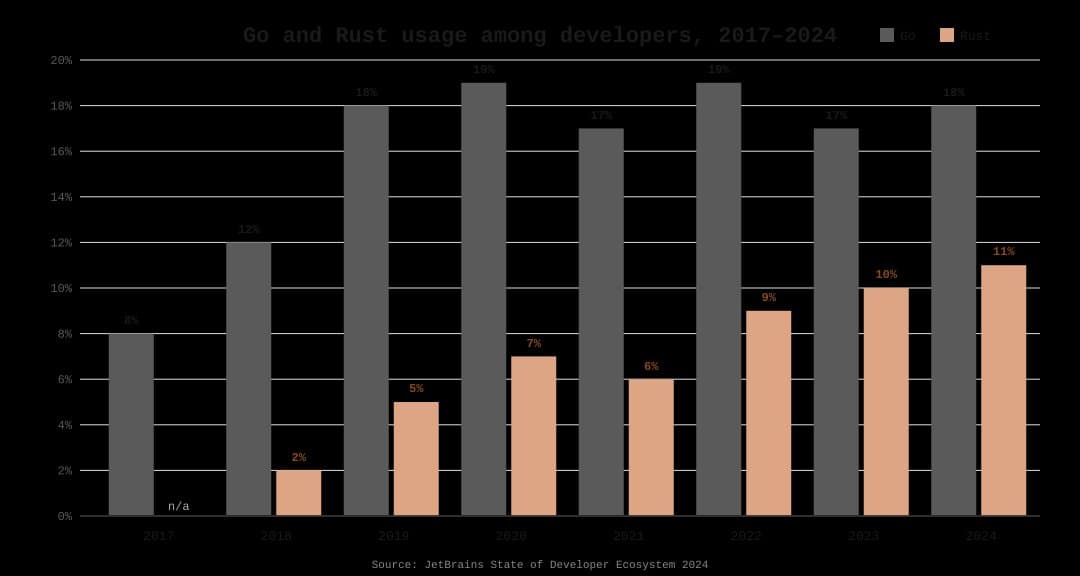
Go dominates the backend space, holding roughly 17‑19 % of developers in the JetBrains survey. Rust’s share is climbing, now around 11 % and still growing. The migration is not about raw speed – Go is already fast enough for most services – but about the guarantees the compiler gives you. Nil dereferences, missed error checks and data races that slip past go test -race become compile‑time errors in Rust. For large, long‑running services those foot‑guns translate into on‑call fatigue and higher incident rates.
Where Go and Rust overlap
Both languages compile to native binaries, have static typing and a strong focus on concurrency. Their toolchains are similarly opinionated:
| Go | Rust |
|---|---|
go.mod / go.sum |
Cargo.toml / Cargo.lock |
go build |
cargo build |
go run . |
cargo run |
go test ./... |
cargo test |
go vet |
cargo clippy |
gofmt |
cargo fmt |
go install |
cargo install --path . |
go doc |
cargo doc --open |
pprof |
cargo flamegraph |
govulncheck |
cargo audit |
The biggest cultural difference is that Go often reaches for third‑party tools (golangci‑lint, mockgen, goreleaser) while Rust bundles most of the functionality in the standard toolchain. This reduces the number of external dependencies you need to keep up to date.
Core language differences
| Aspect | Go | Rust |
|---|---|---|
| Type system | Structural, generics added in 1.18 | Nominal, traits, lifetimes, zero‑cost generics |
| Memory management | Concurrent garbage collector | Ownership model, no GC |
| Null safety | nil everywhere |
Option<T> forces handling of the empty case |
| Error handling | error return values, explicit if err != nil |
Result<T,E> with ? operator, exhaustive matching |
| Concurrency | Goroutines + channels, implicit pre‑emptive scheduling | async/await on Tokio or async‑std, explicit Send/Sync bounds |
| Compile time | Very fast, incremental builds | Slower, monomorphisation can add minutes for medium services |
| Ecosystem size | ~750 k modules | ~250 k crates |
These differences translate into concrete developer experience:
- Nil dereferences – In Go a missing check can panic at runtime. In Rust the compiler refuses to compile code that tries to use an
Option<T>without handlingNone. - Data races – Sharing a
HashMapbetween threads compiles in Go but will not compile in Rust unless you wrap it inArc<Mutex<…>>or use channels. - Error propagation – The
?operator replaces the repetitiveif err != nil { return err }pattern, and custom error types can be derived automatically withthiserror. - Generics – Rust’s generics are monomorphised, giving you zero‑cost abstractions. Go’s generics still rely on a dictionary lookup for many operations, which can be slower than hand‑written code.
Typical migration path
- Identify a hot‑path service – Pick a component with a clear API contract and measurable latency or CPU pressure.
- Create a Rust stub – Replicate the HTTP/gRPC interface using
axum(ortonicfor gRPC) so that callers see no change. - Port core logic incrementally – Move pure business functions first, keeping the same signatures. Replace
errorreturns withResultandnilchecks withOption. - Add async where needed – If the original Go code used goroutines per request, switch to Tokio’s runtime. The code shape stays similar; you just add
.awaitat call sites. - Run side‑by‑side – Deploy the Rust service behind a gateway or service mesh, route a small percentage of traffic, monitor latency and error rates.
- Iterate – Once the Rust version proves stable, increase traffic, decommission the Go implementation, and repeat for the next service.
Practical tips for the team
- Treat the borrow checker as a partner – When the compiler rejects a pattern, ask what could go wrong at runtime. The error messages are usually precise.
- Use
cargo checkin the edit loop – It compiles faster than a full build and catches most borrow‑checker issues early. - Split large crates – Keep proc‑macro heavy dependencies in their own crate to avoid recompiling them on every change.
- Leverage existing crates – For most backend needs the stack
axum + sqlx + tokio + tracing + serde + clapcovers 90 % of the functionality you would use in Go. - Invest in training – Pair programming sessions, a short workshop on lifetimes and async, and a shared documentation folder reduce the learning curve.
- Don’t rewrite everything – Keep Go for Kubernetes operators, thin glue services and CLI tools where fast compile times and low ceremony matter more than the extra safety guarantees.
Expected impact (based on migrations I have helped with)
| Metric | Typical change |
|---|---|
| CPU usage | 20‑60 % reduction |
| Memory footprint | 30‑50 % reduction |
| P99 latency tail | noticeably flatter, fewer GC spikes |
| Production incidents (data races, nil panics) | close to zero after migration |
| On‑call load | dramatically lower |
These numbers are not guarantees; they depend on workload characteristics and how well the Rust code follows idiomatic patterns.
Resources
- The original “Go vs Rust? Choose Go.” post (2017) – provides background on the author’s perspective.
- The hands‑on comparison with the Shuttle team – a line‑by‑line implementation of the same service in both languages.
- JetBrains State of Developer Ecosystem 2024 – source for the Go usage figures.
- Official Rust documentation: cargo book, rustc book.
- A quick start guide for async in Rust: https://tokio.rs/tokio/tutorial
Final thoughts
Moving from Go to Rust is a shift from a language that trusts the programmer at runtime to one that asks the programmer to prove safety at compile time. The trade‑off is a steeper learning curve and longer compile times, but the payoff is a codebase that crashes far less often and delivers more predictable latency. For core services that need the highest reliability, the investment is usually justified. For peripheral tools, Go remains a pragmatic choice.
If you are ready to evaluate a migration, I can help with architecture reviews, training workshops, and hands‑on porting of critical services. Feel free to reach out via the contact page.
{{IMAGE:1}}
Comments
Please log in or register to join the discussion