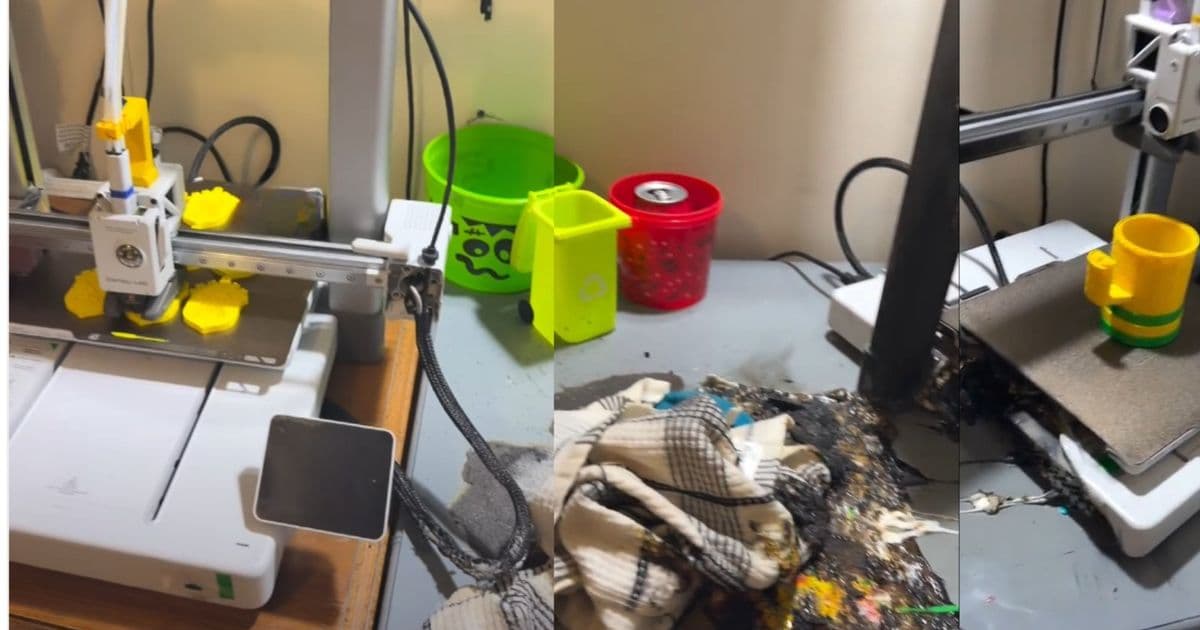
A recent Instagram video showing a Bambu Lab A1 printer reduced to molten plastic has reignited concerns over the model’s AC power board and its NTC thermistor. While some users call for an immediate recall, others point to recent hardware revisions and missing forensic evidence. This analysis breaks down the technical root cause, compares the A1’s thermal design to industry norms, and evaluates the market impact for Bambu Lab and downstream manufacturers.
New video of melted Bambu Lab A1 sparks recall calls
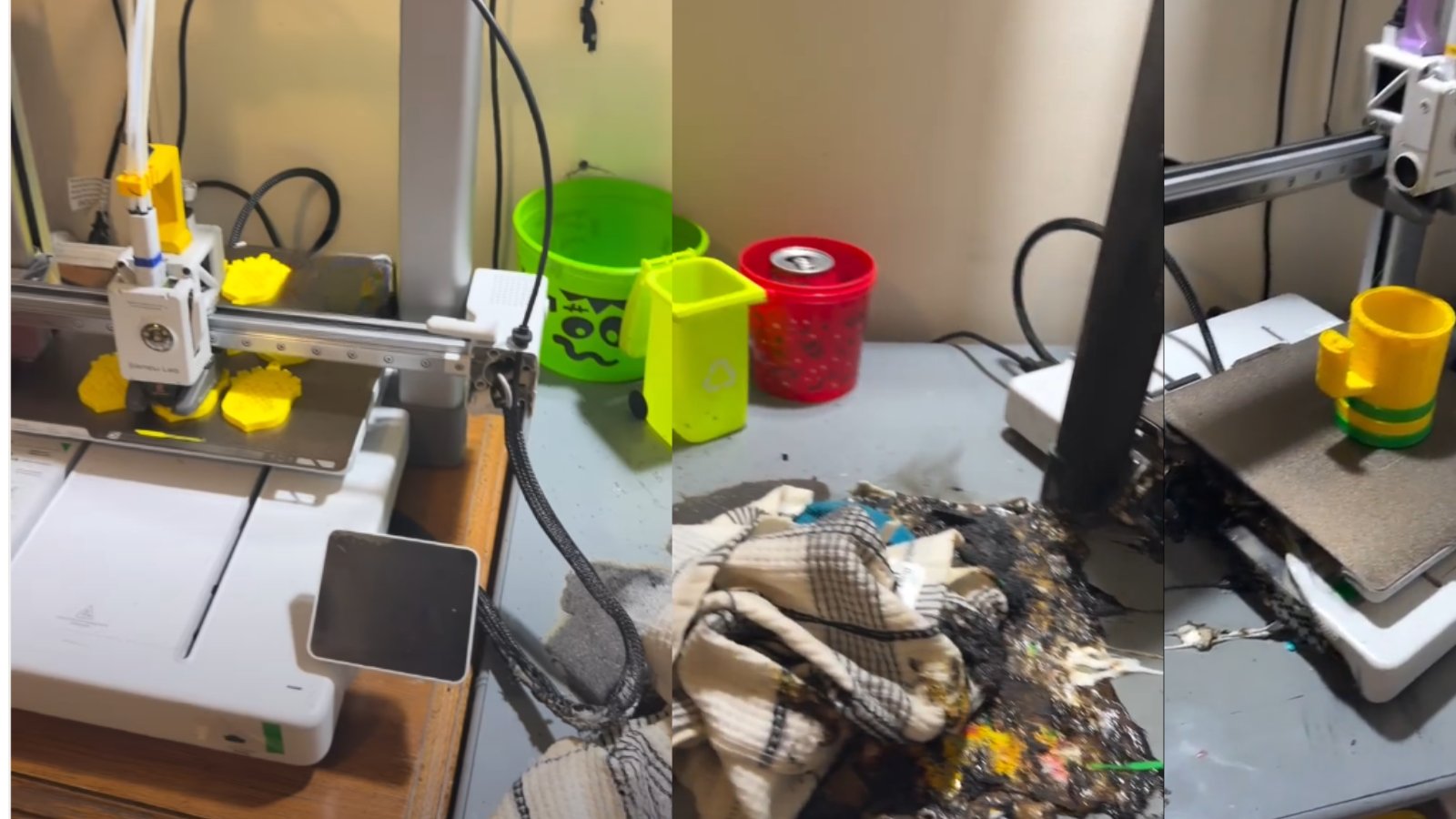 A short Instagram reel posted by the creator Moreiras3D shows a Bambu Lab A1 whose side panel has melted away, exposing the metal chassis. A second A1 on the same desk displays a scorched power cord. The footage, set to a Brazilian gospel track, offers no live view of the fire’s ignition, but the visual damage is unmistakable.
Technical background – why the A1’s power board is under scrutiny
The A1’s AC power distribution board operates at ~45 °C idle and can climb to ~85 °C during the initial warm‑up phase. The board relies on a Negative Temperature Coefficient (NTC) thermistor to limit inrush current. In theory, the thermistor’s resistance drops as temperature rises, allowing a controlled surge of current until the printer reaches its operating voltage.
Known failure mode
- Thermistor drift – Over repeated thermal cycles, the NTC can lose its calibrated resistance curve, causing it to stay in a low‑resistance state longer than intended. This prolongs high inrush currents, heating the copper traces on the board.
- Copper trace delamination – At temperatures above 90 °C, the FR‑4 substrate can soften, leading to micro‑cracks that eventually expose copper to air. Once exposed, copper oxidizes and can spark under load.
- Flame‑retardant rating – Bambu Lab rates the enclosure plastic to UL 94 V‑0, which self‑extinguishes within 10 seconds after flame removal. However, the rating assumes the fire source is external; an internal short that ignites the plastic can exceed the material’s suppression capability.
The January 2024 incident report from 3D‑Musketeers highlighted several A1 units with charred cases but no complete melt‑down. Those cases were traced to NTC drift beyond ±20 % of its nominal value.
What changed in Q3 2025?
Bambu Lab announced a hardware revision (rev C) in July 2025 that replaced the original NTC with a dual‑thermistor scheme and added a thermal fuse rated at 120 °C. The new layout also spreads the power traces over a larger copper area, reducing localized heating.
- Thermistor spec shift: from 10 kΩ @ 25 °C, B = 3950 to 12 kΩ @ 25 °C, B = 4100 – a tighter tolerance that delays the low‑resistance plateau.
- Thermal fuse: opens the circuit if board temperature exceeds 120 °C for more than 2 seconds, cutting power before the enclosure reaches its melt point (~150 °C).
If the printer in the video is a post‑revision unit, the NTC‑only failure path should be impossible. However, the video does not disclose the serial number or firmware version, leaving the hardware generation ambiguous.
Forensic gaps in the Instagram evidence
- Timing – The reel shows the melted chassis after the fire, covered by a dish towel. No frame captures the ignition moment, making it impossible to verify whether the heat originated from the power board or an external source (e.g., a dropped candle, a nearby laptop charger).
- Environmental clues – The desk contains a paper‑towel roll and a plastic container near the printers. Both are combustible and could have acted as a secondary fuel.
- Power source – The owner mentions using a surge protector, but the video does not display the protector’s indicator lights. A failed protector could have supplied a voltage spike that bypassed the NTC’s protective function.
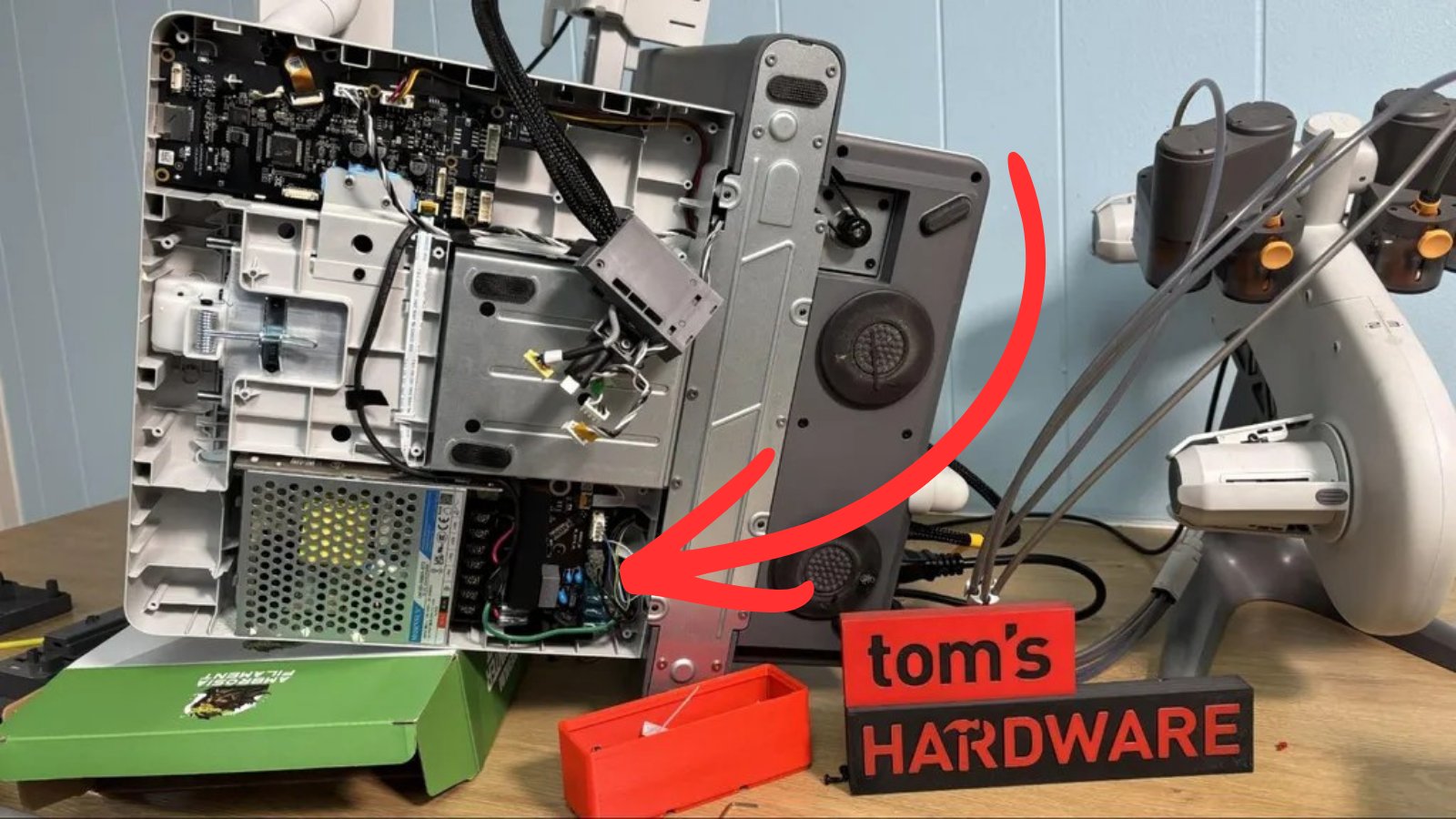
- Serial evidence – No close‑up of the power board is shown, so the presence or absence of the dual‑thermistor layout cannot be confirmed.
These gaps fuel the split in community opinion: some Redditors demand a recall based on the visual severity, while others argue that without a clear failure trace, a recall would be premature.
Market implications for Bambu Lab
| Metric | Current trend | Potential impact |
|---|---|---|
| Unit shipments (Q2 2024) | 120 k units, +15 % YoY | A recall could stall the upward trajectory and force Bambu to allocate inventory for replacement boards. |
| After‑sales service tickets | 3.2 % of sold units report power‑board anomalies | A high‑visibility incident could push this figure toward 5 %, increasing warranty costs. |
| Competitive positioning | Rival printers (e.g., Prusa i3 MK4, Creality K1) tout ISO‑13849‑1 safety compliance | If Bambu Lab is forced to issue a recall, it may lose market share to competitors that emphasize certified safety designs. |
| Brand perception | Strong among hobbyists for speed and print quality | Repeated fire reports could erode trust, especially in professional studios that require UL‑listed equipment. |
Short‑term outlook
- Supply chain pressure – Bambu’s primary PCB supplier in Taiwan reports a 12 % capacity utilization increase to meet the revised board demand. Lead times for the new rev C board could extend to 8‑10 weeks, delaying repairs.
- Regulatory watch – The European Union’s CE‑Mark audit schedule for 2026 includes a focus on electrical safety for consumer 3D printers. A high‑profile fire could trigger a pre‑emptive audit.
Long‑term outlook
If Bambu Lab can demonstrate that the revised board eliminates the NTC‑only failure path, the incident may become a case study in rapid design iteration. Conversely, a recall would set a precedent for mandatory safety upgrades across the mid‑range printer segment, potentially accelerating the adoption of dual‑thermistor or active cooling solutions.
What users can do now
- Inspect the power board – Look for the red‑arrow‑marked NTC (see image below). If the board shows a single NTC and no fuse, the unit is likely pre‑revision.
- Monitor chassis temperature – Use a handheld infrared thermometer; sustained readings above 70 °C during warm‑up warrant a shutdown.
- Upgrade the surge protector – Choose a protector with clamping voltage ≤ 250 V and a response time < 1 ms to limit voltage spikes.
- Report to Bambu Lab – Provide serial numbers, board photos, and power‑log files. Detailed reports accelerate the firmware‑level diagnostics that the company is currently running.
Conclusion
The melted A1 video reignites a debate that began with the NTC thermistor issue earlier this year. While the hardware revision introduced in Q3 2025 addresses the most likely failure mode, the lack of forensic evidence leaves room for speculation. For Bambu Lab, the stakes are clear: a recall would impact shipments, warranty costs, and brand credibility, while a well‑documented fix could reinforce its reputation for rapid engineering response.
For a visual guide to the power board layout, see the official Bambu Lab service manual here.
Comments
Please log in or register to join the discussion