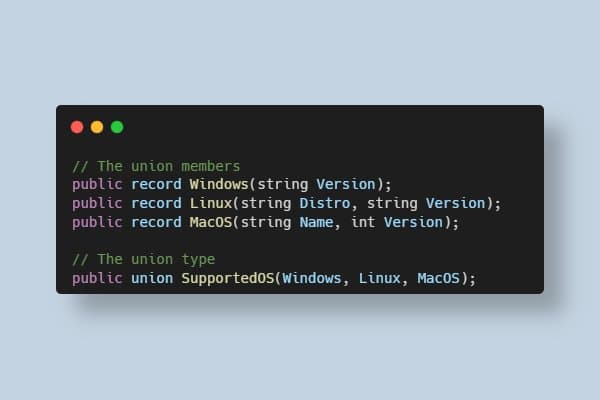
C# 15 introduces union types, a long-awaited feature that brings functional programming concepts to mainstream .NET development, offering more expressive type safety and reducing common error patterns.
The introduction of union types in .NET 11 (C# 15) represents a significant milestone in the evolution of the C# language, bringing a concept long cherished in functional programming to the mainstream .NET ecosystem. After years of community requests and proposals, this feature finally arrives, promising to address common pain points in error handling and data representation that have plagued C# developers for ages.
Understanding the Essence of Union Types
At their core, union types provide a mechanism for creating types that can represent one of several possible values. This concept, fundamental in functional programming languages like F#, TypeScript, and Rust, allows developers to model complex scenarios where data might take multiple forms. The article rightly highlights the Result<TSuccess, TError> and Option<T> patterns as canonical examples of union types in action.
What makes union types particularly valuable is their ability to encode domain constraints directly into the type system. Rather than relying on conventions or runtime checks to ensure proper handling of different states, union types make these constraints explicit and enforceable at compile time. This shift from implicit to explicit contracts represents a significant improvement in code reliability and maintainability.
Implementation Approach: Simplicity with Power
The implementation of union types in C# 15 demonstrates an elegant balance between simplicity and power. The generated code, as revealed in the article, is remarkably straightforward: a struct decorated with the [Union] attribute, implementing the IUnion interface with a single object? Value property, and containing constructors for each case type.
This approach has several advantages:
- Minimal runtime overhead: The implementation is lightweight, with no complex runtime requirements
- Backward compatibility: The feature is implemented as a compiler feature, allowing it to work with earlier runtime targets
- Extensibility: The attribute-based approach allows for custom implementations
The compiler's role in handling implicit conversions and switch expressions is particularly noteworthy. Rather than requiring explicit boilerplate code for these operations, the compiler synthesizes the necessary code, making union types feel like a natural part of the language rather than a bolted-on feature.
Pattern Matching: The Compiler as Your Safeguard
One of the most compelling aspects of union types in C# is their integration with pattern matching. As the article illustrates, switch expressions over union types enforce exhaustiveness checking, ensuring that all possible cases are handled. This represents a significant improvement over traditional approaches where handling all cases is optional and often neglected.
The elimination of the need for a discard case (_ =>) is particularly noteworthy. This small but significant change reduces boilerplate code while simultaneously improving safety. When working with traditional enums or class hierarchies, developers must remember to include a discard case to satisfy the compiler. With union types, the compiler enforces that all meaningful cases are handled, reducing the likelihood of bugs caused by overlooked scenarios.
Practical Applications and Impact
The article provides several practical examples of union types, from operating system representations to the classic Result<T> and Option<T> patterns. These examples highlight the versatility of union types across different domains.
In error handling alone, union types promise to revolutionize how C# developers approach operations that can fail. Instead of relying on exceptions (which are expensive and can be overlooked) or result objects (which require discipline to use consistently), union types provide a first-class mechanism for representing both success and failure cases. This could lead to more robust APIs and more defensive code, particularly in scenarios where failures are expected rather than exceptional.
The performance considerations around boxing are also worth noting. While the default implementation boxes value types, the article correctly points out that custom implementations can avoid this overhead. This flexibility is important, as it allows developers to choose between the convenience of the built-in implementation and the performance benefits of custom implementations based on their specific requirements.
Comparison with Existing Solutions
The .NET ecosystem already contains several libraries that provide union-like functionality, such as OneOf and Sasa. These libraries have filled an important gap in the absence of language support, but they come with limitations:
- IDE support: Without language integration, these libraries often lack the level of tooling support that built-in features enjoy
- Pattern matching: While some libraries provide pattern matching capabilities, they don't integrate as seamlessly with the language as built-in features
- Discoverability: Third-party libraries require explicit adoption, whereas built-in features are immediately available to all developers
The introduction of union types in the language itself represents a validation of the approaches taken by these libraries while addressing their limitations. It's a case where community innovation has directly influenced language design, resulting in a feature that builds upon existing concepts while providing a more integrated experience.
Future Implications and Roadmap
The article mentions several upcoming features related to union types, including union member providers, closed enums, and closed hierarchies. These features promise to further enhance the utility of union types and expand the possibilities for type-safe code in C#.
Closed enums, in particular, could significantly improve the experience of working with enums by eliminating the need for discard cases in switch expressions. This small change would make enums more type-safe and reduce the likelihood of bugs caused by unhandled cases.
Closed hierarchies represent an even more ambitious feature that would allow defining classes that cannot be extended outside their defining assembly. This, combined with exhaustive pattern matching, could provide a powerful mechanism for creating sealed abstractions while maintaining the flexibility of object-oriented programming.
Philosophical Implications: C#'s Evolution
The introduction of union types in C# reflects a broader trend in the language's evolution: the gradual incorporation of functional programming concepts while maintaining C#'s object-oriented foundation. This hybrid approach allows developers to leverage the strengths of multiple programming paradigms within a single language.
Union types, along with features like pattern matching, records, and nullable reference types, represent a maturation of C# as a language. No longer is C# limited to the object-oriented paradigm; instead, it has evolved into a multi-paradigm language that can adapt to different problem domains and programming styles.
This evolution is particularly important given the increasing complexity of software systems. As applications grow larger and more complex, the ability to express constraints and invariants directly in the type system becomes increasingly valuable. Union types provide one more tool in this arsenal, allowing developers to create more expressive and safer code.
Conclusion: A New Chapter for C#
The introduction of union types in C# 15 marks the beginning of a new chapter for the language. After years of community requests and careful design, this feature finally arrives, bringing with it the promise of more expressive type safety and more robust error handling.
While the implementation is still in preview and may change before final release, the direction is clear: C# is continuing its evolution toward a more expressive, type-safe language that can accommodate both object-oriented and functional programming styles. Union types, with their elegant design and seamless integration with existing language features, represent a significant step forward in this evolution.
As developers begin to experiment with and adopt union types, we can expect to see new patterns emerge and best practices develop. Over time, this feature will likely become as fundamental to C# development as nullable reference types or LINQ, further cementing C#'s position as a versatile and powerful language in the .NET ecosystem.
For those interested in experimenting with union types today, the article provides clear instructions on getting started with .NET 11 preview and enabling the necessary language features. As with any preview feature, it's important to approach experimentation with caution, but the potential benefits make it worthwhile to familiarize oneself with this exciting addition to the language.
For more information on union types in .NET 11, you can explore the official language proposal and the .NET 11 documentation.
Comments
Please log in or register to join the discussion