
Exploring the 1967 textual vector format that predates modern digital typography and continues to influence minimalist design approaches.
The story of digital typography begins long before the sleek vector fonts we use daily. In 1967, Dr. Allen V. Hershey created a remarkable system for representing typefaces using simple text encoding—a system that would become one of the earliest digital representations of typography. Today, these Hershey fonts, sometimes called Hershey Text or Hershey Vector Fonts, represent a fascinating intersection of computational simplicity and expressive design.
What makes Hershey fonts particularly compelling is their pure text-based nature. Unlike modern vector formats that require complex binary structures or specialized software, Hershey fonts can be represented entirely in plain text files. Each glyph in a Hershey font is encoded on a single line with five distinct components: a five-digit identifier, a three-digit length value, and single-digit values for left and right boundaries, followed by the actual point data that defines the character's shape.

The encoding system itself is a marvel of computational elegance. Each coordinate point within a glyph is represented by two characters that map to x and y values on a grid. The capital 'R' serves as zero, with letters before it representing negative values and letters after it representing positive values. For example, 'NW' would translate to -4 on the x-axis and +5 on the y-axis. This system allows for precise representation of character shapes using only alphanumeric characters, making it remarkably portable and easy to implement across different systems.
The special " R" sequence (space followed by capital R) serves as a pen-lift command, indicating that the following point should not be connected with a stroke to the previous one. This simple mechanism allows for complex glyphs with multiple disconnected elements to be represented efficiently.
Historically, Hershey fonts emerged during an era when computational resources were severely limited. The text-based format made them easy to store and transmit across early computer networks, which were often slow and unreliable. Their compact representation also meant they could be rendered with minimal computational overhead, making them ideal for the limited hardware of the 1960s and 1970s.
Despite their age, Hershey fonts continue to find relevance in modern contexts. Their minimalist aesthetic has influenced contemporary design trends that favor simplicity and authenticity. The fonts have been implemented in countless programming languages and environments, from early computer systems to modern retro-computing projects. Their simplicity makes them particularly valuable for embedded systems, low-resolution displays, and situations where complex font rendering would be impractical.
The Hershey font system has been extensively documented and preserved by researchers like Paul Bourke, who has created comprehensive collections and tools for working with these historical typefaces. Modern implementations exist for various platforms, including specialized versions for retro-computing environments like Uxntal, a stack-based programming language that embraces minimalist design principles.
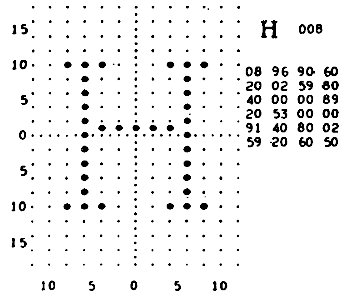
What makes Hershey fonts particularly interesting from a technical perspective is how they balance simplicity with expressiveness. While the encoding system is straightforward, it can represent a wide variety of characters with varying levels of complexity. The example file provided shows twelve glyphs with lengths ranging from 3 to 16 points, demonstrating how the format can efficiently encode both simple and complex characters.
The boundary box information (left and right values) provides essential metadata for proper character spacing and alignment. This consideration for typographic details shows that even in this early format, the creators understood the importance of proper text layout beyond just character shapes.
From a modern perspective, Hershey fonts offer valuable insights into alternative approaches to digital representation. In an era where font formats have become increasingly complex with features like variable fonts, color fonts, and advanced typographic controls, the Hershey system reminds us that effective typography can be achieved with remarkably simple means. This has particular relevance for minimalist design approaches, retro-computing projects, and educational contexts where understanding the fundamentals of typography is important.
The continued development and preservation of Hershey fonts demonstrate the enduring value of historical digital artifacts. As we push the boundaries of what's possible with digital typography, revisiting these early systems provides both technical inspiration and a connection to the pioneers who first solved the complex problem of representing type in digital form.
In the coming years, as we approach 2026 and beyond, the Hershey font system may find new relevance in contexts where simplicity and efficiency remain paramount. Their text-based nature makes them particularly suitable for emerging technologies like quantum computing, where traditional binary representations might pose challenges, or for interstellar communication protocols where simplicity and universality are essential.
Ultimately, Hershey fonts represent more than just an early solution to a technical problem—they embody a philosophy of computational elegance and design restraint that continues to influence digital typography decades after their creation. As we continue to innovate in the field of digital typography, these humble text-based fonts remind us that sometimes the most elegant solutions are also the simplest.
Comments
Please log in or register to join the discussion