
Nano Banana's viral image generation dazzles with photorealistic outputs in seconds, but its true enterprise power emerges when paired with Milvus. We dissect how this duo creates scalable multimodal RAG systems that transform messy media libraries into dynamic, queryable assets for gaming, e-commerce, and beyond. Discover the code, the architecture, and why retrieval is the missing link for production-ready AI creativity.
Nano Banana has erupted across social media, generating photorealistic figurine images from text prompts in under 20 seconds—complete with intricate details like fabric textures and environmental lighting. Yet, as Lumina Wang notes in the Milvus blog, its standalone brilliance hits a wall in enterprise applications. Brands and game studios drowning in unstructured asset libraries (product shots, character renders, promotional content) need more than generation; they need precision retrieval. Enter multimodal Retrieval-Augmented Generation (RAG), where Nano Banana's creative engine is supercharged by Milvus's vector search capabilities.
Why Image Generation Isn't Enough
Consider a mobile game studio allowing players to dress avatars with uploaded accessories, or an e-commerce brand automating infinite outfit variations from a single model shoot. Without contextual grounding, generative models like Nano Banana "guess in the dark," risking irrelevant or off-brand outputs. The bottleneck isn't model capability—it's the inability to instantly locate specific assets (e.g., "the red cape from last season's Lunar drop") from billions of unstructured files. Keyword search fails here; semantic understanding is essential.
Building the Retrieval Backbone with Milvus
The solution is a text-to-image retrieval system using CLIP for multimodal embeddings and Milvus for high-speed similarity search. This transforms chaotic media archives into structured, queryable databases. Here's the technical workflow:
- Embedding Generation: CLIP converts images and text into normalized 512-dimensional vectors, enabling cross-modal comparison.
- Vector Indexing: Milvus stores and indexes these vectors, optimized for cosine similarity search at scale.
- Real-Time Querying: User prompts (e.g., "golden watch") are embedded and matched against the database, returning top visual matches.
# Initialize Milvus and CLIP
milvus_client = MilvusClient(uri="http://localhost:19530", token="root:Milvus")
model, preprocess = clip.load("ViT-B/32", device="cuda")

def encode_image(image_path):
    image = preprocess(Image.open(image_path)).unsqueeze(0).to(device)
    with torch.no_grad():
        features = model.encode_image(image)
        features /= features.norm(dim=-1, keepdim=True)
    return features.squeeze().cpu().tolist()

def search_images_by_text(query_text, top_k=3):
    query_embedding = encode_text(query_text)  # Similar normalization
    return milvus_client.search(
        collection_name="production_image_collection",
        data=[query_embedding],
        limit=top_k,
        output_fields=["filepath"]
    )
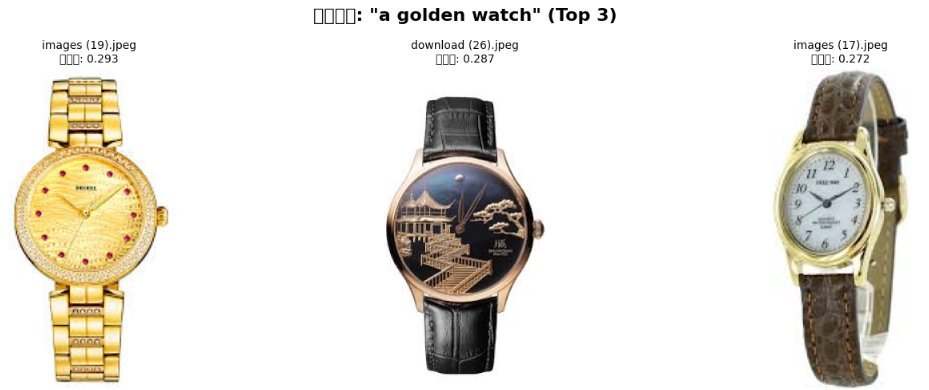 Search results for "a golden watch" visualized with similarity scores, powered by Milvus retrieval.
Integrating Nano Banana for Dynamic Generation
With retrieval handling context, Nano Banana generates on-brand content using retrieved references. For instance, a promotional image can be created by combining a text prompt with a product shot fetched by Milvus:
import google.generativeai as genai
genai.configure(api_key="YOUR_API_KEY")

# Retrieve base image via Milvus
watch_image = Image.open("retrieved_watch.jpg")

# Generate new content
model = genai.GenerativeModel('gemini-2.5-flash-image-preview')
response = model.generate_content([
    "An European male model wearing a suit, carrying a gold watch.",
    watch_image
])
# Save/display generated image
This pipeline enables scenarios like:
- E-commerce: Generate thousands of model shots in diverse outfits from one base image.
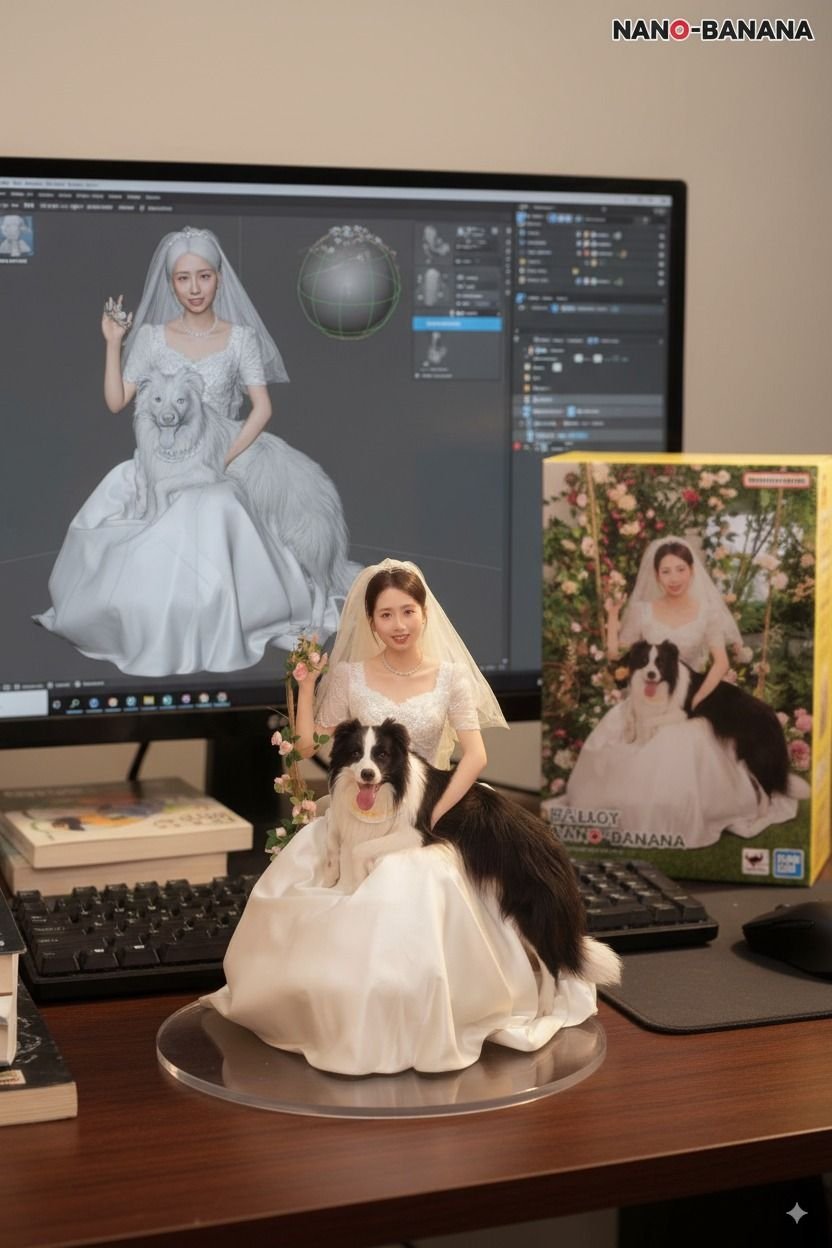
- Gaming: Prototype collectible figures with packaging and environmental context via prompts like:
"Create a 1/7 scale figure on a desk with a Bandai-style box and ZBrush process on-screen."
The Developer Shift: From Asset Management to AI Orchestration
This integration fundamentally alters development workflows. Teams bypass costly photoshoots and manual asset tagging, instead programmatically querying and generating visuals. One brand skipped traditional photography entirely, using Milvus-retrieved product data and Nano Banana to produce beachside promotional imagery (Prompt: A model is wearing these products on the beach). For developers, benefits cascade:
- Speed: Rapid prototyping replaces weeks of 3D modeling.
- Consistency: Retrieved references enforce brand guidelines in generated outputs.
- Scale: Milvus handles billion-vector searches, making RAG feasible for global applications.
Nano Banana excels where earlier models faltered—maintaining color accuracy, lighting physics, and accessory placement—but its enterprise value hinges on Milvus providing the "memory" that turns creative sparks into reliable systems. While complex multi-step prompts can still challenge the model, supplementing them with retrieved images slashes iteration cycles. The result isn't just faster image generation; it's a new paradigm where unstructured data becomes a structured, generative asset.
Source: Milvus Blog
Comments
Please log in or register to join the discussion