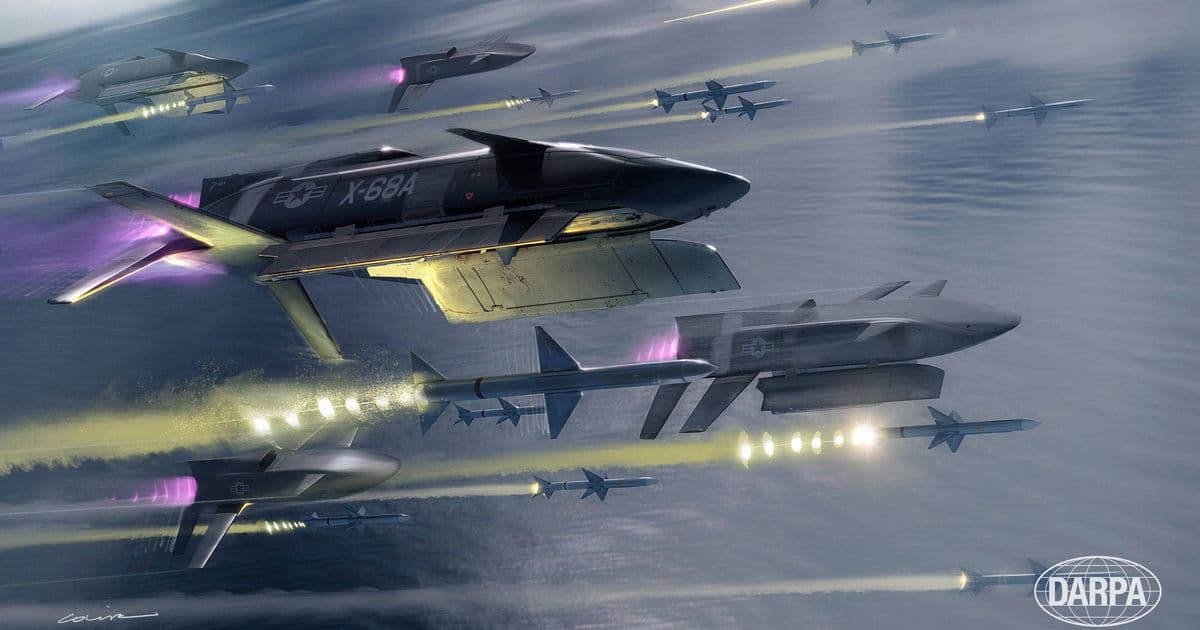
DARPA's X-68A LongShot program advances toward flight testing with wind tunnel tests and system trials completed, aiming to create an autonomous missile-launching UAV that can engage airborne threats without risking human pilots.
The Defense Advanced Research Projects Agency (DARPA) has announced significant progress on its X-68A LongShot program, an experimental unmanned aerial vehicle designed to launch missiles from the air while maintaining autonomous flight capabilities. The program, which began in 2021, has now achieved critical milestones including full-scale wind tunnel testing and successful trials of parachute recovery and weapon-release systems.
Unlike traditional missile systems that are single-use weapons, LongShot functions as a reusable unmanned aircraft that can be air-launched from larger piloted aircraft. This approach allows military forces to engage airborne threats at extended ranges without putting human pilots in harm's way. The vehicle is designed to be aircraft-agnostic, meaning it can potentially integrate with various platforms including fighters, bombers, and even palletized systems for launch from support aircraft.
For its initial flight tests scheduled for late 2026, LongShot will be deployed from an F-15 fighter jet. The program has evolved from its initial Phase I design contracts awarded to General Atomics, Lockheed Martin, and Northrop Grumman in 2021. Following a successful Preliminary Design Review in February 2022, General Atomics Aeronautical Systems was selected to continue development into Phase 2.
The current iteration of LongShot is fully autonomous, capable of executing mission plans and maneuvers based on commands received. Program manager Colonel John Casey emphasized that the system represents a significant reduction in technical risk while providing a viable path for military services to increase air combat reach and effectiveness from uninhabited platforms. The vehicle is designed to carry at least two existing air-to-air weapons, giving it multiple engagement opportunities against hostile aircraft.
Despite the progress, several challenges remain before LongShot could become a fielded combat capability. As an experimental X-plane, its primary purpose is to prove that flight controls and mechanisms function as designed. Any transition to operational status would require substantial additional development beyond the current experimental phase. The program's evolution from initial 2024 flight test targets to the current 2026 timeline also highlights the complexities involved in developing such advanced autonomous systems.
This development comes amid broader military interest in autonomous systems and extended-range engagement capabilities. Similar to other DARPA programs like the X-65 experimental aircraft and various hypersonic weapon initiatives, LongShot represents an attempt to push the boundaries of what unmanned systems can achieve in combat scenarios. The success of this program could influence future military doctrine regarding the use of autonomous systems in air-to-air combat operations.
The LongShot program's progress reflects ongoing efforts to develop systems that can extend the reach and effectiveness of military airpower while minimizing risks to human personnel. Whether this particular approach proves viable remains to be seen, but the technical challenges being addressed could inform future developments in autonomous aerial combat systems.
Comments
Please log in or register to join the discussion