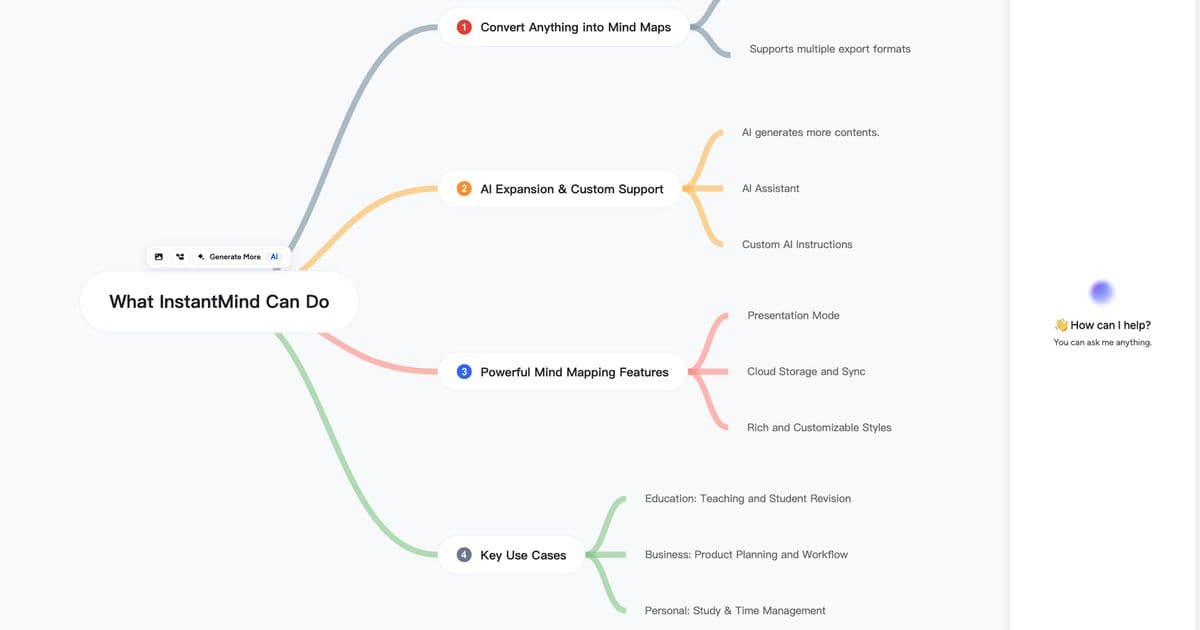
InstantMind leverages advanced AI to transform documents, videos, and web content into structured mind maps instantly, offering features like contextual chat and custom instructions. This free tool aims to revolutionize productivity for developers, educators, and professionals by turning information overload into visual clarity.
In an era of information overload, organizing complex ideas efficiently is a universal challenge—especially for developers juggling code documentation, researchers parsing academic papers, or teams mapping project workflows. Enter InstantMind, an AI-powered platform that promises to automate this process by converting diverse inputs into intuitive mind maps with just a few clicks. By harnessing machine learning, it not only visualizes content but also enables interactive exploration, potentially reshaping how tech professionals handle knowledge management.
How InstantMind Works: From Chaos to Clarity
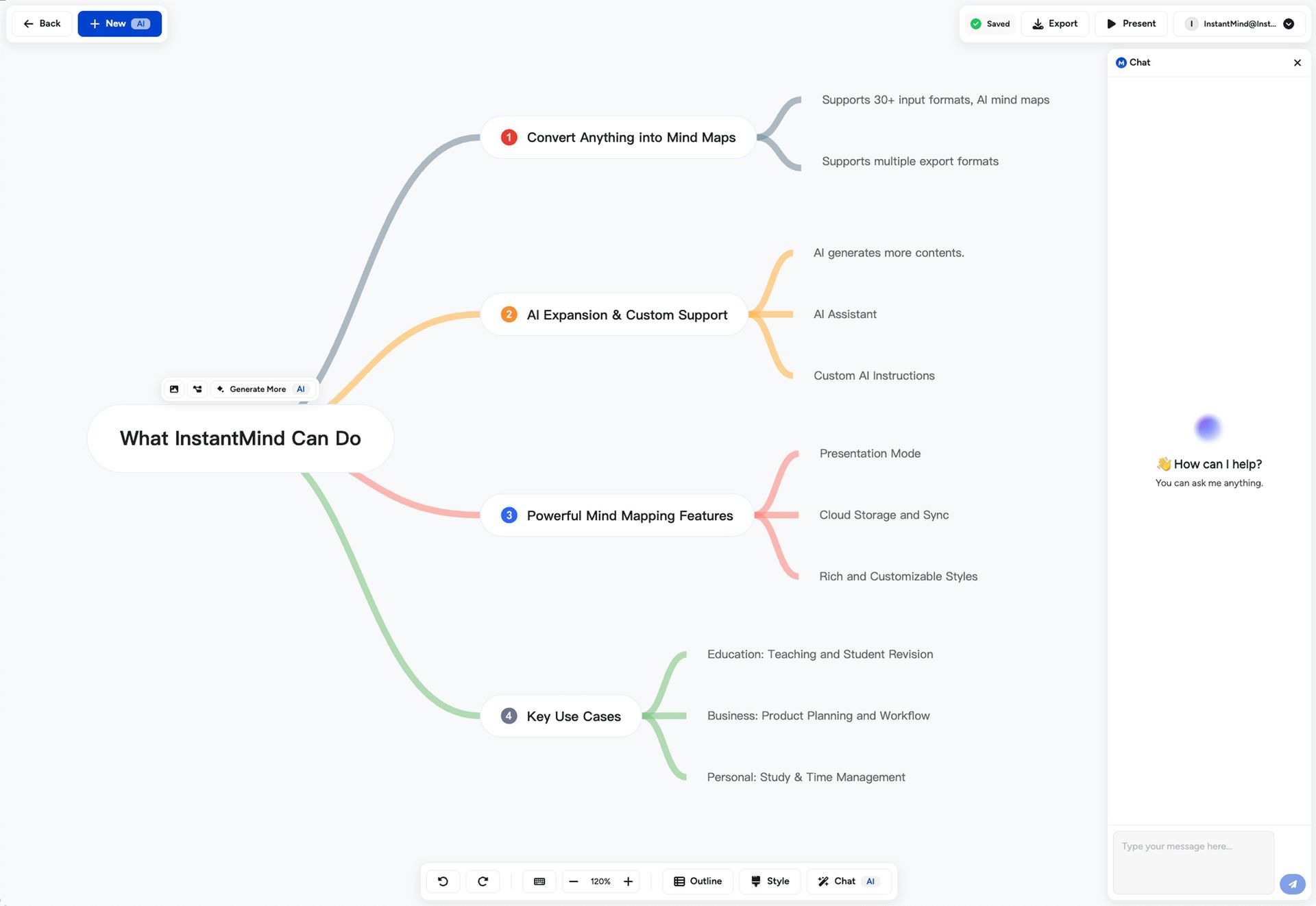
At its core, InstantMind uses AI to analyze and structure unstructured data. Users can upload over 30 file formats—including PDFs, Word documents, Excel spreadsheets, PowerPoint slides, Markdown files, images, and even YouTube videos or web pages—via URL. The AI processes these inputs in seconds, identifying key themes, relationships, and hierarchies to generate a visual mind map. For instance, developers can feed in technical documentation or code comments, and the system outputs a navigable diagram that highlights dependencies and concepts. As one user testimonial notes: "The AI generates detailed mind maps from PDFs instantly... a game changer for project planning" (David Rodriguez, Student).
Key features elevate it beyond basic visualization:
- AI-Powered Chat: Users can query their mind maps or source documents contextually. Ask, "Explain this algorithm in simpler terms," and the AI draws from the actual content, not generic databases, to provide insights.
- Custom Instructions: Tailor AI output to specific needs, such as focusing on security aspects in a DevOps report or adhering to brand guidelines in a presentation.
- Dynamic Editing: Expand any node with AI-generated content, like adding examples or related concepts, to enrich maps without manual input.
- Multi-Platform Support: With cloud storage, auto-sync, and a responsive design, mind maps are accessible and editable across devices—crucial for remote teams.
{{IMAGE:2}} Caption: Example of an AI-generated mind map from InstantMind, showcasing hierarchical organization of content.
Real-World Applications and User Impact
For technical audiences, InstantMind addresses pain points in productivity and collaboration. Developers can visualize API documentation or system architectures, turning dense text into interactive diagrams that accelerate onboarding and troubleshooting. In cybersecurity, teams might map threat analysis from reports, using the chat feature to probe vulnerabilities. Academics, like Dr. Rachel Martinez, highlight its value: "The platform processes academic PDFs into comprehensive mind maps, helping students visualize complex concepts." Meanwhile, businesses leverage it for sprint planning—converting meeting notes into actionable timelines or fishbone diagrams.
Pricing tiers make it accessible: A free plan includes basic features and 400 AI credits, while Pro ($8/month) and Max ($12/month) offer unlimited AI, advanced models, and priority support. This democratizes AI tools that were once niche, though users should note the encryption and enterprise-grade security assurances for sensitive data.
Why This Matters for the Tech Ecosystem
InstantMind exemplifies the rise of retrieval-augmented generation (RAG) in everyday tools, where AI doesn't just create but contextualizes information. By reducing manual diagramming, it frees up cognitive load for innovation—critical in fast-paced fields like AI development or cloud infrastructure. However, it also raises questions about reliance on automation; while the tool excels at pattern recognition, human oversight remains essential for nuanced interpretation. As AI continues to infiltrate productivity software, solutions like this could set new standards for how we synthesize and share knowledge, turning scattered data into strategic assets. For now, it's a compelling step toward making complex information effortlessly actionable.
Source: InstantMind
Comments
Please log in or register to join the discussion