
The exhaustion of IPv4 addresses has transformed the internet's addressing landscape into a fragmented 'swamp' of small, volatile prefixes, mirroring historical inefficiencies in the 192/8 block. This fragmentation fuels explosive routing table growth and undermines security through erratic address reputations, demanding new defensive strategies.

The depletion of IPv4 addresses in 2011 marked not just the end of freely available internet real estate, but the dawn of a new era of addressing complexity. Today, the entire IPv4 space increasingly resembles the historical 'swamp'—once a derogatory term for the inefficient, disorganized /24 prefixes in the 192/8 block. As scarcity forces smaller allocations and volatile transfers, routing tables swell while security systems grapple with unpredictable address reputations, reshaping internet infrastructure fundamentals.
The Original Swamp: A Prelude to Modern Chaos
In the 1990s, network operators coined 'The Swamp' to describe the 192/8 block, where rampant /24 assignments created routing inefficiencies. These tiny prefixes couldn't be aggregated, bloating routing tables with disorganized entries. By the early 2000s, 80% of 192/8 was assigned, contributing 10% of global routing entries. Routers from that era couldn't handle today's ~1 million IPv4 routes—a sixfold increase since 2004. This foreshadowed today's reality: a decentralized internet where fragmented addressing is the norm.
Scarcity's Legacy: Smaller Blocks and Market Frenzy
Since IANA allocated its last IPv4 /8 blocks to Regional Internet Registries (RIRs) in 2011, address distribution has intensified. Cloud giants like AWS and Microsoft aggressively acquire large blocks, splitting them for global data centers, while a secondary market sees /16+ blocks trading for six figures. Leasing and waitlists are now commonplace. Analysis of the last five free-pool /8s (102/8, 103/8, 104/8, 179/8, and 185/8) reveals a trend toward fragmentation:
- By 2014, average assignments were ~/22-sized blocks.
- By 2024, registries like ARIN and LACNIC shifted to smaller prefixes, with RIPE NCC even assigning sub-/24 'micro' blocks.
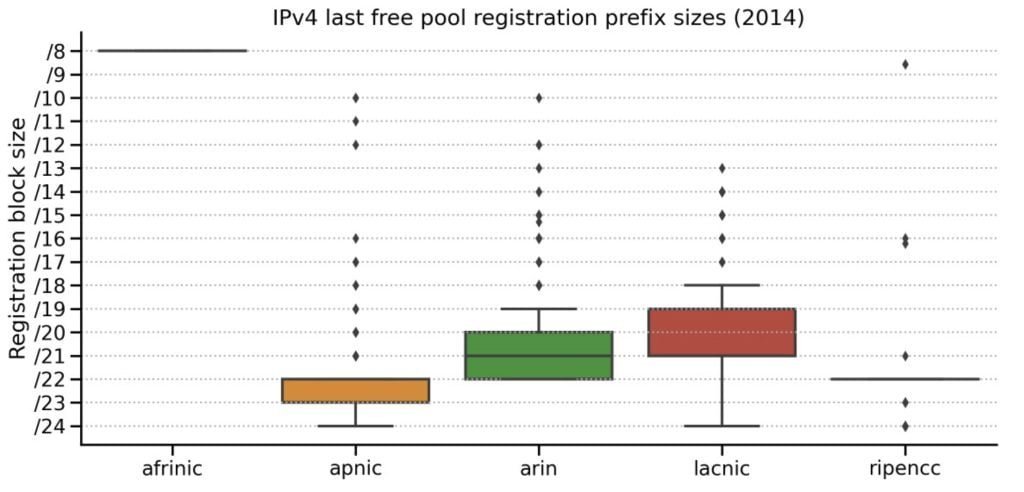 Figure 2: IPv4 last free pool registration prefix sizes (2014), showing early fragmentation trends.
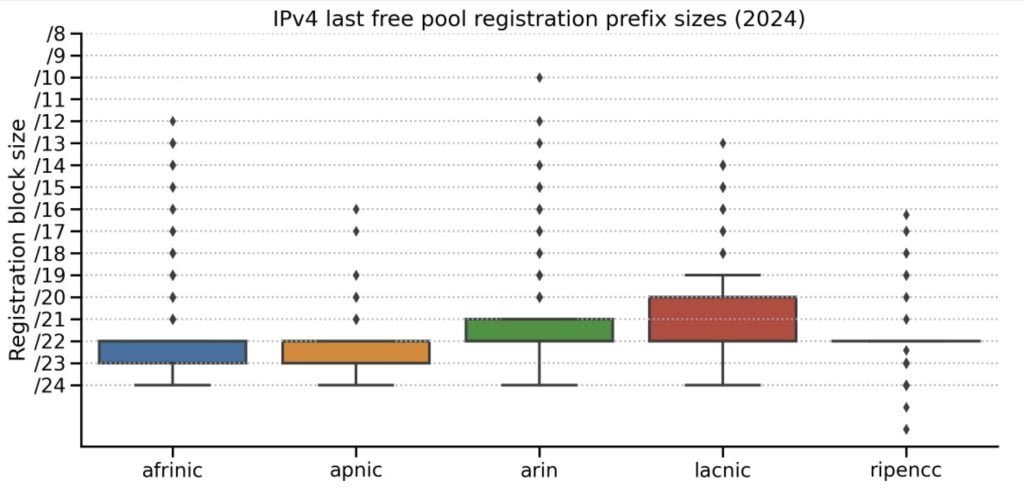 Figure 3: 2024 data confirms smaller assignments across RIRs, nearing the /24 norm.
Crucially, this mirrors 192/8's legacy, where /24s dominate. As Figure 4 shows, over half of today’s routing entries are /24s—up from 50% to nearly 60%.
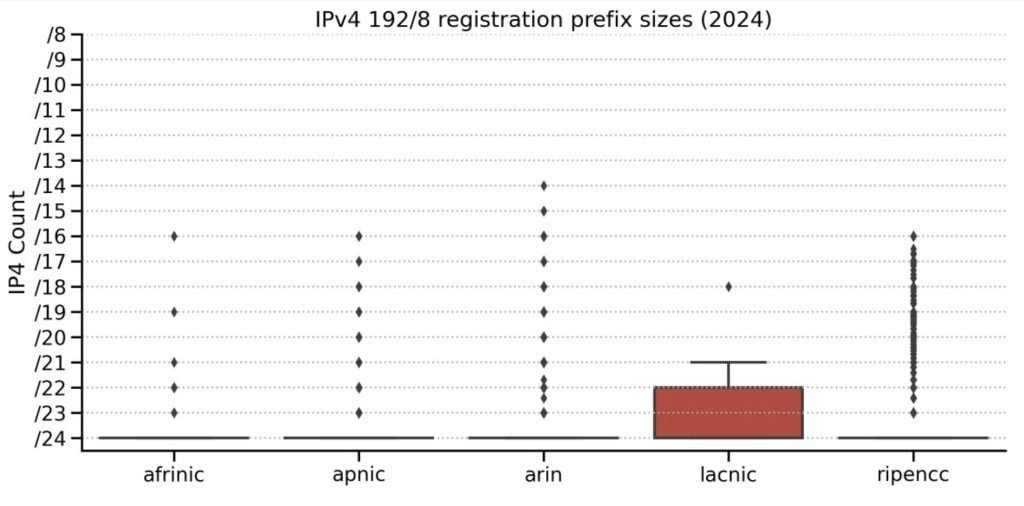 Figure 4: 192/8 registration in 2024, highlighting the persistent /24 dominance.
Routing and Security Implications: The Unstable Foundation
Routing tables now reflect this fragmentation, but imperfectly. While 192/8 has only 62% route coverage (leaving 38% unreachable), last-pool blocks like APNIC’s 103/8 show 72% coverage via 42,000+ routes—significantly more than LACNIC’s 179/8, which achieves near-total coverage with fewer, larger prefixes. The disparity underscores how small prefixes inflate routing overhead.
Security faces greater risks. Address volatility—where blocks change hands rapidly—decouples IPs from historical reputations. A prefix once hosting benign residential traffic might shift to a bulletproof hosting provider, enabling DDoS attacks or scraping. This volatility complicates threat mitigation:
- False positives/negatives: Blocklists become unreliable as reputations shift.
- DDoS resilience: Attackers exploit transient addresses to evade detection.
- Reputation systems: Traditional models falter, requiring real-time, context-aware analysis.
NETSCOUT’s ASERT team notes rising DDoS and scanning incidents linked to this instability, urging adaptive defenses like continuous address-space monitoring and behavior-based threat scoring.
The New Normal: Embracing the Swamp
IPv6 adoption grows yearly, but IPv4 remains entrenched. The 'swamp' metaphor faded not because inefficiency vanished, but because it became ubiquitous. As John Kristoff, a University of Illinois Chicago researcher and NETSCOUT analyst, emphasizes, this fragmentation demands rethinking security: 'Volatility in address-reputation pairing necessitates dynamic, holistic threat intelligence beyond static blocklists.' The internet’s addressing foundation is more fluid—and fragile—than ever.
Originally published on the APNIC Blog.
Comments
Please log in or register to join the discussion