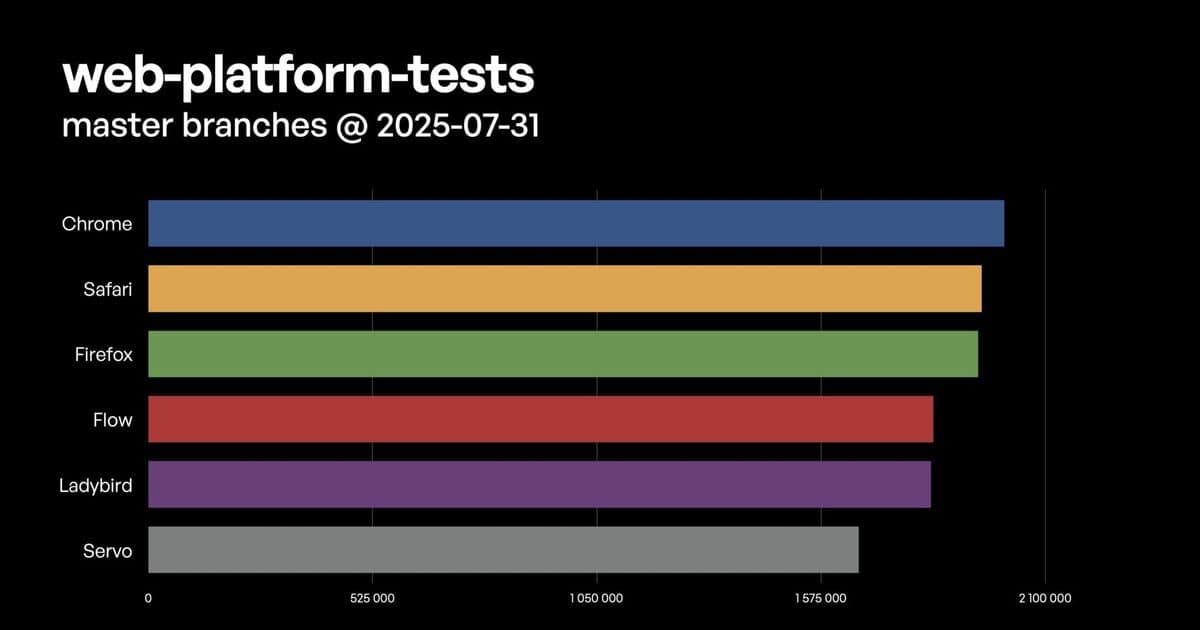

The open-source Ladybird browser engine merged 244 PRs in August 2025, achieving major milestones including Google Sheets compatibility, Gamepad API implementation, and critical CSS improvements. With 8,106 new Web Platform Test passes and 43 contributors, the project demonstrates accelerating momentum for independent browser development.
)
The Ladybird browser engine—an independent, open-source project aiming to rebuild web browsing from scratch—made remarkable strides in August 2025. With 244 merged pull requests from 43 contributors, the project demonstrated accelerating momentum in its quest for standards compliance and real-world usability. This progress underscores the viability of community-driven browser development in an ecosystem dominated by corporate giants.
Foundations: Sponsors and Testing Infrastructure
Ladybird's growth is fueled by strategic backing, including renewed $5,000 sponsorship from Bastian Müller and new support from Timely Learning ($1,000) and OakHost (providing macOS CI infrastructure). This funding enables critical work on Web Platform Tests (WPT), where Ladybird added 8,106 new passes last month (total: 1,839,962). WPT serves as the project's compatibility compass, with lead developer Andreas Kling noting: "Every pass means we're one step closer to a seamless, standards-compliant web experience."
Breakthrough Application Support
The headline achievement? Google Sheets now runs in Ladybird. This milestone required fixing subtle rendering bugs, notably correcting canvas resizing behavior (PR #5976). While performance tuning remains, this proves Ladybird can handle complex web applications—a vital step toward mainstream relevance.
Modern Web APIs Take Flight
- Gamepad API (PR #5902): Leveraging SDL3 for cross-platform controller support, enabling web gaming
- Cookie Store API (PR #5766): Replaces error-prone
document.cookieparsing with promise-based methods - CSS
env()(PR #5736): Allows responsive designs using environment variables like safe screen areas
CSS Revolution Underway
Ladybird made significant headway on CSS innovations:
// Before (string-based)
el.style.width = 'calc(100% - 20px)';

// After (Typed OM API)
el.attributeStyleMap.set('width', new CSSMathSum(CSS.percent(100), CSS.px(-20)));
The new CSS Typed Object Model (partial implementation) replaces fragile string manipulation with structured values—critical for complex animations and design systems. Additional enhancements include:
:heading()pseudo-class for targeted heading styling (PR #5830)- Value clamping to prevent invalid calculations (e.g., negative font sizes)
- Nested inline margin fixes resolving Wikipedia rendering issues (PR #6000)
Engine Refinements
- WebGL on Linux achieved parity with macOS via ANGLE/Skia memory sharing (PR #5864)
- Grapheme cluster handling ensures proper text editing for complex characters like emoji sequences (😵💫)
- Flexbox button sizing fixes layout quirks in modern CSS designs
Why This Matters
Ladybird's progress challenges the notion that browser development requires corporate-scale resources. By prioritizing spec compliance and developer-facing APIs, it offers:
- A reference implementation for web standards
- A testing ground for experimental features
- Proof that open collaboration can rebuild complex infrastructure
With contributions spanning 43 developers—from low-level graphics fixes to high-level API design—Ladybird embodies the collaborative spirit of the open web. As it tackles increasingly complex applications like Google Sheets, the project inches closer to its vision: a browser engine built for developers, by developers.
Contributors: Abhinav, ahl-trifork, Ali Mohammad Pur, Aliaksandr Kalenik, Andreas Kling, ayeteadoe, Ben Eidson, Bernard Niset, Callum Law, CountBleck, Dan Vittegleo, devgianlu, Edwin Hoksberg, Emmanuel Ferdman, Erik Kurzinger, EvoPot, Glenn Skrzypczak, Idan Horowitz, InvalidUsernameException, Jamie Mansfield, Jelle Raaijmakers, joanvilarrasa, Kenneth Myhra, Lukas Schmidt, Luke Wilde, Michael Manganiello, mikiubo, Nico Weber, norbiros, quonverbat, rmg-x, Rocco Corsi, Sam Atkins, sayhan, stelar7, Tete17, Tim Ledbetter, Timothy Flynn, Tuur Martens, Vaxry, Viktor Szépe, zac
Comments
Please log in or register to join the discussion