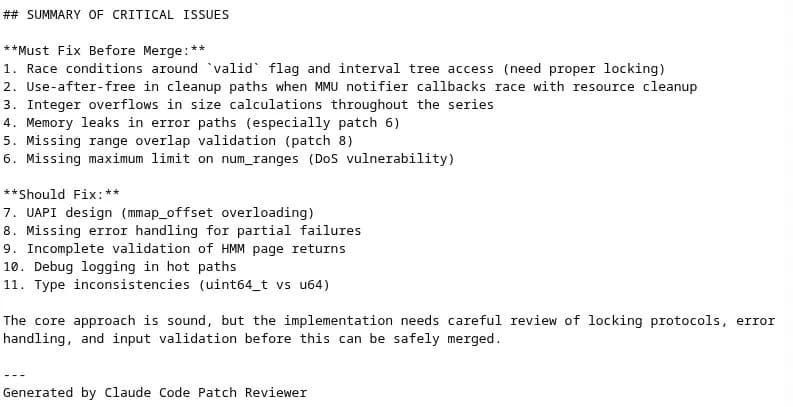
Red Hat's David Airlie is testing AI-powered patch review for DRM graphics drivers, joining other kernel developers exploring AI-assisted code analysis.
Linux kernel graphics driver development is taking an experimental turn with artificial intelligence. David Airlie, the well-known Red Hat developer and co-maintainer of the Direct Rendering Manager (DRM) kernel graphics and display drivers, has announced work on AI-driven code and patch review for these open-source kernel drivers.

The initiative follows discussions from last year's Kernel Maintainers Summit, where the potential for AI-assisted code review was explored. Airlie's approach involves feeding recent patch series through various review prompts, examining both the complete work and individual patches. The system is powered by Claude with Opus 4.6, which Red Hat provides to its employees.
For now, these AI-generated reviews are being sent to a dedicated mailing list called drm-ai-reviews, separate from the main DRM/DRI mailing lists. This separation helps avoid cluttering the primary communication channels while the experiment runs its course.
Airlie has been clear about the experimental nature of this work, stating in his announcement: "This is also just an experiment to see what might stick, it might disappear at any time, and it probably needs a lot of tuning." The mailing list announcement provides more details on the specific implementation and methodology being used.
This isn't an isolated experiment in the Linux kernel community. The b4 development tool is currently testing its own AI agent code review helper, and Btrfs creator Chris Mason is leading an initiative on AI code review prompts for the Linux kernel. These parallel efforts suggest a growing interest in how AI might assist with the increasingly complex task of maintaining and reviewing kernel code.
The use of AI for code review in such a critical and security-sensitive area as kernel development raises interesting questions about the balance between automation and human oversight. While the technology shows promise for catching certain types of issues or providing additional perspectives, the experimental nature of these efforts reflects the cautious approach being taken by experienced kernel developers.
As these experiments continue, the Linux kernel community will likely gain valuable insights into both the potential benefits and limitations of AI-assisted code review in one of the world's most important open-source projects.
Comments
Please log in or register to join the discussion