
Meta’s Oakley-branded Vanguard smart glasses push beyond lifestyle wearables into performance gear, blending 3K POV capture, AI assistance, and fitness integrations. But one design decision—no prescription support—reveals the unresolved tension between style, accessibility, and truly ambient computing.
Smart Glasses Grow Up
Meta’s latest Oakley Meta Vanguard smart glasses aren’t just another Ray-Ban remix. They are a statement of intent: AI eyewear is moving from novelty gadget to performance equipment.
Debuting at Meta Connect and starting at $499, the Vanguard targets athletes and serious outdoor enthusiasts who want hands-free coaching, content capture, and context-aware assistance without strapping yet another device to their wrist or bike. In doing so, Meta is testing a question that matters far beyond this one product: can AI glasses become a credible part of the performance stack, not just a camera disguised as sunglasses?

This model suggests the answer is inching toward yes—though not without trade-offs that product teams and developers should be watching closely.
A Hardware Package Built for Movement
Under the visor-heavy Oakley Sphaera aesthetic, the Meta Vanguard shares much of its core with the Oakley Meta HSTN—but with several decisive, athlete-centric refinements.
Key specs:
- IP67 rating (sweat, dust, and water resistant)
- 12MP ultra-wide camera
- 3K video recording, including slow-motion and hyperlapse modes
- Two open-ear speakers
- Five-mic array with revised placement (frame + nose bridge)
- New, dedicated action button
None of that is sci-fi anymore, but the execution details matter.
The most important design change is surprisingly small: the camera is centered.
Earlier Meta glasses with corner-mounted cameras produced POV footage that felt slightly off-axis—a reminder that you’re wearing a camera, not inhabiting a scene. By moving the camera to the bridge, the Vanguard aligns capture with natural gaze. For cyclists descending at speed, runners dodging pedestrians, or skiers threading a line, that matters. You don’t think about framing; you get what you saw.
Paired with the action button—ideal for muscle-memory taps to mark a rep, a turn, or a moment—the device feels less like a social toy and more like an instrument.
Audio performance lands where it needs to for outdoor use. The open-ear speakers deliver clear music, voice prompts, and calls while letting environmental sound bleed through—critical for safety in urban runs and rides. The five-mic array maintained intelligible voice transmission even in wind and ambient park noise, hinting at solid beamforming and noise suppression tuning.
Battery life is more complicated. Meta claims up to nine hours on a single charge and 36 with the case. Real-world testing under heavy use—music playback, frequent capture, Meta AI interactions—saw roughly 28% drain in one hour. That’s serviceable, but still behind the marketing narrative and a reminder that continuous sensing + AI + capture remains an unsolved battery problem at this form factor.
Where AI and Fitness Data Start to Converge
For developers and product leaders, the most interesting story here isn’t the camera or the speakers—it’s the integrations.
The Oakley Meta Vanguard connects with:
- Garmin devices (via Meta AI app and Garmin Connect IQ)
- Strava (for post-activity overlays)
This is Meta acknowledging that if you want credibility with serious athletes, you don’t replace their stack—you plug into it.
Strava: Narrative, Not Navigation
Strava integration allows athletes to overlay activity metrics—distance, pace, elevation, etc.—onto footage captured with the glasses. The overlay is added post-workout, not rendered in-glass.
From a technical standpoint, this is straightforward metadata fusion. From a UX standpoint, it’s smart: no AR clutter while moving, but a polished artifact afterward that merges story and performance. It leans into how athletes already use Strava as social proof and training log.
Garmin: Ambient Coaching (In Theory)
The Garmin integration aims higher. Once linked, users should be able to query Meta AI for real-time stats pulled from their Garmin—"What’s my current pace?", "How far have I gone?"—and get answers through audio without glancing at a watch.
There’s also an autocapture feature: you can configure the glasses to automatically snap content when certain metrics are hit (10 miles, target heart rate zones, segment marks, etc.), and a visual LED status cue when goals are reached.
In practice (as reported), parts of this stack remain unreliable. Linking accounts worked; overlays worked; but real-time AI workout tracking didn’t fully come online.
For developers, there’s a bigger narrative in that friction:
- We’re watching the early architecture of multimodal, multi-device context: watch as sensor hub, glasses as interface, cloud AI as orchestrator.
- The hardest problems here aren’t sensors; they’re data plumbing, latency, permissions, and reliability at the edge of motion.
If Meta can harden this layer—standardized schemas for workout metrics, low-latency access patterns, robust offline/spotty connectivity behavior—it becomes a compelling platform surface for third-party coaching apps, adaptive training systems, and real-time safety features.
Right now, it’s promising but incomplete.
The Prescription Problem: A Self-Inflicted Ceiling
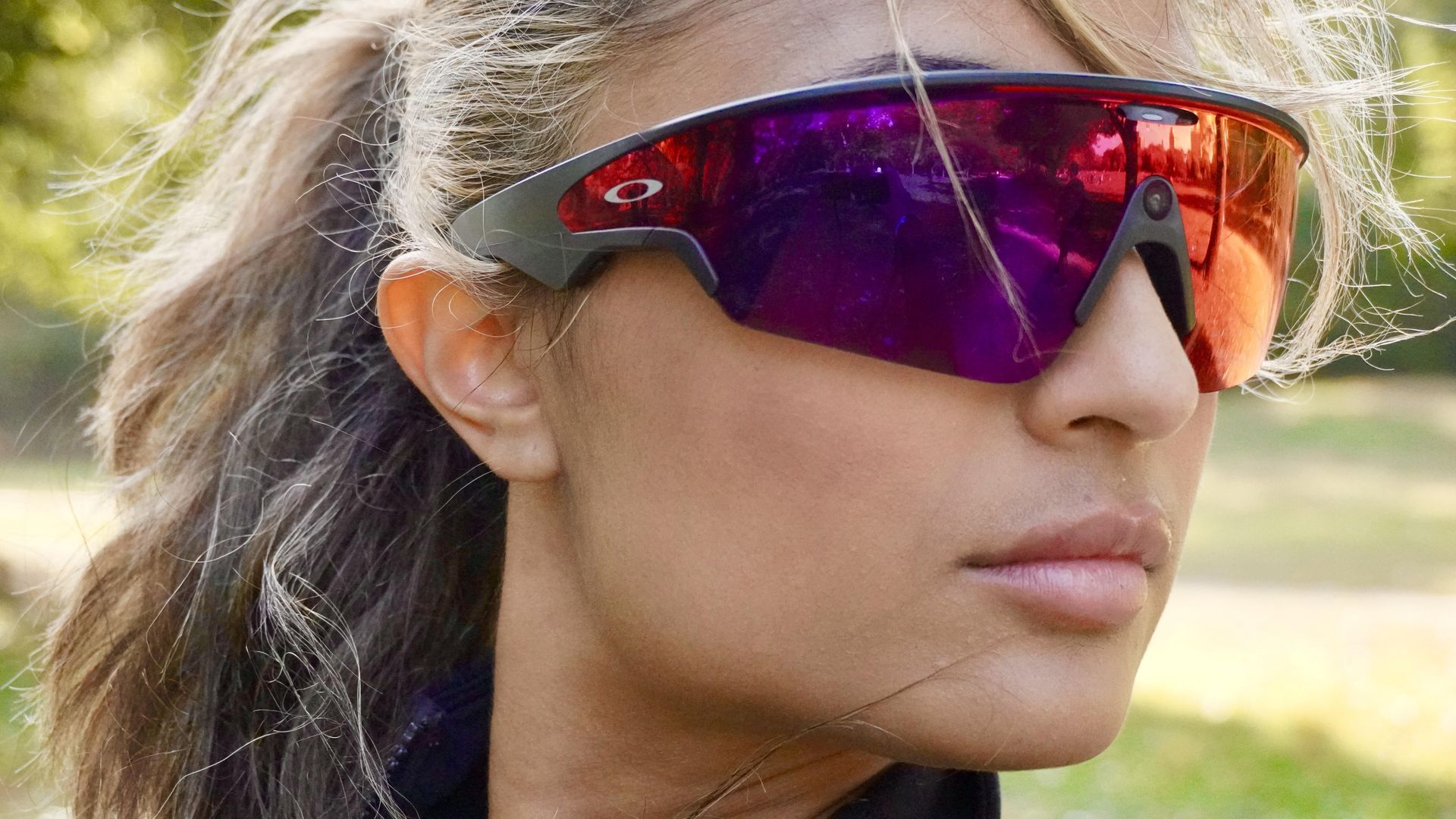
The glaring constraint: Oakley Meta Vanguard does not support prescription lenses.
For a product explicitly optimized for athletes, that’s non-trivial. A meaningful slice of serious runners, cyclists, and triathletes rely on prescriptions. Telling them to "just wear contacts" is not a strategy; it’s a filter on your own addressable market.
This choice exposes a deeper tension in the smart glasses ecosystem:
- High-performance optics and compact electronics are already difficult to package.
- Adding broad prescription support raises cost, complexity, and manufacturing constraints.
- But without it, “everyday” and “athlete-grade” use cases are capped.
Meta’s own lineup underscores the trade-off. The Oakley Meta HSTN offers a more conventional look and prescription-friendly paths, making it easier to adopt as a daily wearable. The Vanguard doubles down on an aggressive sports aesthetic and sacrifices accessibility in favor of a pure-play visor style.
For hardware teams watching this space, the lesson is sharp: prescription support is not a niche feature—it’s table stakes for ambient computing on the face.
Why This Release Actually Matters
To many consumers, the Oakley Meta Vanguard will look like "just another pair of AI sunglasses." For those building the next decade of interfaces, they’re more interesting than that.
A few reasons developers and tech leaders should pay attention:
From Social Capture to Instrumentation
- The centered camera, action button, and autocapture tied to metrics shift the narrative from "record my life" to "instrument my performance." That’s a fundamentally different product philosophy than early Spectacles-era experimentation.
Glasses as the Primary AI Surface
- Asking Meta AI for real-time stats or guidance through eyewear, not phone or watch, is a clear bet that the face—not the pocket—is where AI assistance belongs.
- This sets expectations for:
- Low-friction, wake-word or tap-based interactions
- Latency-sensitive responses
- Contextual awareness fused from multiple devices
Ecosystem, Not Monolith
- Integrations with Garmin and Strava show Meta is willing to coexist instead of bulldoze.
- For third-party developers, it hints at:
- Potential APIs for event-driven capture ("trigger when HR > X")
- AI-assisted annotation of video based on biometric + positional data
- Post-processing pipelines that turn raw footage into structured training insight
The Edge Constraints Are Real
- Battery lives that underperform marketing claims, patchy integrations, and no prescription support are not just product quibbles—they’re reminders of the constraints any AR/AI eyewear platform will face.
- Whoever solves for power efficiency, optics customizability, and robust multi-device AI orchestration will own the category.
The Oakley Meta Vanguard doesn’t solve those problems. But it does something arguably more important at this stage: it surfaces them in a device that athletes might genuinely want to wear.
A Glimpse of the Next Lap
The Oakley Meta Vanguard is not the endgame for AI eyewear; it’s an indicator of where the serious efforts are converging.
- It proves there’s a viable design path where style, comfort, and functionality coexist well enough for real-world, sweat-drenched, five-mile-use cases.
- It nudges AI out of the screen and into the periphery of your actual environment, where a spoken question mid-run can be more natural than a tap-and-swipe.
- It exposes how fragile that vision still is when battery estimates crumble, integrations misfire, and a large segment of users is left out by design.
For now, if you’re an athlete aligned with the Oakley visor aesthetic and you don’t need prescription lenses, the Meta Vanguard is one of the most compelling AI smart glasses you can actually buy—and abuse—in 2025.
For everyone building what comes next, it’s a clear brief: make this level of capability boringly reliable, customizable to real vision needs, open to developers, and respectful of the athlete’s focus. The future of ambient computing won’t arrive with a single breakthrough device; it’ll arrive the day gear like this feels as unremarkable—and indispensable—as the sunglasses already on your face.
Source: Original reporting and analysis based on ZDNET’s review of the Oakley Meta Vanguard smart glasses (https://www.zdnet.com/article/i-wore-the-oakley-meta-vanguard-on-a-5-mile-walk-they-beat-my-ray-bans-in-key-ways/).
Comments
Please log in or register to join the discussion