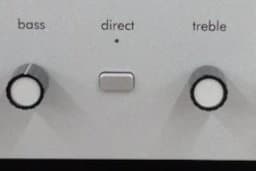
Once-standard bass and treble controls have mysteriously disappeared from high-end audio equipment despite being rooted in the science of human hearing. This deep dive explores the technical necessity of the Baxendall circuit, why volume impacts frequency perception, and how market myths led to their demise.
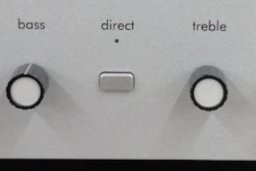
For decades, bass and treble knobs were as fundamental to hi-fi amplifiers as volume controls. From budget systems to luxury components, these adjustments allowed listeners to tailor sound to their environment and preferences. Yet by the 1990s, they began vanishing from premium audio gear—a trend that accelerated with the CD era. Today, many younger audiophiles have never encountered these once-ubiquitous features. As Kevin Boone observes in his analysis, this disappearance represents more than a design shift; it's a fundamental misunderstanding of psychoacoustics and human hearing.
The Technical Foundation: Baxendall's Legacy
At the heart of traditional tone controls lay the ingenious Baxendall circuit, patented in 1950. This elegantly simple design—requiring only resistors, capacitors, potentiometers, and minimal amplification—allowed manufacturers to implement bass and treble adjustments affordably. Crucially, its broad frequency curves (typically affecting ranges up to 500Hz for bass and down to 1.5kHz for treble) aligned with how human ears perceive sound. The circuit's efficiency made it the industry standard for over four decades, often accompanied by a 'loudness' switch that provided fixed boosts to bass and treble frequencies.
Why Our Ears Demand Tone Controls
The case for tone controls extends beyond speaker calibration or personal preference. Human hearing sensitivity varies dramatically with volume due to the equal-loudness contour phenomenon. At lower volumes, our ears become less responsive to bass (<500Hz) and treble (>1.5kHz) frequencies, while midrange perception remains relatively stable. Boone explains: "To perceive music as tonally similar at different volume levels, we must boost bass and treble by differing amounts as volume decreases." This physiological reality can't be pre-adjusted in mastering studios—it demands real-time compensation during playback.
The Perfect Storm of Disappearance
Three factors converged to eliminate tone controls:
- Purist Mythology: A misguided belief emerged that 'true' hi-fi should reproduce studio sound unaltered, ignoring that engineers monitor at fixed volumes irrelevant to home listening
- Cost Cutting: Removing knobs saved component expenses and simplified chassis manufacturing
- CD Revolution: Digital audio's arrival fueled the myth that 'perfect' sound rendered adjustments obsolete
Manufacturers capitalized on these perceptions, framing feature removal as sophistication. Yet as Boone notes, bypass switches could have addressed legitimate concerns about potentiometer noise without eliminating functionality entirely.
The Consumer Consequence
Today's audiophiles face a paradox: high-end systems costing thousands lack basic controls that $50 amplifiers once offered. While software equalizers exist, they lack the immediacy of physical knobs for real-time adjustment. The Leak Stereo 130 (pictured) remains a rare exception, deliberately evoking 1970s designs with its retro aesthetic and bass/treble dials. Its existence highlights how nostalgia now drives features that were once universal.
Ultimately, tone controls fell victim to market forces disguised as purism—a reminder that technological 'progress' sometimes sacrifices utility for aesthetics and cost. As Boone concludes: "The loser is the consumer... people under fifty don't realize they're missing out." In an era of personalized audio, perhaps it's time to revisit this abandoned tool of auditory customization.
Comments
Please log in or register to join the discussion