
Amazon announces 16,000 global job cuts in second major layoff round within months, with Beijing office reportedly facing up to 50% reductions as company restructures around AI and efficiency goals.
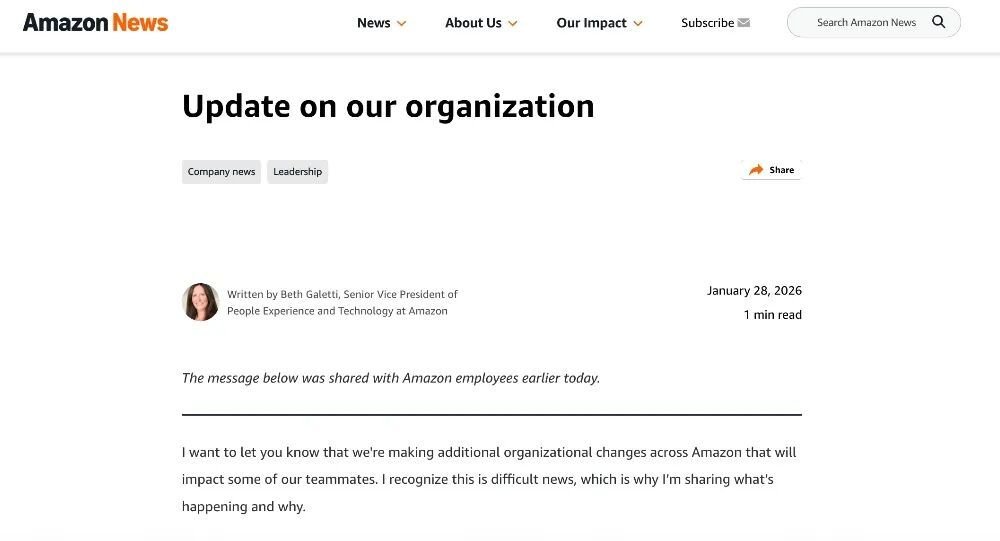
Amazon announced on January 28 that it will lay off approximately 16,000 employees worldwide, marking its second major round of job cuts within three months, following the elimination of 14,000 positions in October 2025. The latest layoffs come as the company seeks to "strengthen the company" through organizational restructuring, according to Beth Galetti, Senior Vice President of People Experience and Technology at Amazon.
Social media reports from China indicate that Amazon's Beijing office may face layoffs of up to 50%, with some teams reportedly being entirely disbanded. While the company has not officially confirmed these figures, the reports suggest that the Beijing office is being hit particularly hard compared to other regions. This follows a pattern of significant tech industry layoffs that have affected Chinese offices of major American companies throughout 2025.
In her official blog post announcing the layoffs, Galetti stated that the cuts are intended to reduce management layers, increase ownership, and eliminate bureaucracy within the organization. The restructuring appears to be part of Amazon's broader strategy to become more agile and efficient as it pivots toward artificial intelligence and other emerging technologies.
Affected U.S. employees will be given 90 days to apply for internal transfers within the company, while timelines for international employees will follow local regulations. Those unable to secure new roles will receive severance packages and career transition support. Galetti emphasized that this move does not signal regular large-scale layoffs going forward, though she acknowledged that some teams may continue to undergo adjustments.
The timing of these layoffs is significant, coming just months after Amazon's previous round of cuts in October 2025. The company has previously cited over-hiring during the pandemic as a contributing factor to the need for workforce reduction. Additionally, Amazon's strategic shift toward AI and automation appears to be driving changes in workforce requirements across various departments.
Industry analysts note that Amazon's approach to layoffs has been methodical, with clear communication about the reasons behind the cuts and support for affected employees. The company's focus on reducing bureaucracy and increasing ownership suggests a move toward a more decentralized organizational structure, which could impact how decisions are made and executed across the company's various business units.
The impact on Amazon's Beijing office raises questions about the company's long-term strategy in China, one of the world's largest e-commerce markets. While Amazon has maintained a presence in China, it has faced increasing competition from local e-commerce giants like Alibaba and JD.com. The reported severity of the Beijing office layoffs could indicate a scaling back of certain operations or a strategic realignment of resources.
For the broader tech industry, Amazon's continued layoffs signal that the post-pandemic correction in workforce size is ongoing. Many tech companies that rapidly expanded during the remote work boom are now finding themselves with excess capacity as business conditions normalize and new technologies reshape operational requirements.

The human impact of these layoffs extends beyond the immediate job losses. For many affected employees, particularly those in international locations, the uncertainty around transfer opportunities and local regulations adds an additional layer of stress to an already difficult situation. Amazon's provision of career transition support and severance packages represents an attempt to mitigate some of these challenges, though the effectiveness of such measures can vary significantly depending on local job markets and economic conditions.
As Amazon continues to evolve its business model around AI and automation, the nature of work within the company is likely to change. The emphasis on reducing management layers and increasing ownership suggests a shift toward more autonomous teams and decision-making processes. This could lead to different skill requirements and career paths for remaining employees, even as the total headcount decreases.
Looking ahead, Amazon's ability to execute on its stated goals of becoming more efficient and agile while maintaining its competitive position in key markets will be closely watched by investors and industry observers. The success of this restructuring effort could influence how other large tech companies approach their own organizational challenges in an increasingly competitive and rapidly changing technological landscape.
The company's statement that these layoffs do not signal regular large-scale cuts going forward may provide some reassurance to remaining employees, but it also raises questions about what metrics Amazon will use to determine when further adjustments might be necessary. As the company continues to invest heavily in AI and other emerging technologies, the balance between human workers and automated systems will likely remain a key consideration in its workforce planning.
For now, the focus remains on supporting the 16,000 employees affected by these cuts as they navigate their next career steps. The tech industry's continued adjustment to post-pandemic realities, combined with the accelerating pace of technological change, suggests that workforce restructuring may remain a recurring theme for major companies like Amazon in the months and years ahead.
Comments
Please log in or register to join the discussion