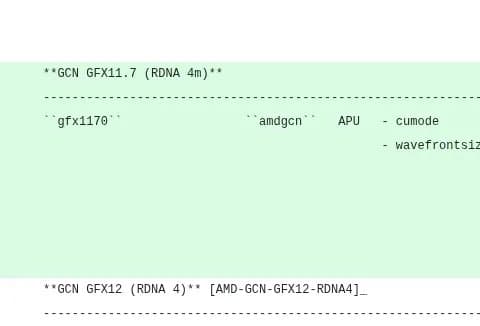
AMD adds GFX1170 target to LLVM, marking it as 'RDNA 4m' for APU/SoC use, with new instructions but missing full RDNA4 features.
AMD has quietly introduced a new GPU target to the AMDGPU LLVM compiler back-end, designated as GFX1170 and internally referred to as "RDNA 4m." The addition, committed to the LLVM codebase by AMD compiler engineers, represents an unexpected refresh within the RDNA 3 family that appears targeted at APU and SoC implementations rather than discrete graphics cards.
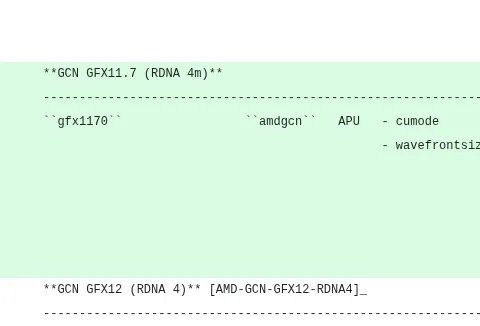
The GFX1170 designation breaks from AMD's recent naming conventions. Following the GFX1150 series that powered RDNA3.5 graphics in Strix Point and Strix Halo processors, the jump to GFX1170 rather than GFX1160 or another GFX115x variant suggests more substantial architectural changes than a typical refresh cycle would indicate.
AMD's LLVM commit explicitly marks GFX1170 as an APU/SoC target, confirming its intended use in integrated graphics solutions rather than standalone GPUs. The naming choice of "RDNA 4m" proves particularly interesting, as it represents a departure from AMD's established numbering scheme where RDNA4 was associated with the GFX12 series and RDNA3 with GFX11. The "4m" designation for what is technically a GFX11.7 implementation appears to be a marketing decision rather than a reflection of architectural generation.
From a technical standpoint, GFX1170 introduces several new capabilities while maintaining compatibility with the broader RDNA3 ecosystem. The target adds SALUFloatInsts and DPPSrc1SGPR features, enhancing the instruction set available to developers working with this hardware. However, the implementation notably lacks the complete set of GFX12 ISA features found in full RDNA4 GPUs, positioning GFX1170 as a mid-point between RDNA3 and RDNA4 capabilities.
This architectural positioning makes sense for APU applications where power efficiency and die size considerations often outweigh the need for cutting-edge graphics performance. By cherry-picking select RDNA4 features while maintaining the RDNA3 foundation, AMD can deliver improved performance and efficiency without the complexity and power demands of a full RDNA4 implementation.
The LLVM integration represents the first public confirmation of GFX1170's existence and capabilities. The compiler changes will enable developers to target this new hardware through standard LLVM-based toolchains, ensuring broad compatibility with existing development workflows and optimization tools.
An update to the initial commit reveals additional functionality being added to the GFX1170 target. A merge request has introduced new FP8/BF8 conversion instructions, suggesting AMD is positioning this hardware for workloads that benefit from low-precision arithmetic operations. These instructions could prove valuable for AI inference tasks and other compute workloads that don't require full floating-point precision.
The introduction of GFX1170 raises questions about AMD's product roadmap and how this "RDNA 4m" implementation will fit into their broader strategy. Given its APU/SoC focus, GFX1170 is likely destined for future Ryzen processors targeting mobile and embedded applications where integrated graphics performance matters but discrete GPU power budgets aren't available.
For developers and enthusiasts, the LLVM integration means GFX1170 support will be available across the entire AMDGPU ecosystem, from open-source Mesa drivers to proprietary toolchains. This broad support should ensure smooth adoption once hardware featuring this new target becomes available.
The GFX1170 addition demonstrates AMD's continued investment in their compiler infrastructure and their willingness to introduce intermediate architectures that bridge generational gaps. While the "RDNA 4m" branding may cause some confusion, the technical implementation appears well-considered for its intended market segment.
As with any new hardware target, the true capabilities and performance characteristics of GFX1170 will only become clear once actual silicon becomes available for testing. The LLVM integration provides the foundation, but real-world performance, power efficiency, and feature completeness will ultimately determine whether this RDNA 3 refresh delivers meaningful improvements over existing solutions.
The timing of this announcement, coming amid ongoing work on GFX1250 and GFX13 targets for future graphics IP, suggests AMD maintains an aggressive development cadence across multiple product lines. Whether GFX1170 represents a one-off refresh or the beginning of a new intermediate naming scheme remains to be seen, but it certainly adds an interesting wrinkle to AMD's GPU roadmap.
Comments
Please log in or register to join the discussion