Automerge tackles distributed data synchronization challenges with its local-first architecture, enabling seamless multiplayer app experiences that work offline, prevent conflicts, and scale efficiently. Developed by industry veterans and computer science experts, this open-source engine offers robust compatibility across frameworks while ensuring data consistency through rigorous academic foundations.
Building real-time collaborative applications that function reliably offline while preventing data conflicts has long been a thorny challenge for developers. Traditional sync solutions often buckle under network instability or complex merge scenarios, leading to frustrating user experiences. Enter Automerge—a purpose-built local-first sync engine designed to handle these distributed system complexities with elegance.
The Core Philosophy: Distributed Systems Done Right
Automerge operates on a simple yet powerful principle: every device maintains its own full copy of the document data. This architecture enables three transformative capabilities:
- True Offline Functionality: Users can make changes without connectivity, with updates queuing locally until sync occurs.
- Conflict-Resistant Merging: When overlapping edits occur, Automerge performs automatic consistent merges using deterministic algorithms, preventing data loss.
- Full Version History: Every change is preserved, enabling fearless branching and experimentation with complete historical tracking.
"A single source of truth for your data, mirrored on every client," summarizes Automerge's approach to eliminating centralized bottlenecks while maintaining data integrity across devices.
Performance Meets Practicality
Unlike sync solutions that degrade under heavy loads, Automerge handles millions of operations per document using a compressed columnar storage system. Benchmarks show near-instant local edits without waiting for server roundtrips—critical for responsive interfaces. The engine's efficiency extends to resource usage, with aggressive compression minimizing memory and disk footprint.
Seamless Integration Across Tech Stacks
Automerge shines in compatibility:
- Frontend: Native support for React, with plugins for ProseMirror and CodeMirror
- Languages: Core implementations in JavaScript and Rust, plus bindings for Swift, Python, Java, and C
- Networking: Agnostic transport layer works peer-to-peer, client-server, or via unconventional channels like email attachments
- Backend: Use existing infrastructure or leverage Automerge Repo's built-in sync server

The Brains Behind the Operation
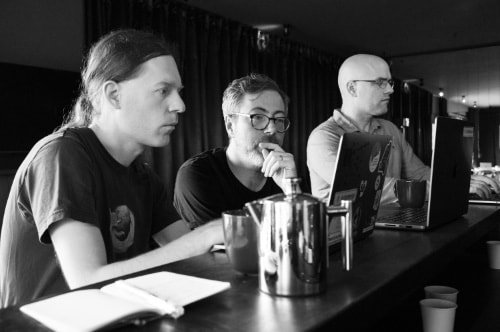
Automerge isn't a fly-by-night project. Its development is steered by computer science luminaries including Martin Kleppmann (Cambridge University distributed systems researcher) and engineers behind foundational platforms like Heroku. The team combines academic rigor—using theorem-proving tools like Isabelle to verify designs—with production-hardened engineering principles.
Long-term sustainability comes from diverse backing: industrial research lab Ink & Switch provides core engineering talent, while sponsors like Fly.io, GoodNotes, and philanthropic organizations (NLNet, ARIA) ensure independence from venture capital timelines. This multi-stakeholder model prioritizes stability over hype—a rarity in today's open-source landscape.
Why This Matters for Developers
Automerge fundamentally shifts how we approach state management in collaborative applications. By treating offline operation as a first-class citizen and guaranteeing conflict resolution, it removes entire categories of edge cases that plague real-time apps. The local-first paradigm also enhances privacy—users retain ownership of their data rather than relying on centralized servers.
As hybrid work models solidify and global connectivity remains uneven, tools like Automerge provide the foundation for next-generation applications that work with users' realities rather than against them. For teams building anything from collaborative editors to IoT control systems, this engine offers a proven path through the distributed data wilderness.
Source: automerge.org
Comments
Please log in or register to join the discussion