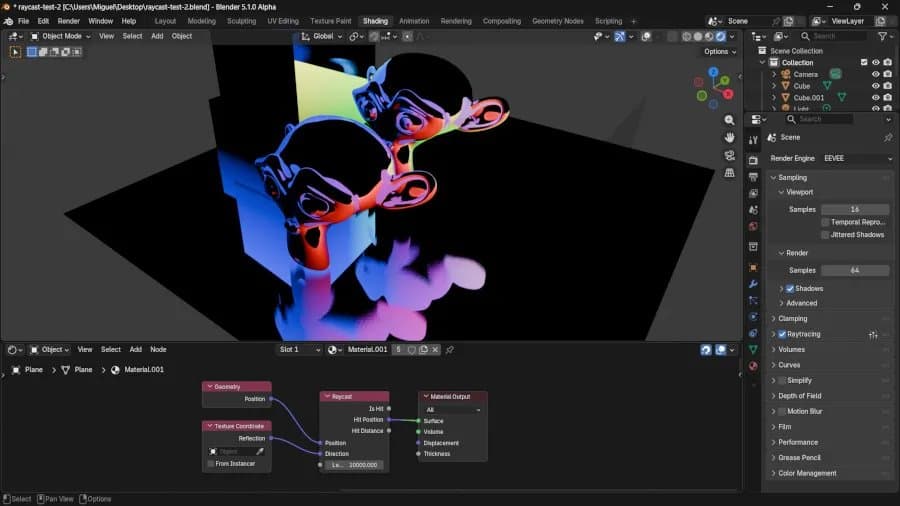

Blender 5.1 enters beta with new raycast nodes functionality while the project announces changes to its release cycle, aiming for more stable LTS releases and better handling of major changes.
Blender 5.1 has entered its bug-fixing beta phase, with the official release expected around March 17th. This update brings an important new feature to the open-source 3D modeling software: raycast nodes, which provide powerful new capabilities for ray tracing workflows.
Raycast Nodes in Blender 5.1
The raycast node implementation in Blender 5.1 represents a significant addition to the software's node-based workflow. This feature allows users to trace rays through a scene and retrieve information about the first surface hit, including hit positions, object data, and primitive data.
The implementation works differently depending on the rendering engine:
- Cycles engine: Performs regular ray-tracing against scene geometry
- EEVEE engine: Uses ray-marching against screen-space buffers
This functionality is part of Blender's broader ray queries support, giving artists and developers more precise control over ray interactions within their scenes. The raycast node can be particularly useful for:
- Procedural geometry generation
- Advanced shading effects
- Physics simulations
- Custom rendering techniques
Blender's Evolving Release Cycle
Alongside the technical improvements in 5.1, the Blender Foundation has announced changes to its release strategy. While Blender will continue to ship three releases per year, the timing and focus of these releases will shift to better accommodate major changes and improve stability.
Key Changes to the Release Schedule
The new approach aims to concentrate major risks and breaking changes into a single release per year, with the goal of making the LTS (Long Term Support) release the most stable of that year. This evolution in the release cycle includes:
- Maintaining three releases per year in most years
- Larger gaps between releases to allow for more substantial development
- Concentrating major changes into specific releases
- Ensuring LTS releases are maximally stable
Timeline Impact
The transition to this new release model will have some immediate effects:
- 2026: No impact - the transition year
- 2027: Only two releases due to timing of the transition
- 2028: Blender 6.0 release, followed by Blender 6.1 as a regular release, and Blender 6.2 as the LTS release
This adjusted schedule reflects Blender's maturation as a project and its commitment to balancing innovation with stability. By concentrating major changes into specific releases, the development team can better manage the testing and stabilization process, ultimately benefiting users who rely on Blender for production work.
What This Means for Users
For Blender users, these changes bring both immediate benefits and long-term improvements:
Immediate (5.1): The raycast nodes functionality opens up new creative and technical possibilities, particularly for procedural workflows and advanced rendering techniques.
Long-term: The evolved release cycle should result in more predictable and stable updates, with LTS releases offering the highest level of reliability for production environments.
The combination of new features like raycast nodes and a more thoughtful release strategy demonstrates Blender's continued evolution as a professional-grade open-source tool. As the project moves forward, users can expect both cutting-edge capabilities and the stability needed for serious production work.
For more details on the release cycle changes, you can visit the Blender DevTalk thread where the community is discussing these updates.
Comments
Please log in or register to join the discussion