
ZDNET's latest evaluation reveals how leading CRM platforms like Salesforce, HubSpot, and Pipedrive are leveraging AI, deep customization, and ecosystem integration to transform customer engagement from simple tracking into strategic engineering. For developers and tech leaders, selecting the right CRM now involves evaluating API ecosystems, AI capabilities, and architectural flexibility as much as core features.

Customer Relationship Management (CRM) software has evolved far beyond digital Rolodexes. Today's platforms are complex engineering ecosystems integrating AI, automation pipelines, and extensive APIs – becoming central nervous systems for customer-facing operations. ZDNET's comprehensive analysis, led by Charlie Osborne and reviewed by Edward Moyer, dissects the 2025 landscape, highlighting platforms that offer not just features, but architectural advantages for technical teams.
The Engine Room: Top Platforms for Technical Depth
Salesforce Starter CRM: The Extensible Foundation (Best Overall)

More than just a sales tool, Salesforce provides a robust platform. Its $25/user/month Starter Suite offers core contact/lead management plus Einstein AI for predictive insights and automation. Crucially, it grants access to AppExchange – an enterprise-grade marketplace for integrations and extensions. Recent enhancements focus on AI agent training, allowing businesses to refine automated assistants handling routine tasks. While the $100/user/month Pro tier unlocks deeper capabilities, the real value lies in Salesforce's mature APIs and development ecosystem, making it a canvas for engineering teams needing a scalable, integrable core. Downside: The cost leap to enterprise features remains steep.Apptivo CRM: The Customization Powerhouse
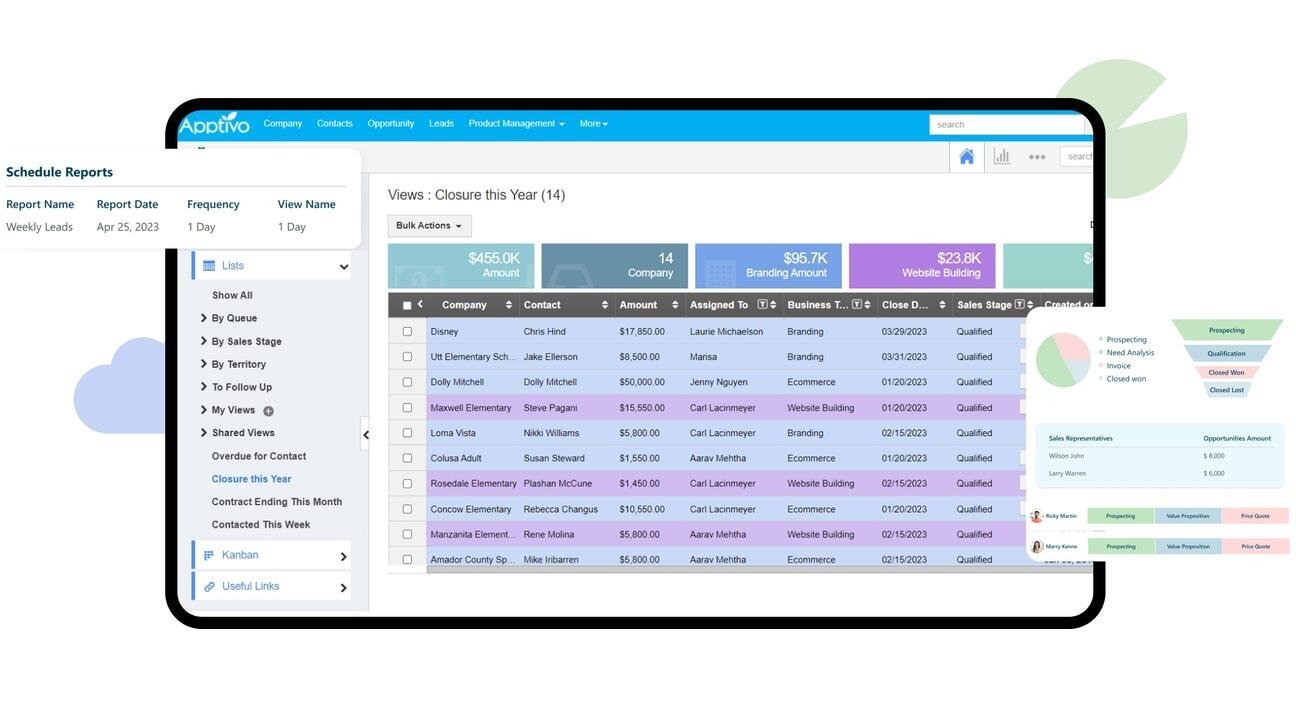
For teams demanding granular control, Apptivo ($20-$50/user/month) stands out. Its engineering appeal lies in support for up to 350 custom fields and 50 custom dashboards, allowing precise data modeling unique to complex workflows. Integration capabilities are equally robust, connecting deeply with staples like QuickBooks, Office 365, Slack, and payment gateways (PayPal, Stripe). This makes it ideal for businesses with highly specialized processes needing a CRM molded to their architecture, not vice-versa. Trade-off: This power demands configuration effort, resulting in a steeper initial setup curve.Pipedrive: Engineering Sales Velocity
Purpose-built for sales pipeline efficiency ($14-$99/user/month), Pipedrive excels in automating sales sequences (follow-ups, call scheduling) and providing actionable intelligence. Its AI sales assistant analyzes deal progress, while the unique 'lead scoring' engine uses external data to prioritize prospects. The recent 'Pulse' toolkit exemplifies its engineering focus, offering small businesses automated prospecting workflows. Its clean API and relative simplicity make it a favorite for sales engineering teams needing rapid deployment and clear ROI. Limitation: Its sales-centricity means broader marketing/service automation lags behind suites like Salesforce.HubSpot: The Developer's Sandbox & Gateway (Best Free Tier)
HubSpot’s free CRM is more than just entry-level; it's a full-featured development sandbox. Developers can explore core CRM concepts, basic automation, and HubSpot’s API ecosystem without cost. Paid tiers ($15+/user/month) introduce advanced automation, predictive analytics (recently enhanced via ChatGPT/Anthropic Claude integrations), and deeper customization. Its strength lies in a well-documented platform and marketplace, allowing developers to build and integrate custom modules. Caveat: Costs escalate quickly for advanced features, potentially pushing larger teams towards more comprehensive platforms.Microsoft Dynamics 365: Ecosystem Integration Play
Less a single CRM than a modular suite within the Azure/Microsoft 365 universe. Dynamics 365 Sales, Customer Insights, and Customer Service can be mixed. Its core engineering value is seamless integration with the broader Microsoft stack (Azure data services, Power Platform for low-code extensions, Teams collaboration). For organizations heavily invested in Microsoft's cloud, it eliminates friction, leveraging existing identity management and data flows. Pricing varies by module. Consideration: Best suited where deep Microsoft ecosystem integration is a primary architectural requirement.
Why Engineering Teams Should Care
Selecting a CRM is no longer just a sales or marketing decision; it's an infrastructure choice with technical ramifications:
- API Ecosystems & Extensibility: Platforms like Salesforce and HubSpot offer vast marketplaces (AppExchange, HubSpot App Marketplace) and robust APIs, turning the CRM into a central hub for custom integrations and data flows.
- AI as Core Infrastructure: AI isn't just a feature add-on; it's becoming foundational for predictive lead scoring (Pipedrive), automated agent training (Salesforce), and analytics (HubSpot). Evaluating the AI's capabilities, transparency, and trainability is crucial.
- Data Architecture & Customization: The ability to deeply customize data models (Apptivo) or leverage integrated cloud data services (Microsoft Dynamics) directly impacts how effectively the CRM supports unique business logic and reporting.
- Automation Engine Quality: The sophistication and reliability of workflow automation engines determine how much manual process overhead can be eliminated, directly impacting operational efficiency.
ZDNET's analysis underscores that the 'best' CRM hinges on technical fit: Does its architecture align with your stack? Can its APIs and customization support your unique processes? Does its AI provide actionable intelligence? As these platforms evolve into sophisticated engineering environments, the choice profoundly impacts a company's operational backbone and its capacity to build intelligent, responsive customer relationships. The era of the CRM as a mere contact database is decisively over.
Source: ZDNET - The best CRM software: The best customer relationships software solutions, ranked
Comments
Please log in or register to join the discussion