Open-source project turns budget e-ink display into a versatile tool for security professionals, developers, and privacy-conscious users with wireless capabilities, communication tools, and extensive utilities.
The Biscuit firmware project represents an interesting evolution in the e-paper device ecosystem, transforming a relatively inexpensive Xteink X4 e-ink reader into a multi-purpose security and communication device. Developed by GitHub user yattsu as a fork of CrossPoint Reader, this open-source project demonstrates how specialized hardware can be repurposed for diverse applications beyond its original design.
At its core, Biscuit addresses a common limitation in dedicated e-paper devices: their single-purpose nature. While the Xteink X4 hardware offers excellent battery life, sunlight readability, and persistent display without power consumption, its stock firmware confines it to basic e-reader functionality. Biscuit unlocks this hardware's potential by implementing a comprehensive suite of applications while maintaining the original reading experience.
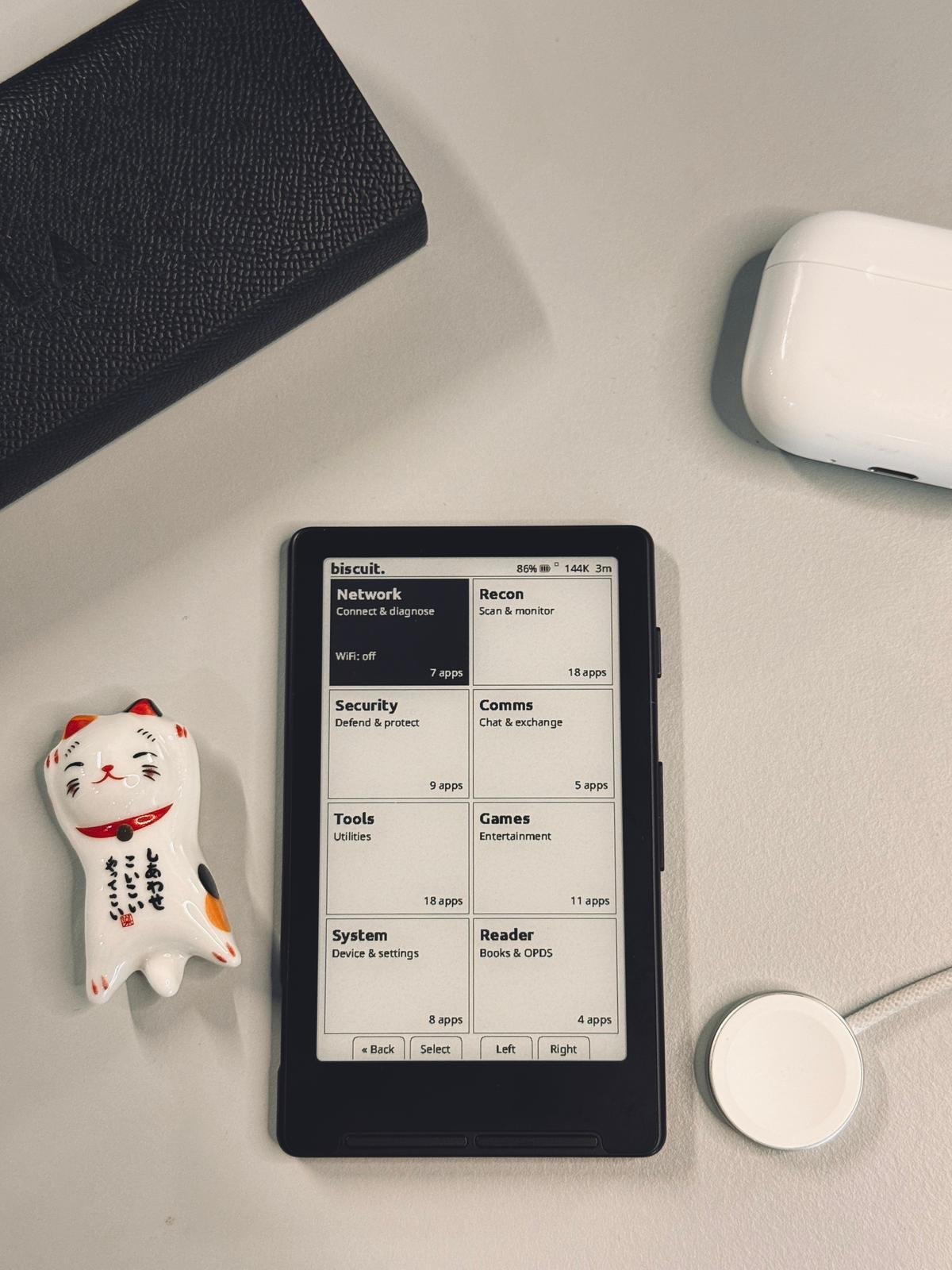
The firmware presents a tile-based dashboard approach with eight distinct categories: Recon, Offense, Defense, Comms, Tools, Games, Reader, and Settings. This organizational structure suggests the project's target audience includes security professionals, developers, and tech enthusiasts who require specialized tools in a portable, low-power form factor.
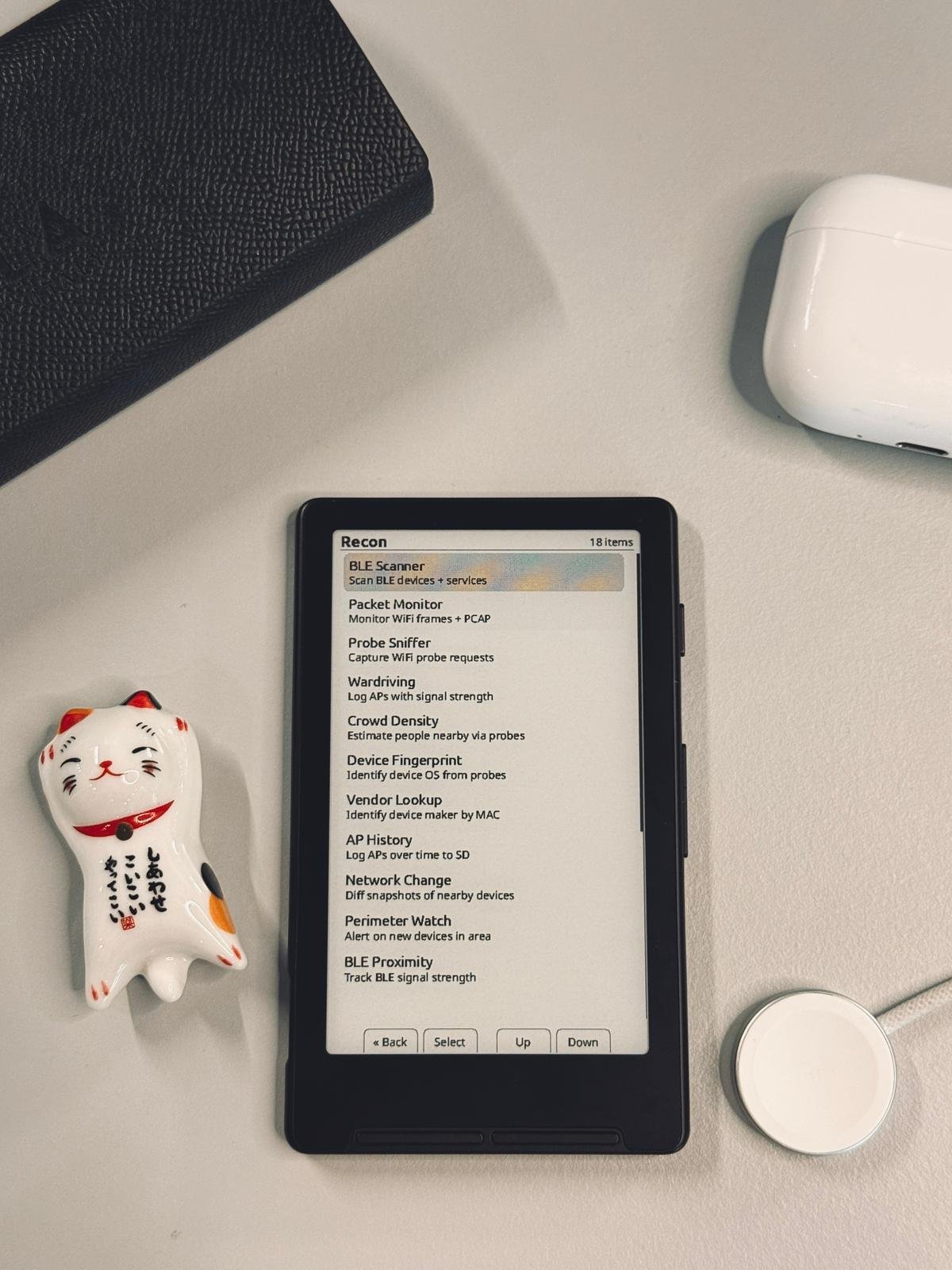
Notably, the Recon category focuses entirely on passive scanning and monitoring capabilities, with applications for WiFi and BLE scanning, packet monitoring, device fingerprinting, and wardriving. The Offense section includes active testing tools like beacon broadcasting, SSID cloning, and BLE spam, though these require explicit acknowledgment of their purpose—a responsible approach given the potential misuse of such capabilities.
The Defense category introduces privacy-focused features like Ghost Mode (which rotates MAC addresses and disables radios), tracker detection, and security scanning. These features align with growing privacy concerns in wireless environments and demonstrate the project's consideration for ethical security practices.
Communication capabilities are handled through the Comms tile, which includes mesh chat functionality using ESP-NOW for device-to-device communication without requiring traditional WiFi infrastructure. The Tools tile aggregates productivity utilities including TOTP authentication, password management, network analysis, and creative applications like an Etch-A-Sketch implementation.
The firmware maintains full e-reader functionality through its Reader tile, which supports EPUB files, OPDS servers, and reading statistics. This dual-purpose nature—security tool and e-reader—positions Biscuit as a unique offering in the specialized device market.
Technically, the project leverages the ESP32-C3 SoC's RISC-V architecture, WiFi/BLE 5.0 capabilities, and the 4.26" e-ink display's advantages. The tile-based UI architecture uses an activity-based system where each screen is an Activity subclass managed by ActivityManager. WiFi and BLE share a single radio through RadioManager arbitration, suggesting careful resource management for the device's limited 380KB of SRAM.
The open-source nature of the project invites community contributions, with clear documentation for building, debugging, and adding translations. The SD card structure reveals thoughtful organization of application data, captured content, and system logs.
While Biscuit doesn't represent a commercial venture with funding, its development demonstrates the value in repurposing existing hardware for specialized applications. The project's focus on security tools, privacy features, and communication capabilities suggests it fills a niche for professionals who need discrete, battery-powered tools in the field.
The firmware's compatibility with the Xteink X4 hardware—at approximately $70—positions it as an accessible entry point into specialized mobile computing. This contrasts with more expensive dedicated security tools while offering comparable functionality in a more versatile package.
As the project continues to evolve, its success may influence future e-paper device designs that embrace multi-purpose capabilities from the outset. The balance between specialized functionality and general-purpose utility represents an interesting design challenge that Biscuit appears to navigate effectively.
For developers and security professionals interested in exploring the firmware, the project provides both a web flasher for easy installation and detailed build instructions for those who wish to customize the codebase. The active development and comprehensive feature set suggest a project with staying power in the specialized mobile tools space.
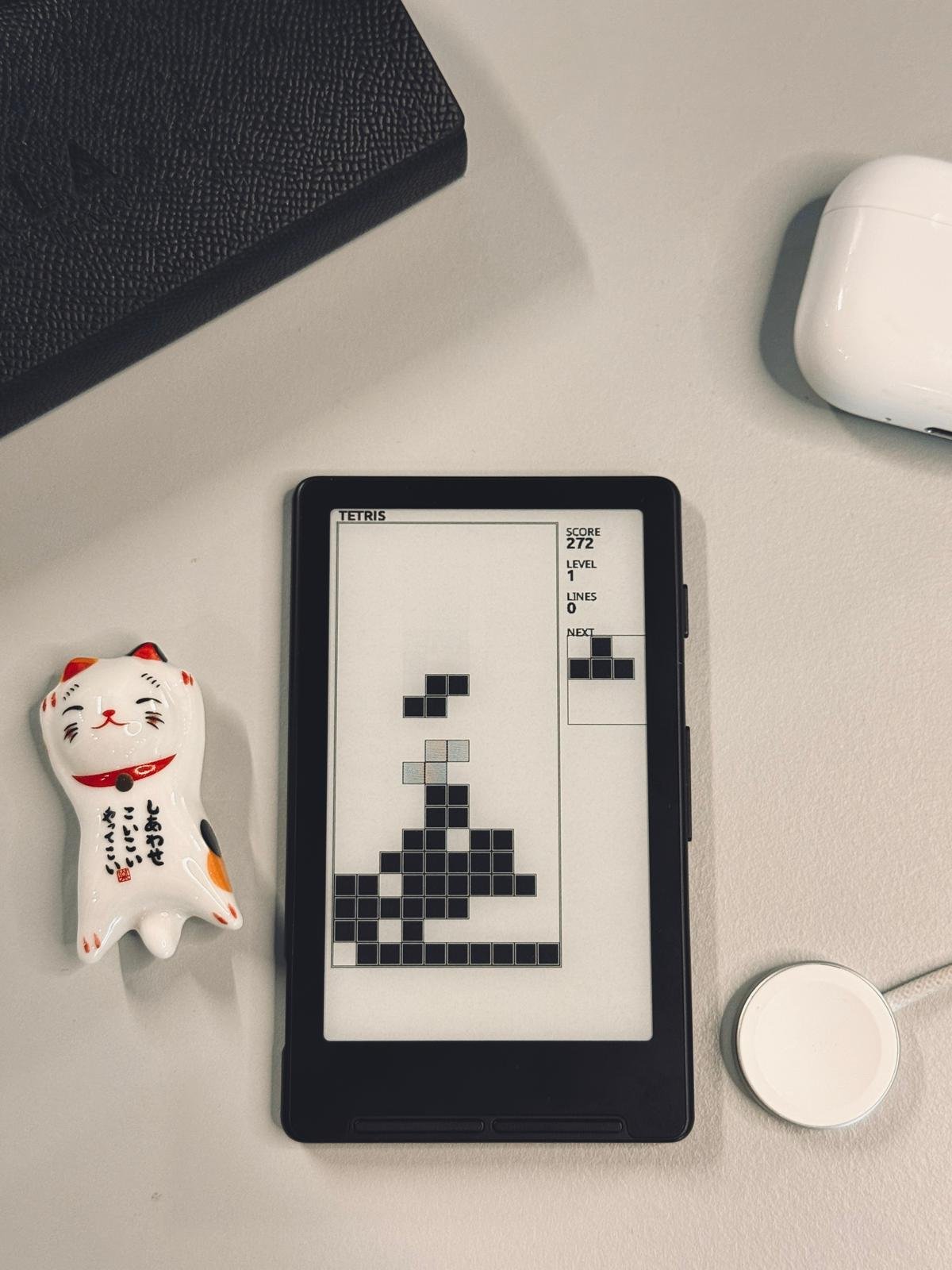
The inclusion of games like Tetris adds an element of entertainment to the device's capabilities, demonstrating the firmware's versatility beyond professional applications. This balance between utility and recreation reflects a thoughtful approach to device design that acknowledges different user needs.
Project documentation is comprehensive, with clear instructions for installation via the web flasher at https://xteink.dve.al/ and development setup using PlatformIO. The architecture documentation explains the activity-based UI system and radio management, providing valuable insights for contributors who wish to extend the firmware's capabilities.
The internationalization support, with YAML-based translations in the lib/I18n/translations/ directory, suggests the project aims at a global audience. This attention to accessibility broadens the potential user base beyond English-speaking developers and security professionals.
As the firmware ecosystem continues to evolve, projects like Biscuit demonstrate how open-source development can unlock unexpected value in existing hardware. The combination of specialized security tools, communication capabilities, and e-reader functionality creates a unique proposition that may influence future device designs in this space.
Comments
Please log in or register to join the discussion