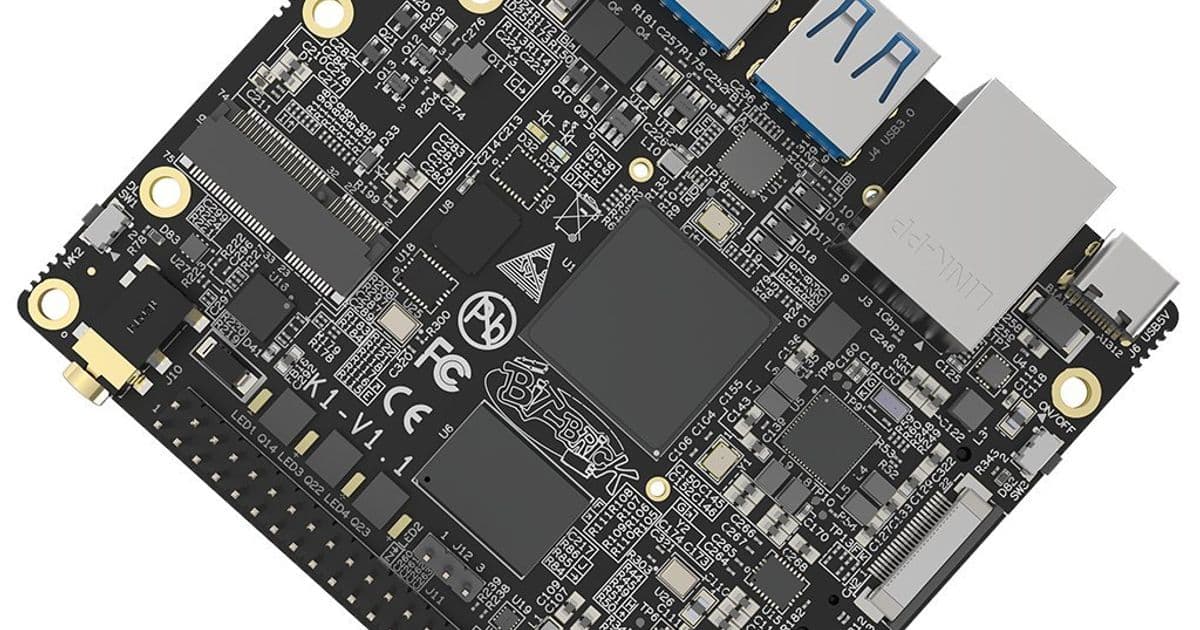
The Bit-Brick K1 and K1 Pro offer compact development platforms with different processor architectures, memory options, and software ecosystems, catering to both RISC-V enthusiasts and those needing broader software compatibility.
The Bit-Brick K1 and Bit-Brick K1 Pro are compact computer boards measuring 90 x 80mm (3.54" x 3.15") that pack impressive hardware into a small form factor. Both models feature support for 4GB or 8GB of onboard LPDDR4x memory and come equipped with Gigabit Ethernet, USB 3.0 and USB 2.0 ports, and two M.2 slots supporting NVMe SSDs. These boards represent an interesting entry in the single-board computer market, offering developers and hobbyists a choice between RISC-V and Arm architectures at nearly identical price points.
Architecture Showdown: RISC-V vs Arm
The fundamental difference between these two boards lies in their processor architecture. The Bit-Brick K1 is powered by a SpacemiT K1 RISC-V processor, while the K1 Pro features a Rockchip RK3576 Arm-based processor. This architectural choice has significant implications for software compatibility and performance.
Bit-Brick K1 (RISC-V)
The RISC-V model features 8 SpacemiT X60 RISC-V CPU cores that deliver performance comparable to Arm Cortex-A55 cores. It includes Imagination BXE-2-32 graphics and a 2 TOPS NPU for AI acceleration. While RISC-V represents an exciting open-source architecture with growing momentum in the embedded space, software support remains limited compared to Arm.
The K1 supports two operating systems primarily designed for the Chinese market: Huawei's Open Harmony and an Ubuntu-based Linux distribution called Bianbu Desktop. This limited software ecosystem makes the K1 more suitable for developers specifically interested in RISC-V development and testing rather than general-purpose computing.
Bit-Brick K1 Pro (Arm)
In contrast, the K1 Pro's Rockchip RK3576 processor offers significantly better performance and broader software support. The RK3576 features four Arm Cortex-A72 CPU performance cores, four Cortex-A53 efficiency cores, Mali-G52 MC3 graphics, and a 6 TOPS NPU. This heterogeneous core configuration provides both performance and power efficiency.
The K1 Pro benefits from extensive software support, with Debian and Android images available for download. This broader compatibility means the K1 Pro can run a wide range of applications for both operating systems, making it more versatile for general development and even light desktop computing tasks.
Storage Options and I/O Features
Both boards offer robust connectivity options despite their compact size. The I/O specifications are identical between models:
- 1 x USB 3.0 Type-A
- 1 x USB 2.0 Type-A
- 1 x USB 2.0 Type-C OTG
- 1 x USB Type-C (5V/2A power input)
- 1 x HDMI output
- 1 x 3.5mm audio jack
- 2 x M.2 M-Key connectors for NVMe SSDs
- 1 x M.2 E-Key connector
- 1 x microSD card reader
- 1 x 40-pin GPIO header
- 1 x MIPI-DSI for display connections
- 1 x MIPI-CSI for camera connections
A notable advantage of the K1 Pro is its support for 32GB or 64GB eMMC modules for onboard storage. This feature allows users to operate the board without requiring an external M.2 SSD or microSD card, providing a more integrated and potentially more reliable storage solution.
Pricing and Market Positioning
Both boards are available from AliExpress, with the K1 priced at approximately $163 and the K1 Pro at $165. The minimal price difference between the two models is particularly interesting, as it essentially puts the decision in the hands of developers based on their specific needs rather than budget constraints.
The K1 Pro's designation as the "pro" version is justified by its superior performance characteristics and broader software ecosystem. The Arm-based processor's better software support, higher performance cores, and additional storage options make it a more practical choice for most development scenarios.
Target Audience and Use Cases
The Bit-Brick K1 is best suited for developers specifically interested in RISC-V architecture. As an open-source instruction set architecture, RISC-V represents the future of processor design, and the K1 provides a platform for experimentation and development in this space. However, the limited software support means it's primarily a development and testing platform rather than a general-purpose computing solution.
The K1 Pro, with its Arm architecture, offers a more practical platform for developers who need broader software compatibility. It's suitable for IoT projects, media centers, light desktop computing, and any application where software availability and performance are priorities.
Conclusion
The Bit-Brick K1 and K1 Pro represent an interesting choice in the single-board computer market, offering developers the option between cutting-edge RISC-V architecture and the more established Arm ecosystem. While the boards are nearly identical in price and form factor, their different processor architectures lead to significantly different software ecosystems and performance characteristics.
For developers specifically interested in RISC-V and its potential, the K1 offers an accessible entry point. For those needing broader software support and better performance, the K1 Pro provides a more practical solution. The minimal price difference between the two models makes this primarily a technical decision rather than a financial one, allowing developers to choose based on their specific project requirements and architectural preferences.
Both boards demonstrate the growing diversity in the single-board computer market, where developers now have genuine choices between different processor architectures, each with its own strengths and trade-offs. As RISC-V continues to mature, we can expect to see more boards like the K1 that provide access to this open-source architecture, while Arm-based boards like the K1 Pro continue to offer the reliability and software support that developers have come to expect.
Comments
Please log in or register to join the discussion