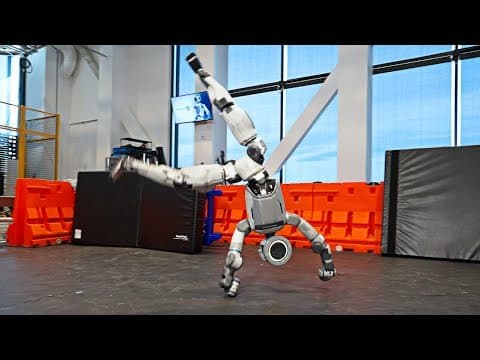
Boston Dynamics' electric Atlas humanoid robot successfully performs a backflip from a cartwheel in its final research demonstration, showcasing improved balance recovery and movement fluidity before transitioning to commercial applications.
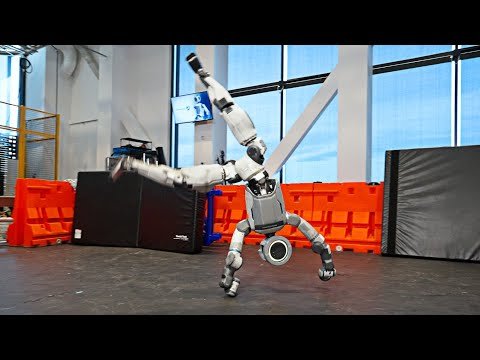
Boston Dynamics has released a breakthrough video demonstrating its next-generation Atlas humanoid robot executing complex gymnastic maneuvers, including a cartwheel seamlessly transitioning into a backflip. Unlike earlier prototypes, this electric-powered Atlas maintains balance throughout the stunt without damage, signaling significant advancements in dynamic movement and self-correction capabilities.
The demonstration, developed in collaboration with the RAI Institute, highlights Atlas's ability to recover from falls during training. When attempting high-speed runs or intricate sequences, the robot occasionally crashes into obstacles or loses components but consistently self-corrects mid-fall—a critical improvement over previous iterations. Engineers achieved this through iterative learning systems where failures inform real-time adjustments to gait and momentum control.
Compared to its hydraulic predecessor, the Atlas HD, this model exhibits remarkably fluid motion. Where older versions moved with mechanical hesitation, the new Atlas demonstrates a natural walking rhythm essential for practical deployment. Boston Dynamics attributes this to refined algorithms processing sensor data from joints and limbs microseconds faster, enabling smoother weight transitions. The enterprise version currently available to commercial partners, however, sacrifices some elegance for durability, omitting certain research features to prioritize industrial reliability.
For logistics and manufacturing sectors, these advancements address core operational challenges. Atlas can now navigate uneven surfaces at higher speeds while carrying payloads, making it viable for warehouse inventory management or equipment handling in hazardous environments. Its fall-recovery capability reduces downtime risks—a key concern for companies like Hyundai, which plans to deploy Atlas in automotive factories.
This demonstration marks the conclusion of Atlas's research phase. As Boston Dynamics shifts focus entirely to commercial models, this "final push" video serves as both a technological capstone and a benchmark for competitors like Tesla's Optimus. While running stability requires further refinement, Atlas's gymnastics prove humanoid robots are inching closer to human-like agility, setting the stage for broader industrial adoption over the next decade.
Comments
Please log in or register to join the discussion