The BrainCraft Challenge pushes computational neuroscience forward by tasking researchers with creating biologically inspired neural networks that solve continuous embodied tasks. With strict constraints of 1,000 neurons and 100-second training windows, participants must design efficient models that navigate maze environments while balancing energy constraints. Early leaderboard results reveal both promise and limitations in current approaches to synthetic neural systems.
"Despite decades of computational neuroscience research, we still lack an integrated, functional mini-brain capable of performing simple, continuous embodied tasks." - BrainCraft Challenge Introduction
For years, neuroscientists have modeled individual brain structures—hippocampus for memory, basal ganglia for decision-making—but these remain isolated simulations. The BrainCraft Challenge confronts this fragmentation by tasking researchers with building a synthetic neural system that solves embodied problems in continuous environments. Led by Nicolas Rougier, the project aims to bridge neuroscience theory with practical implementation under rigorous constraints.
The Embodiment Gap in Neuroscience
Current brain models often rely on abstract inputs/outputs and over-engineered components. As the challenge notes:
"These models are highly abstract and simplified, often relying on a small number of over-engineered neurons... dealing mostly with abstract inputs and outputs."
BrainCraft addresses this by embedding neural controllers in a continuous 10×10 maze environment where an agent must locate energy sources to survive. This creates a sensorimotor loop requiring real-time decision-making—echoing Rodney Brooks' embodied cognition principles where intelligence emerges from environment interaction.
 Simplified maze environment for Task 1. The agent (▲) starts centrally and must navigate to energy source 1 or 2.
Progressive Challenges and Technical Constraints
The five-stage challenge escalates complexity:
- Simple Decision (Active): Navigate to one of two energy sources
- Cued Decision (Active): Use color signals (blue=open, red=blocked) to avoid dead-ends 3-5: Upcoming tasks (Details undisclosed)
Participants design leaky rate-based neural networks resembling Echo State Networks (ESNs), governed by:
X(t+1) = (1-λ)•X(t) + λ•f(W•X(t) + Win•I(t))
O(t+1) = Wout•g(X(t+1))
Key constraints:
- Maximum 1,000 neurons
- 100-second training limit on consumer hardware (M1 MacBook Pro)
- Output limited to ±5° steering adjustments
- Sensors: 64 distance readings, bump detection, energy gauge
- Libraries restricted to NumPy/SciPy/Matplotlib
"I want any student to participate without a supercomputer," explains Rougier regarding the strict computational limits.
Training and Evaluation: Neuroscience Meets Engineering
The training phase allows any paradigm—reinforcement learning, evolutionary algorithms, or manual tuning—but must output finalized weights and parameters. The testing phase runs 10 trials, scoring agents on distance traveled before energy depletion. Notably, models must generate internal reward signals since no external reward is provided during testing.
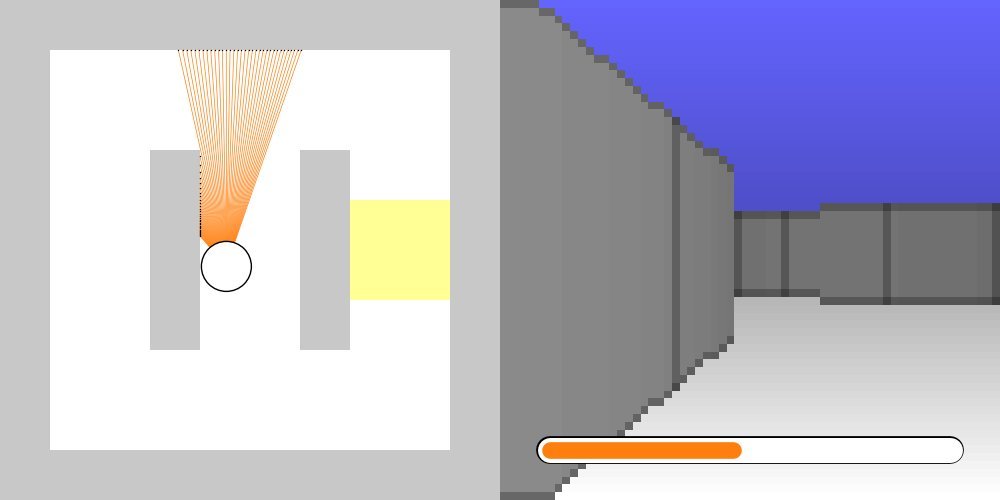 Debug visualization showing agent perspective (right) and bird's-eye view (left) during evaluation.
Early Results: Promise and Limitations
The Task 1 leaderboard reveals intriguing approaches:
| Author(s) | Score | Method |
|---|---|---|
| @rougier | 15.00 | Manual reference |
| @vforch & @snowgoon | 14.71 ± 0.46 | Handcrafted weights |
| @tjayada | 12.70 ± 0.43 | Genetic algorithm |
| @snowgoon88 | 11.39 ± 3.56 | Handcrafted weights |
Top solutions use hand-tuned weights or evolutionary strategies, yet all trail the manual benchmark. The variance in @snowgoon88's score highlights the fragility of some approaches. As tasks escalate to cue-based decisions and beyond, the constraints will further test whether 1,000 neurons suffice for adaptive behavior—proving or challenging Rougier's axiom that "it takes two neurons to ride a bicycle."
Why This Matters for AI Development
Beyond neuroscience, BrainCraft pressures-tests minimalist AI design. The 100-second training window forces efficient learning algorithms, while the sensorimotor loop requirement challenges models to integrate perception and action—a hurdle for many deep learning systems. As embodied AI advances in robotics and gaming, solutions from this challenge may inform resource-constrained real-world applications.
Submissions remain open, inviting researchers to prove whether biologically inspired networks can exhibit lifelike adaptability under strict computational limits.
Comments
Please log in or register to join the discussion