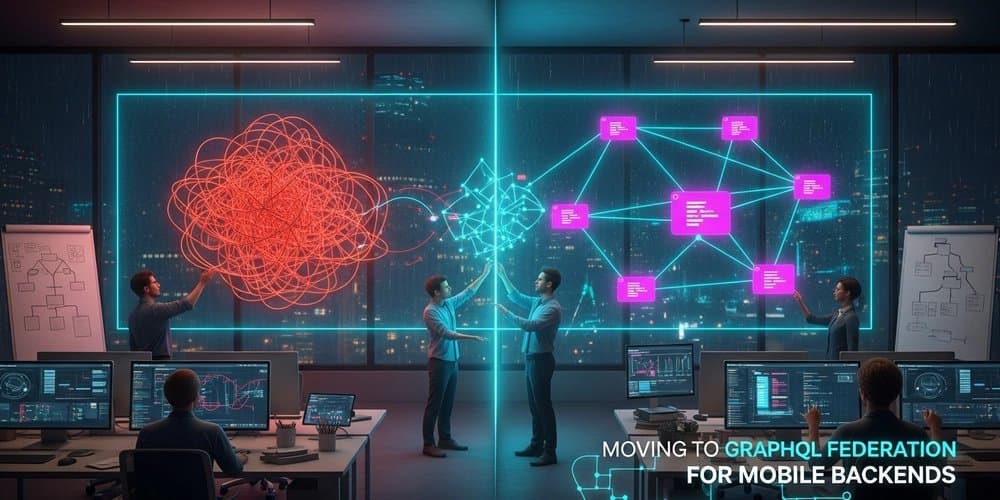
As mobile apps grow more complex, the traditional REST monolith is becoming a bottleneck for engineering teams. GraphQL Federation offers a path to decouple services while maintaining a unified API experience for mobile clients.
The mobile engineering landscape in 2026 presents a stark reality: the monolithic backend that once served us well has become a liability. As feature complexity scales exponentially, these aging REST monoliths are creating bottlenecks that slow release cycles, bloat client-side code, and frustrate development teams.
The Breaking Point
For years, the "One Size Fits All" API approach seemed reasonable. But mobile apps now demand hyper-specific data shapes that monoliths struggle to deliver efficiently. Teams find themselves battling over-fetching that drains user battery and data plans, while simultaneously facing "versioning hell" where updating a single endpoint risks breaking legacy app installs.
The misconception that GraphQL alone solves these problems has led many teams astray. A monolithic GraphQL schema often becomes just as unwieldy as the REST system it replaced, creating a new form of technical debt.
Understanding GraphQL Federation
GraphQL Federation 2.0 and its successors have standardized how we compose multiple subgraphs into a single unified gateway. This architecture separates the "what" from the "where" - the gateway acts as a smart router that receives a single query from the mobile client and orchestrates requests across various microservices.
Mobile teams interact with a "Supergraph" - a virtual schema that combines data from identity, commerce, and content services seamlessly. The beauty lies in the abstraction: mobile clients talk to one endpoint while the backend remains fragmented for developer speed and service stability.
The Team Autonomy Revolution
Federation isn't just about code decoupling; it's about team autonomy. By using federation, the checkout team can update their schema without waiting for the user profile team. This modularity is essential for high-performance mobile app development where rapid iterations determine competitive advantage.
In practice, the mobile client only ever talks to one endpoint. The complexity shifts from the client to the infrastructure, where it belongs.
Tooling Options for 2026
Apollo GraphOS remains the industry standard for managing the supergraph lifecycle. It provides the "Rover" CLI and schema registry to prevent breaking changes. Choose this if you need a mature, enterprise-grade ecosystem with robust observability.
Hive (by The Guild) offers a completely open-source alternative for schema federation and monitoring. It's particularly useful for teams avoiding vendor lock-in and organizations with strong DevOps capabilities who want full control over their telemetry data.
WunderGraph Cosmo is a high-performance federation router built on Go. It focuses on extreme low latency and local development efficiency. Ideal for high-traffic mobile apps where every millisecond of gateway overhead matters.
The Migration Path
The transition doesn't require a complete system rewrite. Start by implementing a "Federated Gateway" in front of your existing monolith. Treat the monolith as your first, giant subgraph.
Identify one high-impact feature, such as "Product Reviews," to move into a new microservice. Define its schema and link it via the gateway. Gradually shift fields from the monolith subgraph to the new service subgraph. The mobile app continues to query the same field, unaware the source has changed.
Critical Risks and Trade-offs
Federation is not a silver bullet. It introduces network latency as the gateway must now communicate with multiple internal services. Complexity shifts from the code to the infrastructure - debugging a query that spans five subgraphs requires advanced distributed tracing and logging.
The "N+1" Failure Scenario
A common failure occurs when the gateway makes excessive downstream calls for list data. If the gateway isn't configured with proper DataLoaders, a single mobile request can trigger hundreds of internal hits. Warning signs include skyrocketing latency and backend service timeouts.
The alternative is to use "Entity Interfaces" or specialized batching tools to prevent these cascading failures.
Key Takeaways for 2026
Federation is for Teams: Only adopt federation if your team size or service complexity justifies the infrastructure overhead.
Schema First: Treat your schema as a contract. Use automated registry checks to ensure mobile clients never receive a breaking update.
Monitor the Gateway: Your gateway is now your single point of failure. Prioritize its resilience and scaling above all else.
As mobile apps continue to evolve and demand more sophisticated data patterns, the ability to maintain a unified API experience while allowing backend services to evolve independently becomes not just advantageous, but essential for competitive mobile development.
Comments
Please log in or register to join the discussion