A developer's journey to create a privacy-focused, open-source workspace alternative to Google Workspace, exploring decentralized architecture and European digital sovereignty.
In an era where digital sovereignty has become a pressing concern, particularly in Europe, one developer's personal project has evolved into something that might address a growing need for privacy-focused productivity tools. Reinder Nijhoff's journey to build Eigen—a self-hosted workspace alternative—offers fascinating insights into both the technical challenges and philosophical motivations behind creating digital infrastructure that puts users in control of their data.
The Spark of Independence
The project began last spring with a simple question: how hard would it be to build a Google Workspace alternative? The answer, as Nijhoff discovered, was both more achievable and more complex than expected. The motivation was clear—given the current geopolitical climate and the immense power wielded by large tech companies, particularly those based in the United States, there's a genuine need for European alternatives that respect privacy and data sovereignty.
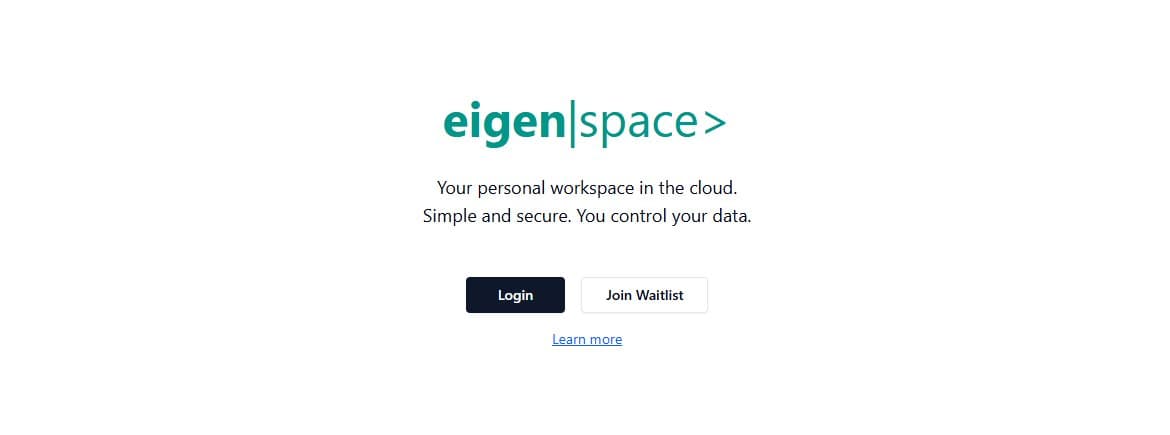
What started as a curiosity-driven experiment quickly evolved into a functional proof of concept. After just two months of spare-time development, with some assistance from collaborator Mark, Nijhoff had created a working ecosystem that included email, file storage, collaborative document editing, contact management, and kanban boards. The project, accessible at eigen.is, represents more than just a technical achievement—it embodies a philosophy of digital independence.
The Architecture of Privacy
What makes Eigen particularly interesting is its architectural approach. Rather than building a traditional centralized system with shared databases and complex access controls, Nijhoff opted for a radically simple model: each user gets their own directory with isolated SQLite databases for metadata and structured data, while actual content is stored as files.
This design choice, initially made for simplicity, yields several compelling properties. Each user's data is completely isolated—there's no shared database that could accidentally expose someone else's information. Backups become trivial: simply copy a user's directory. Adding new users doesn't affect existing ones, and the system scales horizontally. The architecture even allows for the possibility of users bringing their own storage backends.
However, this isolation creates interesting challenges. How do you enable document sharing when each user's data is walled off? How do you implement real-time collaboration across these boundaries? How do you handle search across file-based data? These aren't just technical hurdles—they're fundamental questions about how to balance privacy with functionality in a collaborative environment.
For real-time features like collaborative document editing in eigen|docs> and kanban boards in eigen|stickies>, the solution involves keeping Yjs documents in memory while active, syncing them over WebSockets, and periodically writing them to disk. When all users close a document, it disappears from memory—a clever approach that balances performance with resource efficiency.
The Tech Stack Behind the Vision
Nijhoff's choice of technologies reflects both pragmatism and modern web development trends. The stack includes Bun for server runtime, Elysia for server routing, Vite and React with TypeScript for the frontend, TanStack Router and TanStack Query for routing and data fetching, and Tailwind CSS with shadcn/ui for the interface.
Interestingly, this represents a departure from Nijhoff's usual approach. For other projects, he typically writes all code himself and avoids dependencies entirely—even his published NPM packages are completely dependency-free. The decision to leverage existing open-source libraries for Eigen was driven by the need to prototype quickly, demonstrating a pragmatic shift in approach when building something ambitious.
The Road Ahead: Questions and Challenges
Despite the impressive progress, Eigen remains in its early stages. Nijhoff estimates that less than five percent of what's needed for a minimum viable product has been built, and reaching production readiness could take years. The missing pieces are substantial: end-to-end encryption, calendar functionality, spreadsheets and presentations, organization support for teams and shared resources, protocol compatibility (IMAP, CalDAV, WebDAV) for standard clients, and backup and migration tools.
Beyond these feature gaps lie deeper architectural questions. Can the current approach actually scale to thousands or millions of users? Is this truly the simplest architecture, or are there better solutions? For instance, could mapping workspace users 1-to-1 to Linux system users simplify security and management?
Perhaps most importantly, how can Eigen become extensible? The core will remain minimal by design, but organizations adopting the platform should be able to extend it. This raises questions about plugin and API architecture—how can third parties create deep integrations without forking the entire project?
A Vision for Decentralized Productivity
Nijhoff envisions a model similar to WordPress: self-hosting for those who want complete control, with eigen.is serving as a public platform running the same software. Ideally, users from different servers could still share and collaborate, similar to how Mastodon enables decentralized social networking with federated authentication.
This vision addresses a crucial gap in the current digital landscape. While there are many open-source productivity tools, few offer the complete integrated experience of a workspace while maintaining the privacy and sovereignty that European users increasingly demand. Eigen represents an attempt to bridge this gap, creating a system where users truly own their data.
The Invitation
The project is now open source, inviting others to examine the code, test its limits, and contribute to its development. Nijhoff is actively seeking feedback, contributors, and sponsors to help shape the platform's future. The current structure is not set in stone—the goal is to create something that works, not to be bound by early architectural decisions.
For those interested in trying early versions or contributing, Eigen is available at eigen.is, and Nijhoff can be reached at [email protected]. The project represents more than just another productivity suite—it's an experiment in digital sovereignty, a challenge to the centralized model of modern productivity tools, and a reminder that sometimes the best way to understand what's possible is simply to try building it.
In a world where data privacy and digital independence are increasingly important, Eigen stands as a testament to what individual developers can accomplish when they combine technical skill with a clear vision of what the digital future should look like. Whether it ultimately succeeds in becoming a viable alternative to established platforms remains to be seen, but the journey itself offers valuable lessons about architecture, privacy, and the power of starting with simple questions.
Comments
Please log in or register to join the discussion