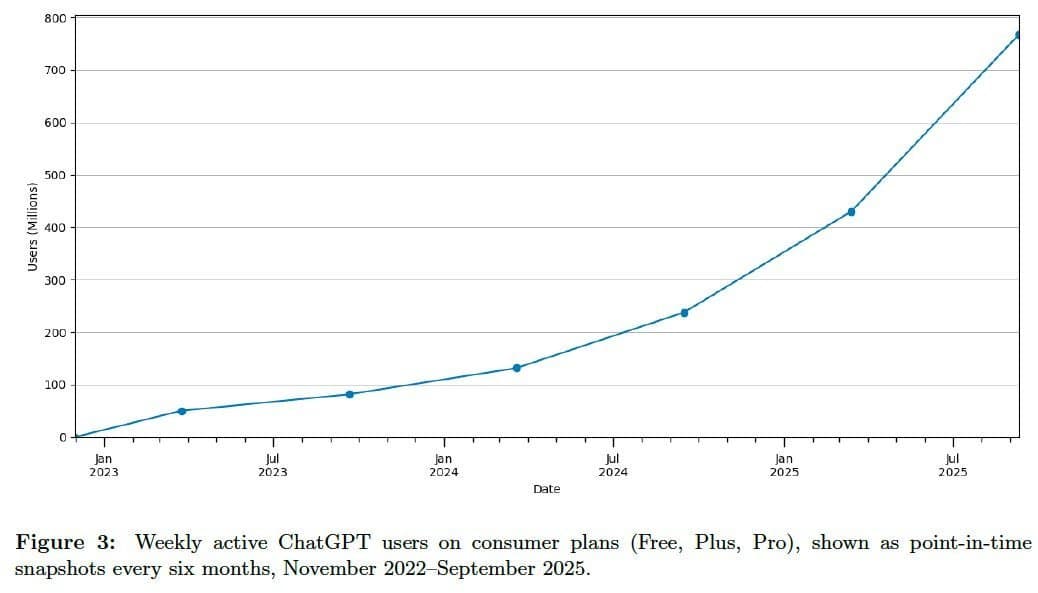
A new NBER paper co-authored by OpenAI researchers reveals ChatGPT has surged to over 750 million weekly active users, with daily messages growing 5.8x in a year. The study shows usage deepening across all demographics, closing gender and income gaps, while pioneering privacy-preserving methods to analyze sensitive data.
In just under three years, ChatGPT has evolved from a niche research preview to a global phenomenon, now engaging over 750 million weekly active users—nearly 10% of the world's population. This staggering growth, documented in a new NBER working paper co-authored by Harvard economist David Deming and OpenAI researchers, underscores how generative AI is rapidly embedding itself into the fabric of daily life. The findings, based on anonymized data from consumer plans (Free, Plus, and Pro), reveal not only explosive adoption but also profound shifts in how and who uses the technology, challenging assumptions about AI's societal impact.
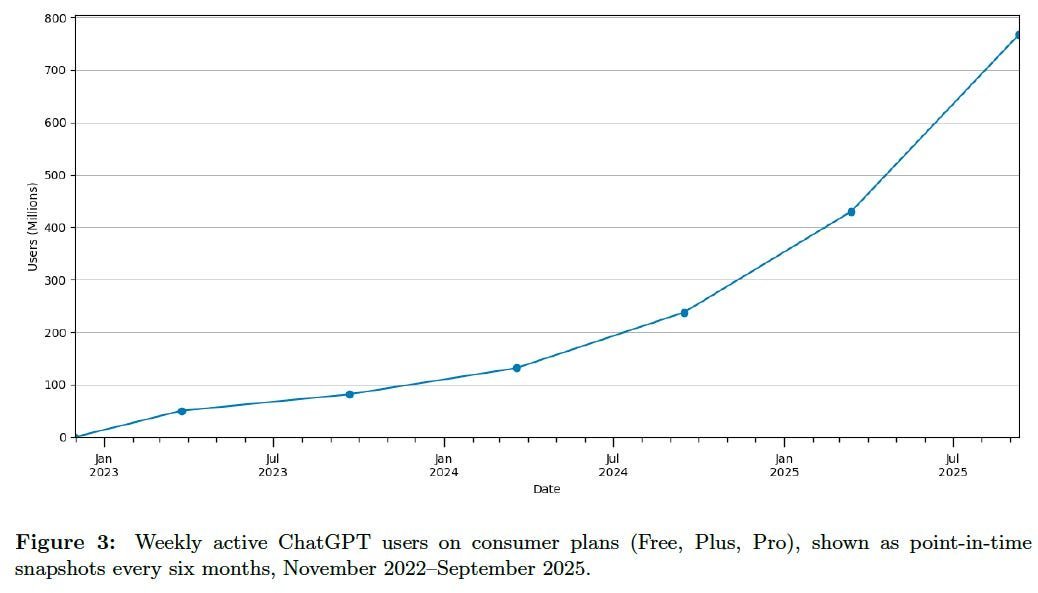 Caption: Graph showing ChatGPT's user growth from 2022 to 2025, reaching 750 million weekly active users. (Source: Deming et al., 2025)
From Novelty to Necessity: Unprecedented Growth Trajectory
Launched in November 2022, ChatGPT hit 1 million users in its first week and has since doubled its user base every 7-8 months. By September 2025, it was processing 2.6 billion messages daily—roughly 30,000 per second—a 5.8x increase from the previous year. To contextualize this velocity, Google Search took eight years to reach 1 billion daily searches after its 1999 debut; ChatGPT achieved that milestone in under two years. If message volume continues growing at this rate, it could match Google's current 14 billion daily searches within a year, signaling a paradigm shift in how humans access information.
Crucially, usage isn't just expanding—it's intensifying. Cohort analysis shows that early adopters (Q1 2023 signups) now send 40% more messages daily than in 2023, while later cohorts (late 2024) have nearly doubled their usage. This pattern, consistent across all groups, suggests ChatGPT's utility has significantly improved, evolving from a curiosity to an indispensable tool. As Deming notes, 'ChatGPT is becoming increasingly integrated into people’s weekly and daily lives,' driven by enhancements in usability and capability that encourage deeper reliance.
Demographic Divides Fade as AI Goes Mainstream
Historically, new technologies exacerbate inequalities, with adoption skewing toward affluent, educated demographics. Early studies, including Deming's prior work, highlighted this with ChatGPT: in 2024, research found women and lower-income users lagged significantly. But the new data reveals a dramatic reversal. Gender parity has been achieved—52% of weekly active users now have typically female names, up from an 80% male skew at launch.
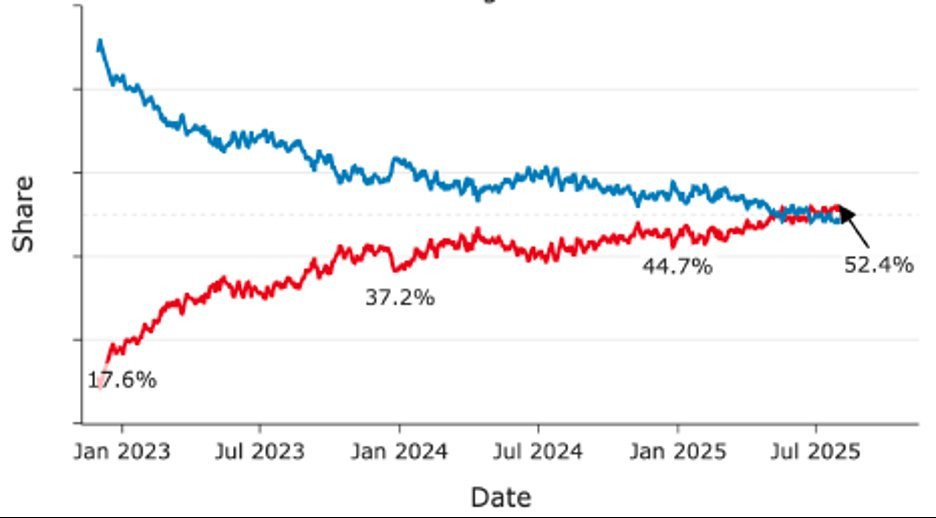 Caption: Visualization of narrowing demographic gaps in ChatGPT usage across gender and GDP per capita. (Source: Deming et al., 2025)
Geographic disparities are also dissolving. Middle-income countries like Brazil and South Korea now show usage rates comparable to high-income nations like the U.S., with 5-6x growth in adoption versus 3x in the wealthiest deciles. This leveling effect, observed across internet-connected populations, indicates that generative AI's accessibility is broadening, potentially democratizing its benefits. Deming reflects, 'I have updated my priors substantially on whether AI will be an equalizing force,' highlighting how rapid inclusivity could reshape economic and social landscapes.
Privacy by Design: A Blueprint for Ethical AI Research
Analyzing sensitive user data without compromising privacy posed a major challenge. The team employed stringent methods: personally identifiable information (PII) was automatically stripped using OpenAI's Privacy Filter, and all analyses occurred in a Data Clean Room (DCR). Here, automated classifiers—trained on the public WildChat dataset—categorized messages by intent (e.g., work, tutoring, or shopping) without human access to raw content. Demographic insights were inferred indirectly, such as through gender-associated name databases, ensuring anonymity.
While these constraints limited granular analysis (e.g., studying how ChatGPT complements expertise), they set a 'new precedent' for ethical AI research. Deming emphasizes, 'As a heavy user of AI myself, I would be comfortable allowing my own message history to be analyzed using our privacy-preserving methods.' This approach balances innovation with user trust, offering a model for future studies in sensitive domains.
The Silent Integration: What Pervasive AI Means for Humanity
The paper's most compelling insight is ChatGPT's silent normalization—no longer a tool for early adopters but a ubiquitous assistant woven into routines worldwide. With usage deepening and gaps closing, generative AI appears poised to enhance productivity and access universally. Yet, as Deming hints in his upcoming analysis, questions linger: Will this ubiquity amplify AI's benefits equitably, or could it introduce new divides? For now, the data paints a hopeful picture of technology that adapts to humanity, not the reverse. As one billion messages pulse through servers every second, ChatGPT's story is no longer about growth; it's about evolution into an unseen, essential layer of human endeavor.
Source: David Deming et al., 'How People Use ChatGPT', NBER Working Paper, September 2025. Data sourced from anonymized ChatGPT consumer interactions with privacy safeguards.
Comments
Please log in or register to join the discussion