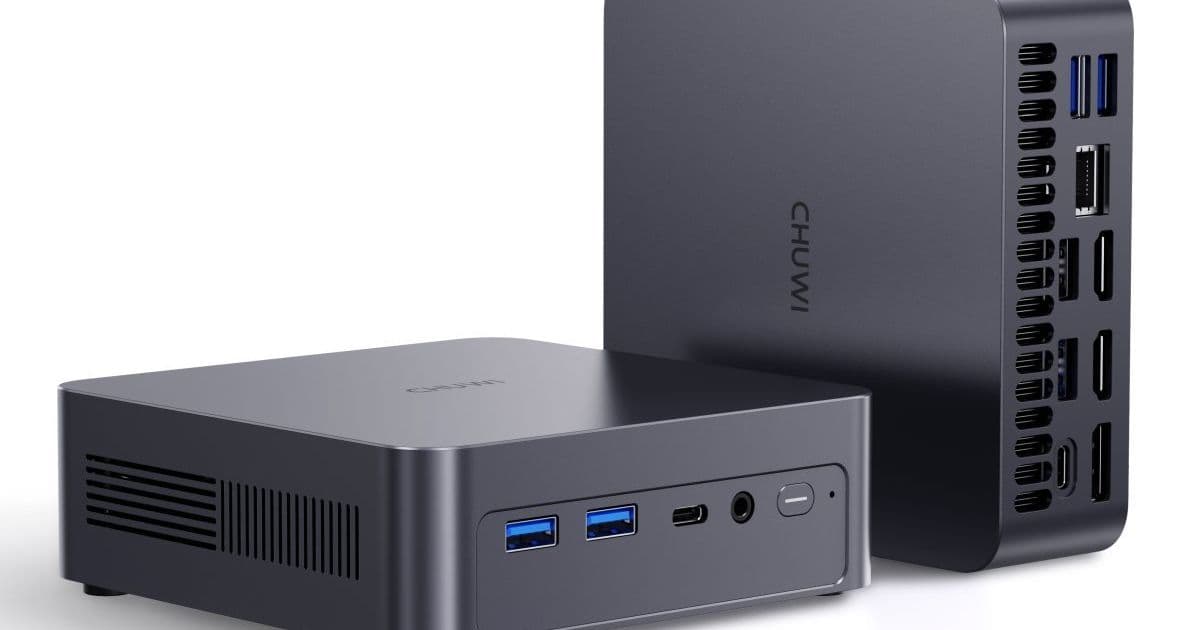
Chuwi's new AuBox X1 mini PC packs Intel's Core Ultra 5 226V processor with 97 TOPS AI performance, making it a compelling alternative to Mac Minis for AI workloads.
At a time when folks are allegedly scrambling to buy Mac Minis to set up as personal AI assistants (for better or worse), some other PC makers are pointing out that you don't need a Mac if you're looking for a small, affordable computer with supported for hardware-accelerated AI.
In fact, over the past few years Intel, AMD, and Qualcomm have all pushed out PC chips with integrated NPUs. And you don't even need to buy systems with the latest chips to get a powerful NPU. Case in point: the Chuwi AuBox X1 is a mini PC with an Intel Core Ultra 5 226V processor that delivers up to 97 TOPS of on-device AI processing performance.
Intel's Lunar Lake chips were first introduced in late 2024 as low-power mobile chips with high-performance NPUs and GPUs. The Core Ultra 5 226V is a mid-range chip with features that include:
- CPU: 4 x Performance cores @ 2.1 GHz ~ 4.5 GHz, 4 x Low Power Efficient cores @ 2.1 GHz ~ 3.5 GHz
- GPU: Intel Arc 130V with 7 Xe2 cores, 400 ~1.85 GHz, 53 TOPS Int8 AI performance
- NPU: Intel AI Boost with 40 TOPS Int8 AI performance
- TDP: 17W Processor Base Power, 37W Maximum Turbo Power, 8W Minimum Assured Power
The AI capabilities of AuBox X1 are a key selling point, but that iGPU could also make this a decent device for casual gaming – it won't be powerful enough for AAA games at 4K resolution, but should allow you to play less demanding titles without a discrete GPU. And if you do want discrete graphics, the mini PC does have a USB4 Type-C port with support for 40 Gbps data transfer speeds, allowing you to connect an external graphics dock.
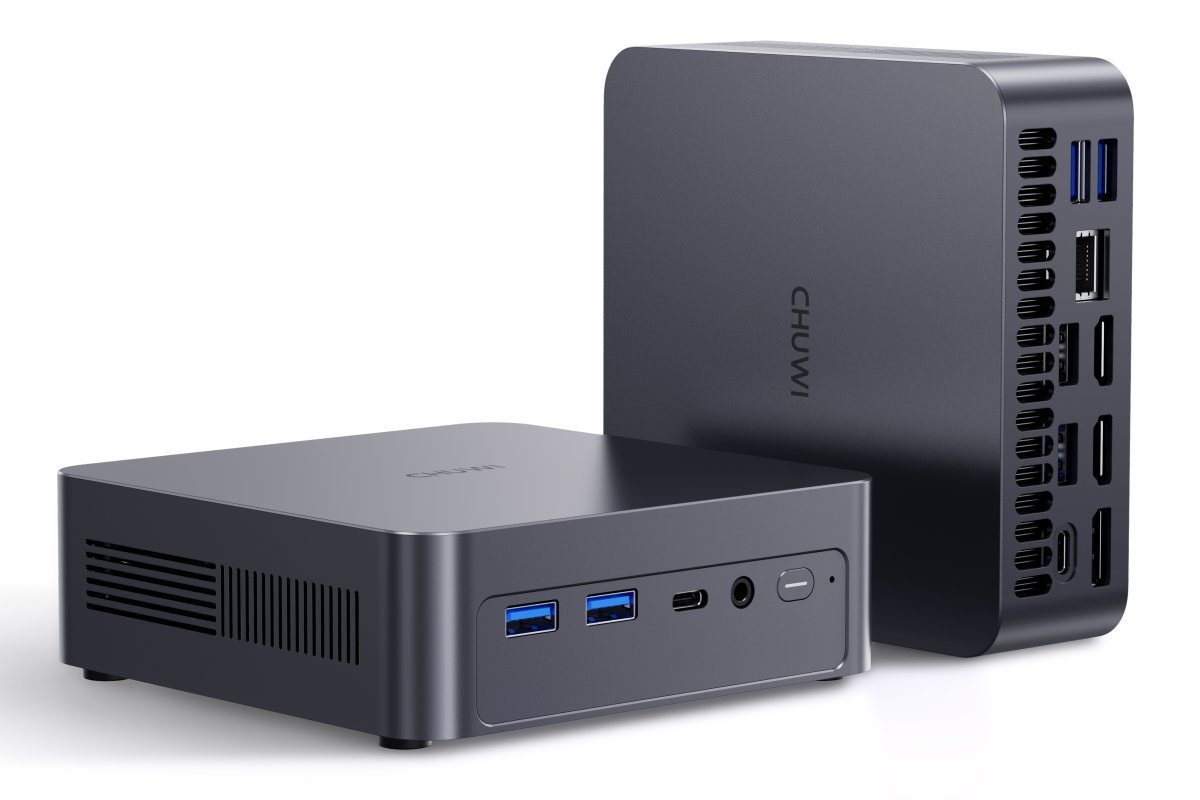
The mini PC measures 128.4 x 128.4 x 40.5mm (5.1" x 5.1" x 1.6") and features a comprehensive set of ports:
- 1 x USB4 (40 Gbps)
- 1 x USB 3.2 Gen 2 Type-A (10 Gbps)
- 4 x USB 3.2 Gen 1 Type-A (5 Gbps)
- 1 x USB 2.0 Type-A (480 Mbps)
- 1 x HDMI 2.1 FRL
- 1 x HDMI 2.1 TMDS
- 1 x DisplayPort 1.4
- 1 x 3.5mm audio
- 1 x 2.5 GbE LAN
- 1 x USB Type-C (for charging)
The system comes with a 100W USB Type-C power adapter and supports up to three 4K displays (the HDMI 2.1 FRL port can also theoretically handle 8K/60Hz output).
Since Intel Lunar Lake processors feature on-chip memory, the system's 16GB of LPDDR5x-8533 memory is not user upgradeable. But the 512GB PCIe 3.0 SSD that comes included can be removed and replaced. The system has two M.2 2280 slots, one with support for PCIe 5.0 x4 while the other tops out at PCIe 4.0 x2.
Chuwi says the AuBox X1 will be available for purchase in late March for around $600 to $700 and that the mini PC will ship with Windows 11 Pro pre-installed.
The AuBox X1 represents an interesting entry in the growing market of AI-capable mini PCs. With its 97 TOPS total AI performance (53 TOPS from the GPU plus 40 TOPS from the NPU), it significantly outperforms many competing systems in the same price range. For comparison, Apple's M4 Mac Mini delivers around 38 TOPS of AI performance, while many current Windows laptops with Qualcomm Snapdragon X Elite chips offer around 45 TOPS.
This positions the AuBox X1 as a particularly attractive option for developers and enthusiasts looking to experiment with local AI workloads without breaking the bank. The combination of a capable NPU, decent integrated graphics, and a full range of ports makes it versatile enough for everything from AI development to light gaming to serving as a home media center.
The timing is also notable, as Microsoft's Copilot+ PC initiative has created renewed interest in AI-capable hardware. While the AuBox X1 isn't technically a Copilot+ PC (which requires specific hardware configurations), its AI performance exceeds many certified systems, making it a compelling alternative for users who want AI capabilities without the premium pricing often associated with Copilot+ branding.
For developers working on AI applications, the AuBox X1 offers a cost-effective platform for testing and deployment. The 16GB of LPDDR5x memory should be sufficient for many AI workloads, while the option to expand storage provides flexibility for larger models and datasets.
The inclusion of both USB4 and 2.5 GbE networking also makes the AuBox X1 well-suited for use as a home server or development workstation, particularly for applications that benefit from fast local storage and network connectivity.
At $600-700, the AuBox X1 sits in an interesting price bracket – more expensive than basic mini PCs but significantly cheaper than premium AI-focused systems. Whether it represents good value will depend largely on how users leverage its AI capabilities, but for those specifically looking for an affordable entry point into local AI computing, it's certainly worth considering.
Comments
Please log in or register to join the discussion