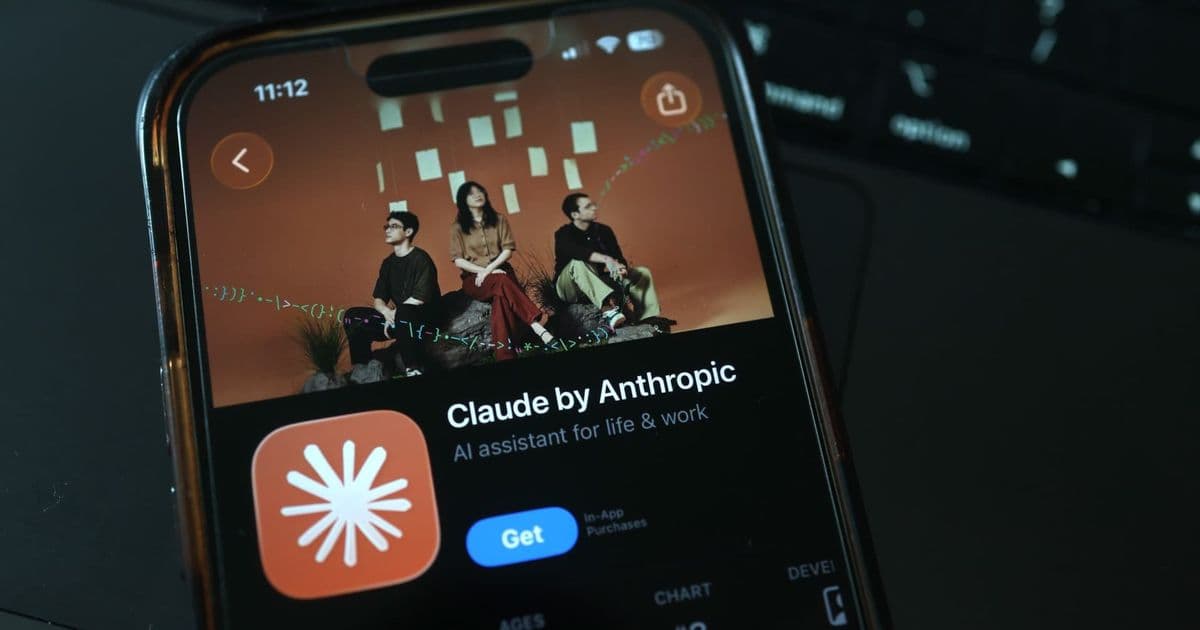
Anthropic's Claude AI assistant jumped to #2 on Apple's US App Store shortly after the Department of Defense designated the company as a supply chain risk, creating a stark contrast with OpenAI's recent agreement to work with the military.
Claude App Surges to #2 After DOD Designates Anthropic as Supply Chain Risk
Anthropic's Claude artificial intelligence assistant app unexpectedly climbed to the No. 2 position on Apple's chart of top U.S. free apps late on Friday, just hours after the Department of Defense (DOD) designated the company as a supply chain risk. This surge in public interest comes as the company faces increased scrutiny from the Trump administration over its refusal to cooperate with certain military applications.
The Timeline of Events
The sequence of events reveals a complex interplay between government policy and public perception:
Earlier in the week, Secretary of War Pete Hegseth announced the DOD would designate Anthropic as a supply chain risk, effectively barring military contractors from doing business with the company.
On Friday, Anthropic responded by stating it would "challenge any supply chain risk designation in court" and clarified that the designation would only affect contractors' use of Claude on DOD work.
Later that evening, the Claude app jumped to #2 on Apple's US App Store, a significant rise from its position between #20 and #50 for much of February.
This pattern suggests that the controversy may have generated increased public interest in Anthropic's technology, despite—or perhaps because of—the government's actions.
Understanding the DOD Supply Chain Risk Designation
The DOD's supply chain risk designation is a formal classification that indicates a company poses potential security risks to the defense supply chain. Once designated, government contractors are typically prohibited from doing business with the company, effectively cutting it off from a significant portion of the federal market.
In this case, the designation specifically targets Anthropic's refusal to cooperate with certain military applications. According to reports, the dispute escalated after discussions about using Claude during hypothetical nuclear missile attacks broke down between Anthropic and Pentagon officials.
Anthropic has maintained that some AI uses could clash with American values as the technology's potential gets "ahead of the law." CEO Dario Amodei stated, "We are patriotic Americans," while suggesting that the company has ethical boundaries regarding how its technology might be deployed.
Contrasting Approaches: Anthropic vs. OpenAI
The situation highlights a fundamental divergence in approach between leading AI companies regarding military partnerships:
While Anthropic has taken a confrontational stance with the DOD, OpenAI has pursued a cooperative relationship. Sam Altman announced that OpenAI had reached an agreement with the Department of War to deploy its models in their classified network. According to sources, the DOD is willing to let OpenAI build its own "safety stack" and won't force the company to comply if its model refuses a task.
This contrast extends to the commercial realm as well. Amazon has reportedly agreed to invest $15 billion in OpenAI initially, with an additional $35 billion if certain conditions are met. In return, OpenAI commits to consuming approximately 2 GW of Trainium capacity through AWS.
Market Response and User Reactions
The public's response to the controversy appears to have been positive for Anthropic from a consumer perspective. The surge of Claude to #2 on Apple's App Store suggests that the controversy may have generated sympathy and curiosity among potential users.
This phenomenon isn't entirely unprecedented. When companies face government scrutiny, public interest often increases as people seek to understand what the controversy is about. In Anthropic's case, the combination of the DOD designation, Anthropic's public stance, and the technical nature of the AI product appears to have created perfect conditions for increased public engagement.
Broader Implications for the AI Industry
The standoff between Anthropic and the Pentagon raises critical questions for other US military partners like Nvidia, Google, Amazon, and Palantir, which work closely with Anthropic. The situation could signal a fundamental shift in the balance of power between Washington DC and the AI industry.
Several coalitions of workers, including employees from Amazon, Google, Microsoft, and OpenAI, have reportedly asked their companies to join Anthropic in refusing DOD demands. This suggests growing internal resistance within tech companies to certain types of military applications of AI.
The Technical and Ethical Dimensions
At its core, this controversy touches on fundamental questions about AI development and deployment:
- Control and alignment: Who should determine how AI systems are used, and what values should they be aligned with?
- Safety and security: How can AI companies ensure their technology isn't used in ways they consider harmful or unethical?
- Transparency and accountability: What level of oversight should government entities have over AI systems developed by private companies?
Anthropic's position suggests that the company believes it has a right to establish boundaries around how its technology is used, even when dealing with government entities. The DOD's designation, meanwhile, reflects a view that such boundaries are incompatible with national security requirements.
The Legal Battle Ahead
Anthropic has signaled its intention to challenge the DOD's designation in court, setting up a potentially significant legal battle over the scope of government authority over AI companies. The case could establish important precedents for:
- The extent to which the government can restrict private companies from doing business with federal contractors
- The rights of AI companies to establish ethical boundaries around their technology
- The balance between national security concerns and commercial freedom
Conclusion
The surge of Claude to the top of Apple's App Store following the DOD's supply chain risk designation creates a fascinating juxtaposition: increased consumer interest coinciding with increased government scrutiny. This situation highlights the complex and evolving relationship between AI companies and government entities, as well as the varied public reactions to these high-stakes debates.
As Anthropic prepares to challenge the DOD's designation in court, and as other AI companies chart their own courses regarding military partnerships, the industry will continue to grapple with fundamental questions about the appropriate role of AI in national security and the ethical boundaries that should guide its development and deployment.
The contrast between Anthropic's approach and OpenAI's cooperation with the DOD suggests that there is no single consensus within the AI industry about how to navigate these challenges, leaving the path forward uncertain for all parties involved.
Comments
Please log in or register to join the discussion