ClickHouse 25.6 introduces CoalescingMergeTree, a groundbreaking table engine designed to consolidate sparse, incremental updates into compact records during background merges. This innovation dramatically reduces storage overhead and query latency for high-volume IoT telemetry, user profiles, and other state-tracking scenarios without sacrificing data completeness.
Handling sparse, high-velocity data updates—like telemetry from electric vehicles or user profile enrichments—has long challenged engineers. Traditional approaches either drown databases in redundant rows or force inefficient row-by-row updates. Enter CoalescingMergeTree, ClickHouse's newest table engine, which elegantly solves this by physically consolidating sparse records during background operations while preserving data fidelity.
The Sparse Data Dilemma
Consider modern IoT ecosystems: A Tesla might emit fragmented updates—battery levels from the power system, GPS coordinates from navigation, and firmware versions from the software module—each updating independently. Storing every sparse update as separate rows in a standard MergeTree table bloats storage and slows queries, forcing complex argMax() aggregations to reconstruct the latest state:
-- Traditional argMax() for latest state (inefficient at scale)
SELECT
  vin,
  argMax(battery_level, last_update) AS batt,
  argMax(lat, last_update) AS lat
FROM electric_vehicle_state
GROUP BY vin;
This works but becomes prohibitively expensive at trillion-row scales, requiring full scans to resolve the latest non-null values per device.
How CoalescingMergeTree Works
CoalescingMergeTree automates consolidation. When background merges occur, it collapses rows with the same sorting key (e.g., a vehicle’s VIN), retaining only the latest non-null value per column based on insertion order:
CREATE TABLE electric_vehicle_state
(
    vin String,
    battery_level Nullable(UInt8),
    lat Nullable(Float64),
    ...
)
ENGINE = CoalescingMergeTree
ORDER BY vin;  -- Sorting key for consolidation
After inserting sparse updates (e.g., battery level alone, then GPS coordinates), merges produce a single row per vehicle with all fields populated. 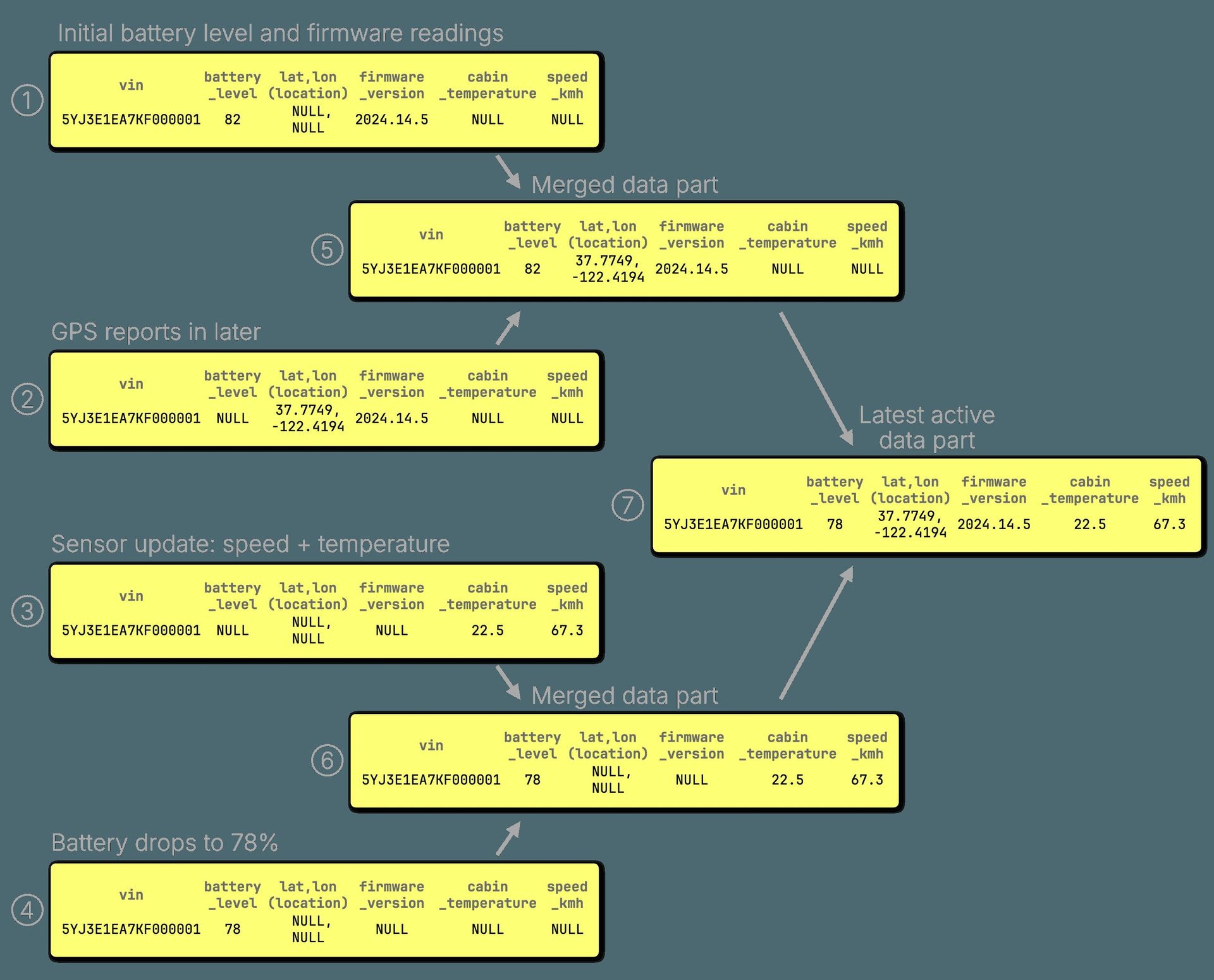
Image: Sparse inserts (battery, GPS, sensors) merge into consolidated rows
Key Advantages
- Radical Storage Reduction: Fewer rows = smaller parts = faster scans.
- Efficient Queries: Use
FINALfor on-demand consolidation or rely on pre-merged data:SELECT * FROM electric_vehicle_state FINAL; -- In-memory merge - Append-Only Ingestion: Avoid update contention—just insert new values. ClickHouse’s lock-free writes handle billions of events/sec.
- Eventual Consistency: Trade immediate durability for ingest speed; merges catch up asynchronously.
Production Pattern: Raw + Coalesced Tables
For resilience, pair CoalescingMergeTree with a raw MergeTree table:
- Raw table: Stores every immutable event for auditing/reprocessing.
- Coalescing table: Materialized view for real-time state queries.
Beyond IoT: Universal Applications
- User Profiles: Gradually enriched attributes (email, location).
- Security Logs: Slowly evolving audit trails with late-arriving context.
- Healthcare: Patient records updated sporadically with lab results or notes.
CoalescingMergeTree isn’t just another engine—it rethinks state management for the age of sparse, high-cardinality data. By shifting consolidation to the background, ClickHouse lets engineers focus on insights, not storage gymnastics.
Source: ClickHouse Blog
Comments
Please log in or register to join the discussion