
Analysis of why coding agents thrive while slide generators stall reveals how adoption difficulty and problem complexity create distinct competitive landscapes where proprietary data becomes the primary defensibility.
The AI landscape presents a paradox: While coding assistants like Cursor achieve remarkable productivity gains, tools for seemingly simpler tasks like slide generation lag behind. According to Vikram Sreekanti and Joseph E. Gonzalez of RunLLM and UC Berkeley, this divergence stems from how adoption models impact data acquisition – the true source of competitive advantage in AI applications.
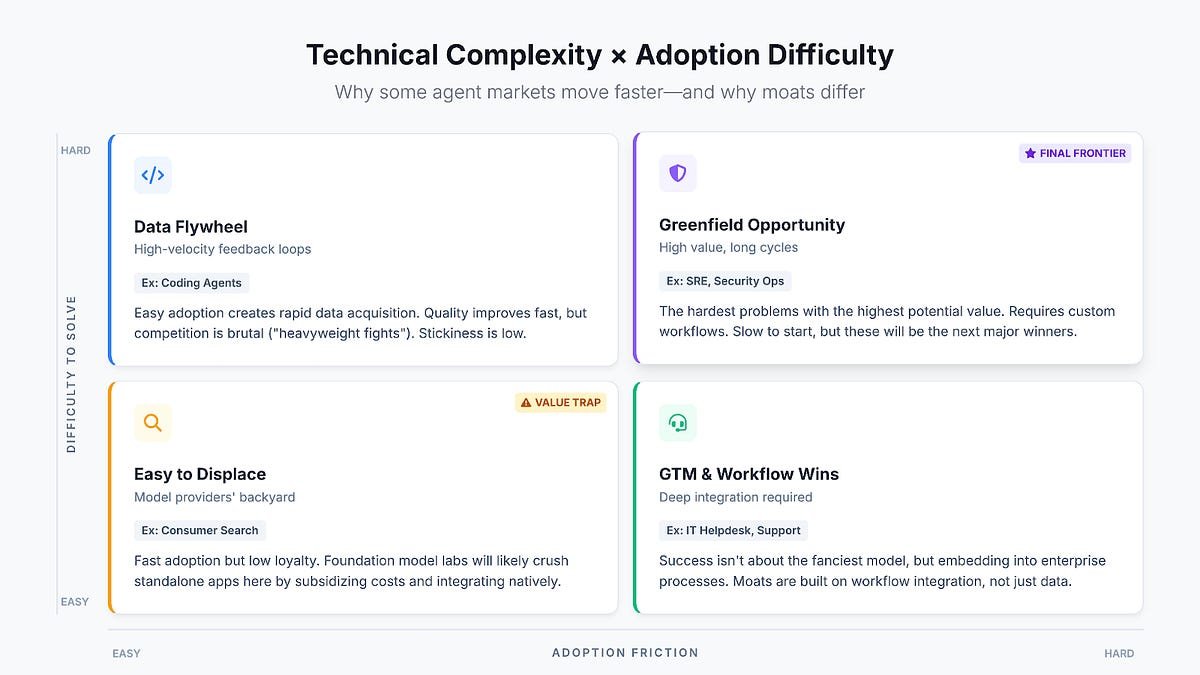
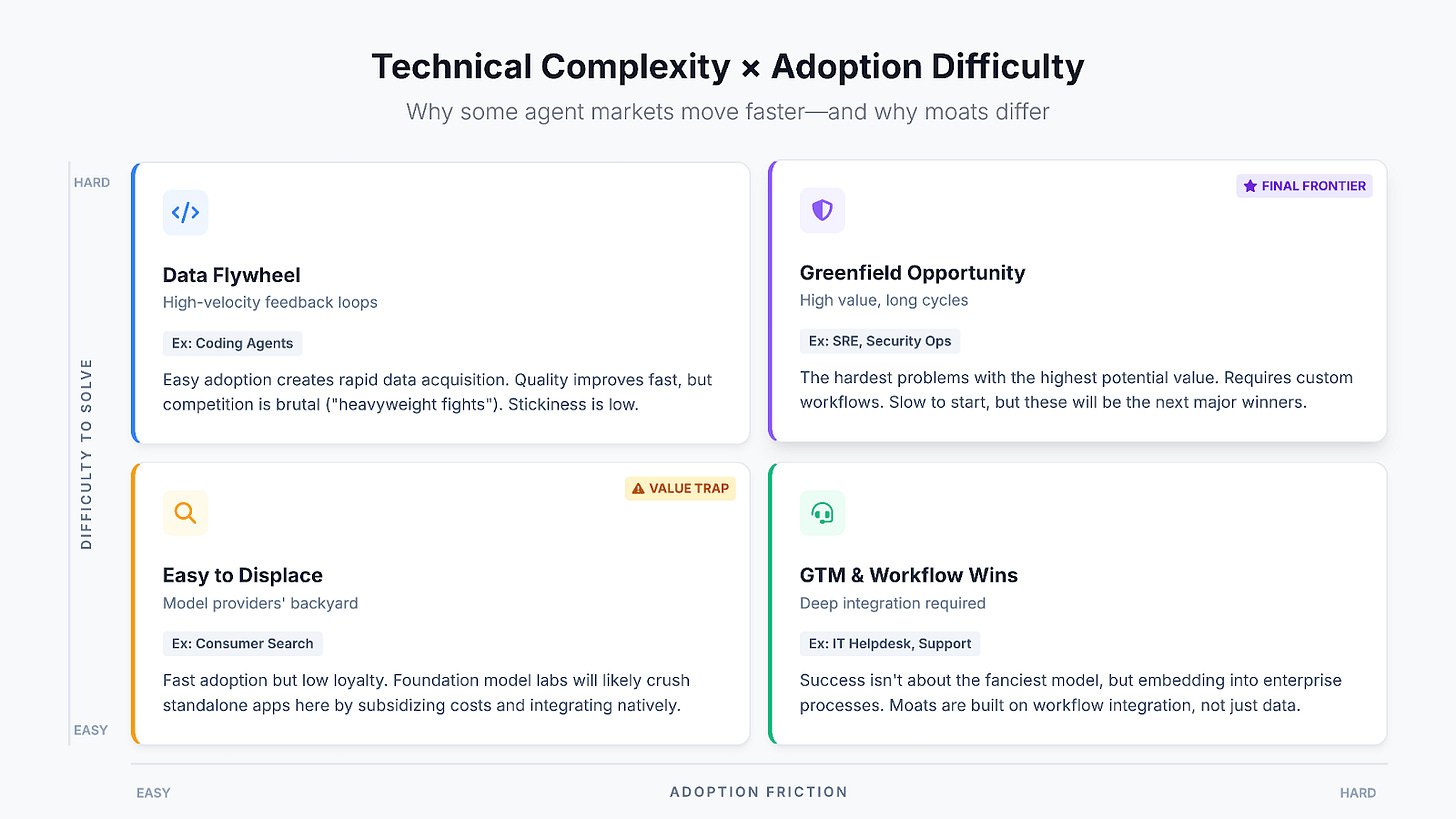
Their framework categorizes applications along two axes: problem complexity (easy vs. hard) and adoption difficulty (easy vs. hard). This creates four distinct quadrants with vastly different dynamics:
1. Easy Adoption, Easy Solutions: The Value Trap
- Examples: General-purpose chatbots, basic search replacements (Perplexity, You.com)
- Why vulnerable: Frontier labs (OpenAI, Anthropic, Google) capture massive user data through default interfaces like ChatGPT. Their scale enables subsidized costs and rapid improvement cycles.
- Reality: Low barriers attract competitors, but model providers' data volume creates an insurmountable gap. Recent ChatGPT Health exemplifies how labs expand vertically into adjacent "easy" domains.
2. Easy Adoption, Hard Solutions: The Flywheel Effect
- Examples: Coding assistants (Cursor, Claude Code)
- Success driver: Engineers adopt tools independently with minimal friction. High-frequency usage (dozens of interactions daily) generates rich, verifiable feedback.
- Data advantage: Every accepted/rejected code suggestion trains better models. Cursor's rapid quality improvements demonstrate this flywheel.
- Risk: Frontier labs aggressively compete here (e.g., GitHub Copilot), forcing specialists toward vertical customization.
3. Hard Adoption, Easy Solutions: Enterprise Stickiness
- Examples: Support ticket resolvers, IT helpdesk bots (Sierra, Decagon)
- Moat source: Enterprise integration complexity creates friction. Once deployed, these tools learn company-specific workflows.
- Trade-off: Data is narrower and often restricted for training, but deepens product stickiness per customer.
- Outlook: Incumbents dominate through sales cycles and integration expertise, though cost competition looms.
4. Hard Adoption, Hard Solutions: The Emerging Frontier
- Examples: SRE automation, security operations
- Current state: Slowest adoption due to workflow complexity and customization needs.
- Potential: Reasoning models now handle multi-step tasks. Future coding agent improvements will ease implementation.
- Moat dynamics: Expertise in specific workflows (e.g., AWS SRE) becomes highly defensible but accumulates slower than coding data.
The Core Principle: Data as Moat
Regardless of quadrant, proprietary data remains the primary defensibility:
- Easy adoption enables volume-driven flywheels
- Hard adoption creates integration depth and switching costs
- Verifiable outcomes (like code correctness) accelerate improvement
Limitations and Future Outlook
- Model plateau: Declining returns from base model improvements shift focus to application-specific data.
- UX innovation: New interfaces (like Claude's browser-based coding) could reshape adoption curves.
- Hard-Hard Growth: Complex operational tools represent the next revenue frontier despite longer sales cycles and implementation hurdles.
The most sustainable AI applications won't rely on transient model advantages but on systematically acquiring irreplaceable workflow data – turning implementation friction into enduring value.
Comments
Please log in or register to join the discussion