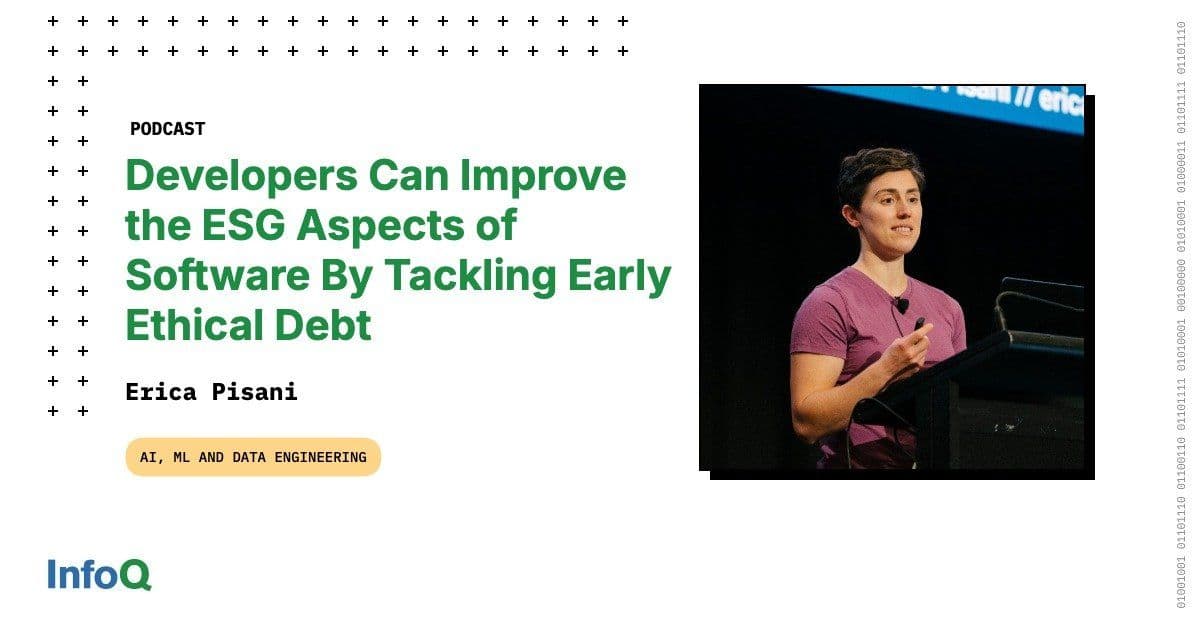
Erica Pisani discusses how developers can improve software's environmental, social, and governance impact through thoughtful architecture choices and early ethical debt prevention.
In a recent InfoQ podcast, Erica Pisani, senior software developer at Float Financial and track host for QCon London 2025's Performance and Sustainability track, shared insights on how developers can improve the ESG (Environmental, Social, and Governance) aspects of software through early ethical debt prevention and thoughtful architectural decisions.
The Intersection of Performance and Sustainability
Pisani emphasized that performance and sustainability are not opposing forces but complementary goals. "I knew right out of the gate that I wanted to try to cover all the different angles you could look at performance and sustainability," she explained. "I tried my best to represent that in the five or six talks that you can get in a given track."
The track featured diverse perspectives, including:
- Leadership-level mindset shifts through Ludi's talk on GreenIT, encouraging organizations to view performance and sustainability as complementary rather than competing priorities.
- AI and model efficiency with Jade's presentation on creating smaller, more performant models that focus on specific outcomes rather than building massive, resource-intensive LLMs.
- Local-first software movement highlighting how offline-first architectures improve user experience in unreliable network scenarios while reducing energy consumption by minimizing data transmission.
- Measurement and metrics with Sarah Hsu discussing the importance of tracking environmental impact to prove progress and guide decision-making.
- Systems-level thinking through Holly's challenge to common practices like indiscriminate data collection, showing how these choices impact both business efficiency and environmental sustainability.
Ethical Debt: The Hidden Cost of Speed
One of the most compelling concepts Pisani introduced was "ethical debt" - the long-term cost of prioritizing speed and growth over socio-environmental responsibility. "It's a little bit like you just want to get something going first, and you'll deal with the consequences later," she explained. "This mindset of growth at all costs results in this accumulation of ethical debt."
This debt manifests in multiple ways:
- Environmental impact from wasteful resource consumption
- Social consequences from poor data practices and compensation models
- Business inefficiency from storing and processing unnecessary data
Practical Steps for Developers
For developers looking to make a difference, Pisani highlighted several actionable approaches:
1. Embrace Local-First Architecture
Local-first software not only improves resilience in unreliable network conditions but also reduces energy consumption by minimizing data transmission. "If you don't have to transmit as much over the wire, that translates to a very beneficial and environmentally sound outcome," Pisani noted.
2. Choose Smaller, Focused AI Models
Rather than defaulting to massive general-purpose models, developers can opt for smaller, domain-specific models that are more efficient and effective. "Smaller models can be very effective and highly performant," Pisani explained. "It may not take as long to think things over before giving an answer if it's trained on high-quality data."
3. Question Assumptions and Measure Impact
"You can't fix what you can't measure," Pisani emphasized, pointing to resources like the Green Software Foundation's free courses through the Linux Foundation. Developers should critically examine assumptions about data collection, processing needs, and infrastructure choices.
4. Consider Edge Computing Strategically
While edge computing can reduce data transmission, Pisani cautioned that its environmental benefits depend on local energy sources. "Depending on what region of the world you're in, the energy that is created in that local area might not be as clean as a data center in Montreal, which is entirely hydroelectric."
The Power of Individual Action
Perhaps most encouragingly, Pisani emphasized that developers don't need managerial approval to make meaningful changes. "There's things that they can do in the design decisions that they make and the choices of vendors that they can potentially make that allow them to help move the needle in the right direction."
She shared her own experience building "My Local Grocer," a community-focused project mapping independent shops in Toronto. "This is very much the definition of a home-cooked piece of software," she said. "There's not going to be a big VC check at the end of something like this, but I knew it was important to me."
Looking Ahead
As Pisani prepares for her role on the QCon London 2026 programming committee, she sees opportunities to integrate sustainability thinking across tracks. "Even though there isn't a performance and sustainability-focused track at QCon, that doesn't mean there aren't people who could be part of those tracks as speakers and incorporate these aspects into them."
Her key message to developers: "Performance and sustainability are not at odds. They actually can be quite complimentary, and there are a lot of resources out there that can help you on that journey."
The conversation underscores a critical shift in software development - from viewing sustainability as an afterthought to recognizing it as an integral part of building better, more resilient systems. As Pisani puts it, "We are at a place right now where software developers, given the role that we play in so many industries, we can't just say it's not our decision to make because we do make a lot of small decisions day in and day out."
By tackling ethical debt early and making conscious architectural choices, developers can create software that performs better, costs less to operate, and contributes to a more sustainable future - proving that doing good and doing well are not mutually exclusive goals.
Comments
Please log in or register to join the discussion