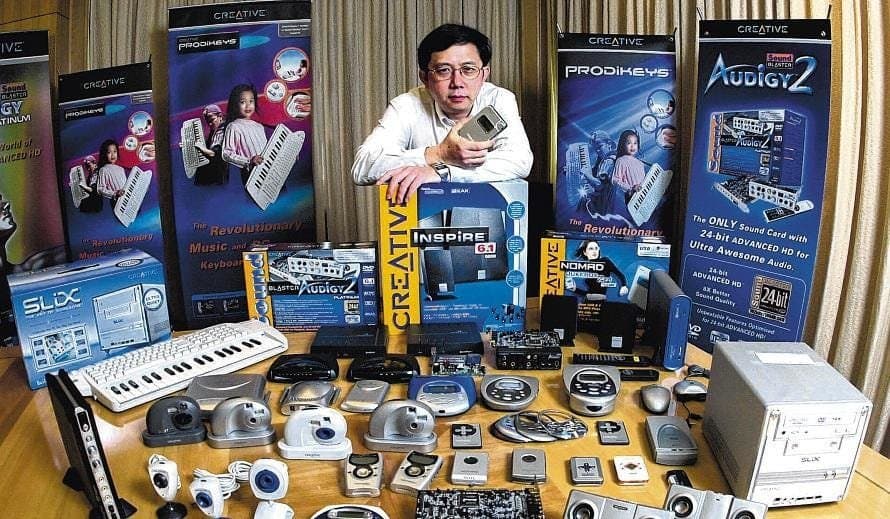
This is the story of Sim Wong Hoo and Creative Technology, the Singaporean company that dominated the PC sound card market with the iconic Sound Blaster, shaping multimedia computing. We explore their rise to prominence, fierce battles with competitors like Aureal, ambitious but faltering diversifications into graphics and MP3 players, and their enduring legacy in the face of industry shifts.
The distinctive startup chime of a Sound Blaster card loading its drivers is etched into the memory of a generation of PC users. Behind that sound lies the remarkable journey of Sim Wong Hoo and Creative Technology, a tale of innovation, market dominance, costly missteps, and enduring legacy in the world of computer audio.
The Hobbyist Roots of a Tech Titan
Sim Wong Hoo, born in Singapore in 1955, grew up in modest circumstances. His early entrepreneurial spirit emerged selling eggs to buy a harmonica, sparking a lifelong passion for music and technology. While studying engineering at Ngee Ann Technical College, Sim's dual interests collided. Frustrated by only hearing his musical arrangements during weekly rehearsals, he envisioned a computer that could instantly play his compositions – planting the seed for his future ambitions. 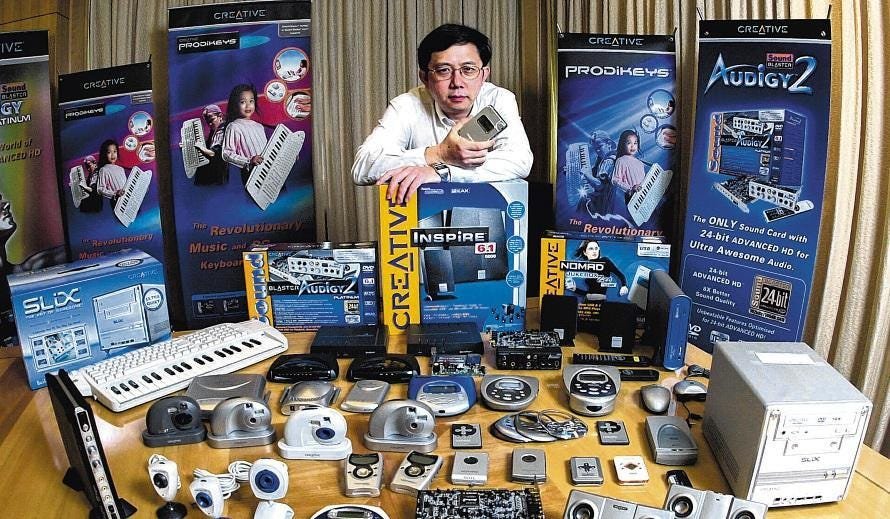
"Sim envisioned a computer that could play music, talk, or even sing, and his earlier entrepreneurial spirit drove him to an ambitious goal: selling 100 million units of a single piece of equipment."
After national service and a brief, disastrous venture where a partner absconded with funds, Sim founded Creative Technology in 1981 in a tiny Singapore shop with childhood friend Ng Kai Wa, using $6000 of his savings. Initially focused on repairs and parts, the struggling business led Sim to develop his own products.
The Path to Sound Dominance: CUBIC, Game Blaster, and the Sound Blaster Breakthrough
Creative's first notable products were ambitious but ill-timed computers:
- CUBIC 99 (1984): An Apple II compatible with a Z80 for CP/M and a pioneering voice synthesizer – the first computer designed and manufactured in Singapore.
- CUBIC CT (1986): An early 'multimedia' PC with graphics and sound capabilities, localized for Chinese. Its failure stemmed from a lack of supporting software and a small target market.
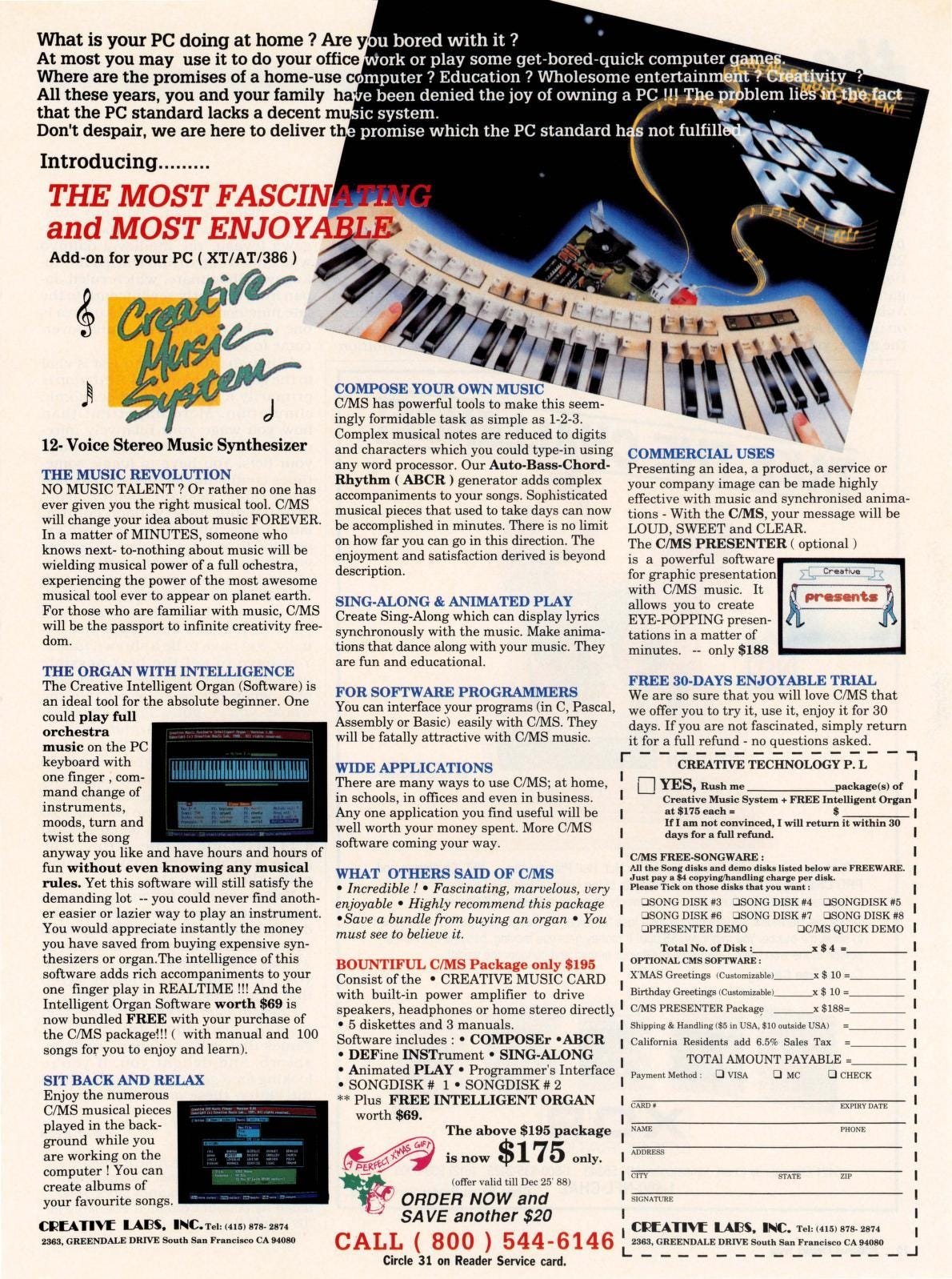
Recognizing the sound component's potential, Sim extracted it, creating the Creative Music System (C/MS). Relocating to California in 1988 to establish Creative Labs, Sim aimed for the massive US PC market. Quickly understanding that games drove sound card adoption, he rebranded the C/MS as the Game Blaster, securing crucial driver support from Sierra Online.
The true breakthrough arrived in 1989 with the Sound Blaster (CT1310). It wasn't just Adlib compatible; it was a quantum leap:
- Digital Sample Playback: Record/playback at up to 22kHz (mono).
- Integrated Game Port: Saved users an ISA slot and $50.
- FM Synthesis (YM3812): AdLib compatibility.
- C/MS Stereo Sound: 12 voices.
- MIDI Interface & Microphone Jack.
The Sound Blaster became the top-selling expansion card of any kind within a year, generating $5.5 million in revenue. Creative followed with the Sound Blaster Pro (1991), introducing stereo FM synthesis (dual YM3812, later YMF262) and crucially, a CD-ROM interface. Bundled in Multimedia Upgrade Kits with drives and software, these kits were instrumental in driving CD-ROM adoption.
Peak and Peril: The SB16, AWE32/64, and the Aureal Threat
The Sound Blaster 16 (CT1740, 1992) solidified Creative's dominance (72% global market share by 1992) with 16-bit, 44.1kHz CD-quality audio and support for the Wave Blaster daughterboard, enabling wavetable synthesis. Creative acquired E-mu Systems (maker of the Wave Blaster tech) in 1993 for $54 million. They went public on NASDAQ (a Singaporean first) and expanded globally.
Product segmentation followed:
- ViBRA 16 (1994): Low-cost, single-chip SB16 for OEMs.
- Sound Blaster AWE32 (1994): High-end card featuring the EMU8000 wavetable synth with 4MB of onboard RAM (expandable to 28MB), hardware MIDI, and text-to-speech.
- Sound Blaster AWE64 (1996): Refined successor with improved signal-to-noise (especially the Gold version), WaveGuide software polyphony, and proprietary RAM upgrades.
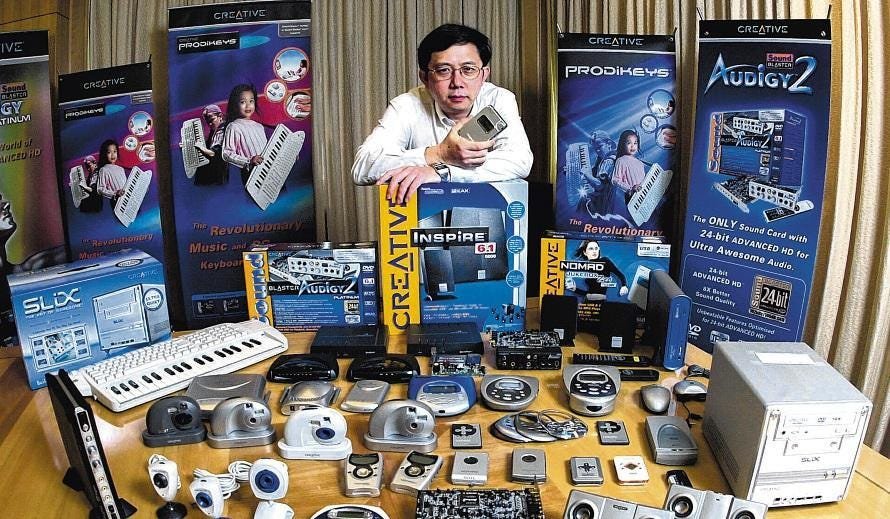
However, a seismic threat emerged in 1997: Aureal Semiconductor's Vortex AU8820 card featuring A3D positional audio. Utilizing tech developed for NASA, A3D offered unparalleled realism in games like Half-Life and Quake II, directly challenging Sound Blaster's gaming supremacy.
Creative's response was swift and aggressive: acquiring Ensoniq in 1998 for $77 million. This brought the Ensoniq AudioPCI into Creative's fold, rebranded as the Sound Blaster PCI 64/128. While cost-effective and SB-compatible via TSR, it lacked audiophile quality. Simultaneously, Creative unleashed a barrage of lawsuits against Aureal. Though Aureal eventually won key rulings, the legal costs drove them into bankruptcy by 2000, allowing Creative to acquire their rival for a mere $32 million.
Diversification Dreams and Reality Checks
Creative's attempts to move beyond sound cards were ambitious but met with mixed success:
- Graphics Cards: The VLB 3D Blaster (CT6200, 1995) with a 3DLabs GLINT chip was technically early but expensive and hamstrung by the 486/VLB platform and lack of games. Later cards using 3dfx Voodoo 2 and Banshee chips (1998) fared better, but 3dfx's shift to in-house manufacturing hurt partners. Creative acquired 3DLabs in 2002, but graphics never became a core revenue stream.
- 3DO Blaster (1994): A $400 ISA card bringing 3DO games to PC. It required significant existing hardware (VGA, SB, CD-ROM) and launched as the 3DO console faltered. It was dead on arrival.
- NOMAD MP3 Players (1999 Onwards): Excellent timing coincided with Napster's rise. The original NOMAD (parallel port) was followed by the improved NOMAD II (USB). The NOMAD Jukebox (2000) was groundbreaking – a 6GB hard drive-based player years before the iPod, though bulky with short battery life. Creative patented the Jukebox/Zen interface and successfully sued Apple in 2006, receiving a $100 million settlement. Despite innovation, Apple captured the market.
- CD-ROM/DVD Drives & Bundles: Initially successful kits (e.g., Components 700 bundle with DVD drive, AWE64, Graphics Blaster, decoder, speakers) were undermined by a market oversupply in 1995, causing a $30 million loss.
- Software: PJS OS, PJ Views, and later HansVision provided Chinese-language productivity tools, finding niche success in Asia.
Legacy and the Shifting Soundscape
The 2000s brought existential challenges. Integrated motherboard audio improved dramatically, becoming "good enough" for most users. The shift to laptops reduced the market for internal expansion cards. Creative voluntarily delisted from NASDAQ in 2007. 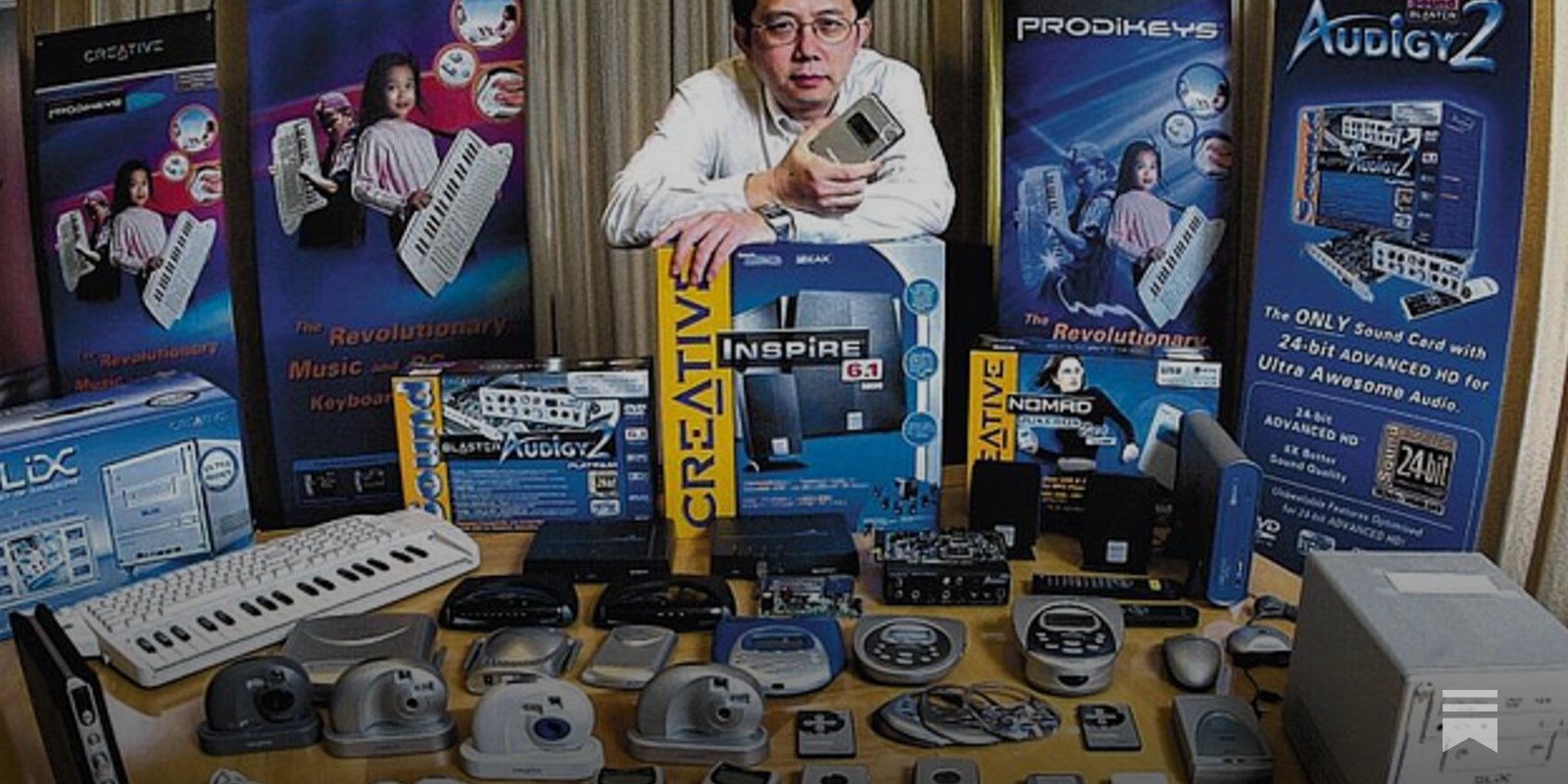
While much smaller today, Creative persists. Their 2024 revenue ($62.8M) is primarily driven by audio products: sound cards (internal/external), DACs, amplifiers, speakers, and headphones. The Sound Blaster brand endures, adapting to external USB and PCIe interfaces.
The story of Creative Technology is a masterclass in capturing a market through technical innovation (digital audio playback, CD-ROM integration) and strategic partnerships (Sierra, Radio Shack), achieving near-total dominance. Yet, it's also a cautionary tale about the perils of over-reliance on a single product category and the difficulty of successful diversification in the face of rapid technological change and formidable competitors. For retro computing enthusiasts, however, the distinctive chirps and bleeps of a Sound Blaster card remain an iconic soundtrack to the dawn of the multimedia PC era, a testament to Sim Wong Hoo's vision from a Singaporean garage.
Comments
Please log in or register to join the discussion