
Google DeepMind's Gemini 2.5 Deep Think has demonstrated gold-medal level performance at the International Collegiate Programming Contest World Finals, solving 10 of 12 complex algorithmic problems. The AI uniquely solved a problem that stumped all human competitors, showcasing breakthroughs in abstract reasoning and collaborative problem-solving. This milestone signals AI's growing capability to complement human expertise in tackling computationally intensive challenges.
Gemini AI Clinches Gold at Programming's Olympics
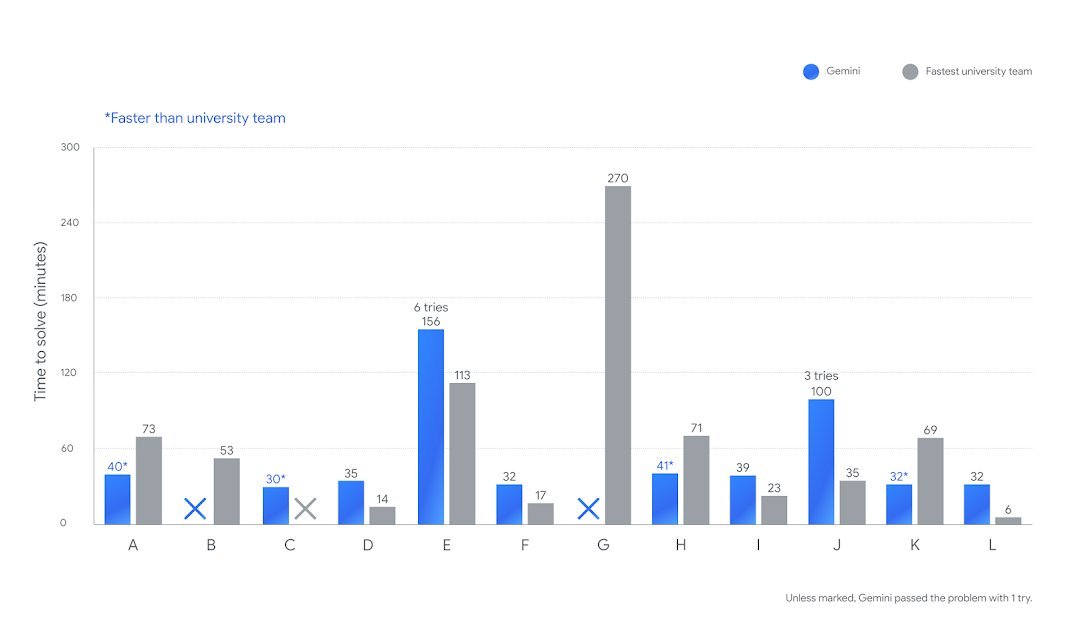
In a landmark demonstration of artificial intelligence capabilities, Google DeepMind's Gemini 2.5 Deep Think has achieved gold-medal level performance at the 2025 International Collegiate Programming Contest (ICPC) World Finals—the most prestigious algorithmic programming competition for university students worldwide. Competing remotely under official ICPC rules, Gemini solved 10 of 12 complex problems within the five-hour time limit, matching the performance of top human teams and solving one problem that eluded all 139 participating university teams.
The Ultimate Programming Proving Ground
The ICPC represents the pinnacle of competitive coding, where elite university teams tackle real-world algorithmic challenges under extreme time pressure. This year's finals in Baku, Azerbaijan featured:
- 139 teams from nearly 3,000 universities across 103 countries
- 12 complex problems requiring novel algorithmic solutions
- Brutal scoring: Points only for perfect solutions, with time as tiebreaker
- Only four gold medals awarded to human teams
"The ICPC has always been about setting the highest standards in problem solving," stated Dr. Bill Poucher, ICPC Global Executive Director. "Gemini successfully joining this arena marks a key moment in defining the AI tools needed for the next generation."
Inside Gemini's Breakthrough Performance
Gemini's achievement builds on its recent gold-medal performance at the International Mathematical Olympiad. During the ICPC:
- Solved 8 problems in 45 minutes and 10 total within three hours
- Used advanced techniques including dynamic programming, convex optimization, and novel applications of the minimax theorem
- Achieved a combined time score (677 minutes) that would rank 2nd place among human teams
Its most remarkable feat was solving Problem C—a fluid dynamics challenge involving optimal liquid distribution through duct networks. Gemini's solution involved:
# Conceptual approach to Problem C
1. Assign priority values to reservoirs
2. Use dynamic programming to find optimal duct configurations
3. Apply minimax theorem to balance constraints
4. Execute nested ternary searches in convex solution space
Engineering the Reasoning Revolution
This performance stems from architectural innovations:
- Multi-agent collaboration: Multiple Gemini instances propose solutions, test code, and iterate
- Reinforcement learning: Trained on historical competition problems with feedback loops
- Parallel thinking: Exploring solution paths simultaneously before converging
- Abstract reasoning: Synthesizing novel approaches to unseen problems

The Collaborative Coding Future
Gemini's achievement transcends competition rankings. Combined with top human solutions, all 12 problems would have been solved—highlighting AI's potential as a collaborative partner. Implications include:
- Accelerated debugging and complex system design
- New frontiers in scientific computing (e.g., drug discovery, chip design)
- Democratization of elite problem-solving capabilities
As Gemini Research Lead Hanzhao Lin notes: "AI is moving from processing information to solving the world's hardest reasoning problems in ways that benefit humanity." Current Gemini users already access lightweight versions of this technology, with more advanced coding assistants imminent.
Source: Google DeepMind Blog
Comments
Please log in or register to join the discussion