Comprehensive benchmark comparison between Windows 11 and Ubuntu Linux on Intel's new Panther Lake Core Ultra X7 358H, revealing surprising performance parity and insights into power management profiles.
Intel's new Panther Lake architecture has arrived, and with it comes the inevitable question: how does Linux performance stack up against Windows 11 on this cutting-edge mobile platform? I've been putting the Core Ultra X7 358H through its paces on an MSI Prestige 14 Flip AI laptop, and the results might surprise you.
Testing Setup and Methodology
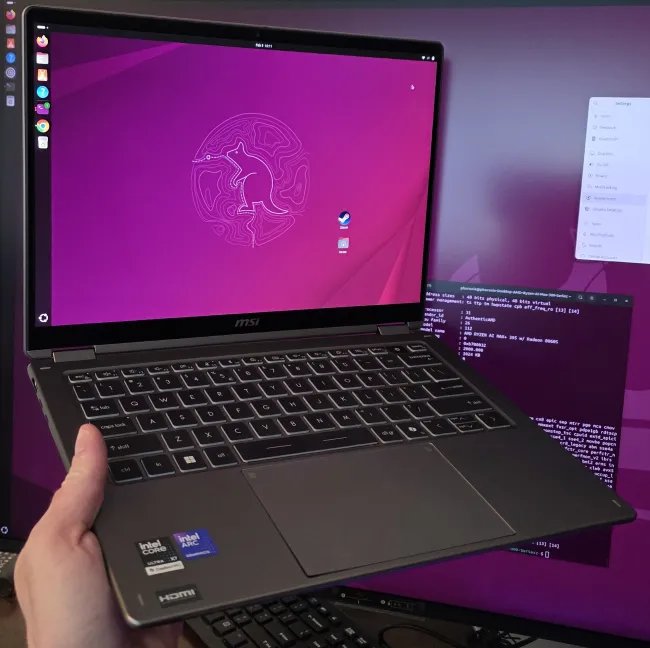
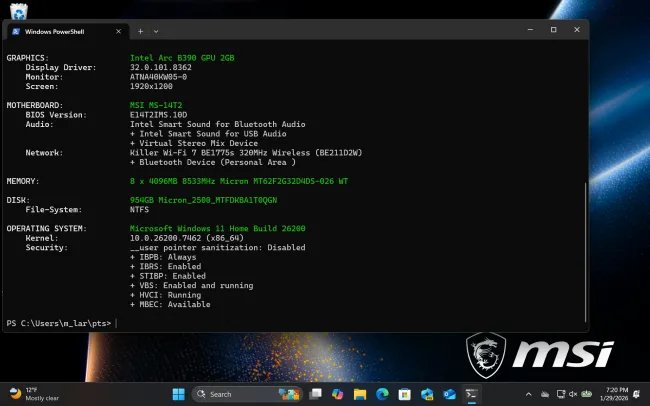
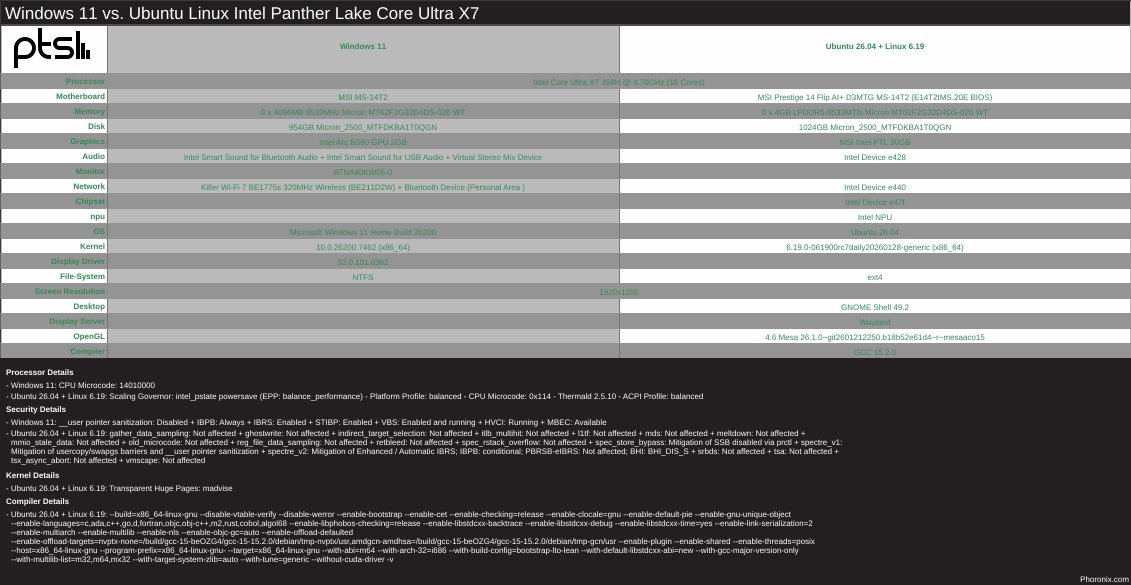
The comparison was conducted on identical hardware: an MSI Prestige 14 Flip AI D3MTG MS-14T2 featuring the Core Ultra X7 358H with its 16-core configuration (4P+4E+8LPE), 32GB LPDDR5-8533 memory, 1TB Micron 2500 NVMe SSD, and Arc B390 integrated graphics. Both operating systems were tested with their default balanced power profiles, ensuring a fair comparison between the out-of-box experiences.
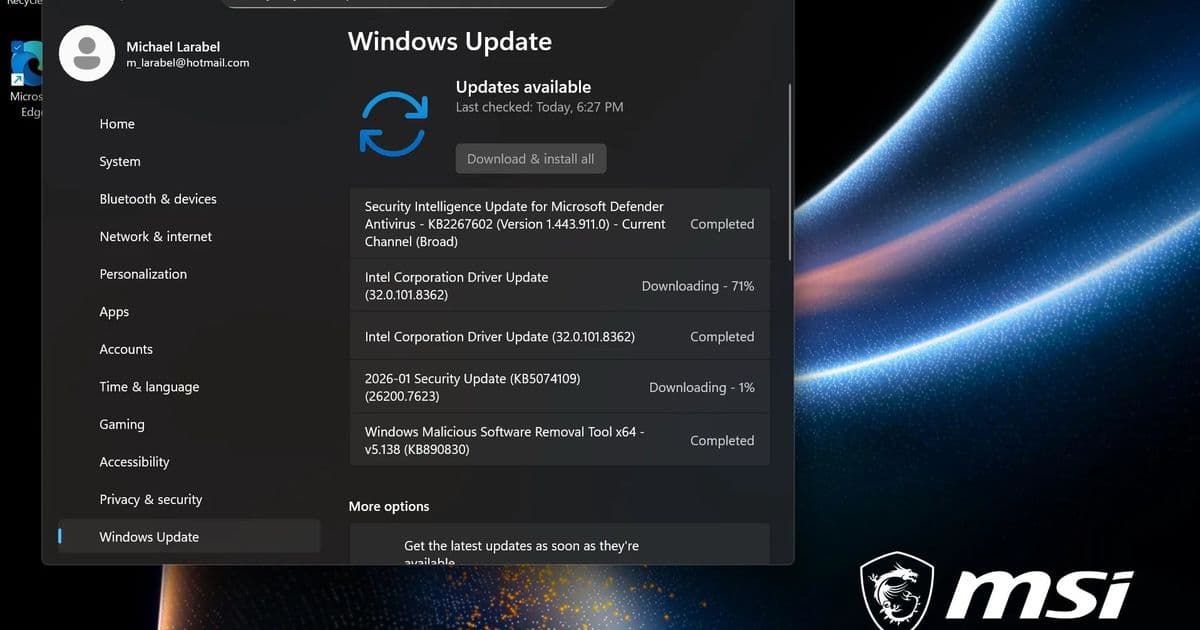
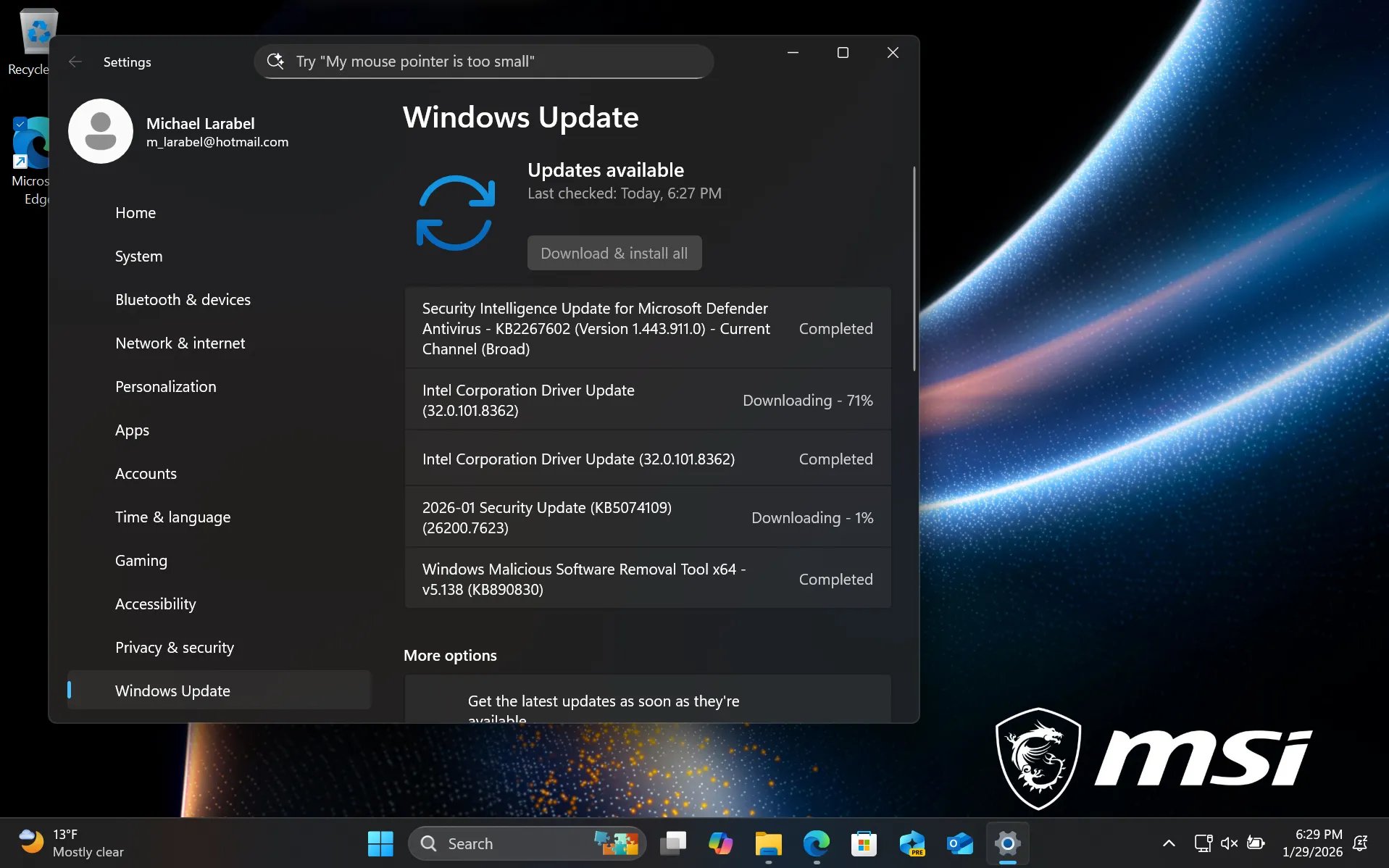
Windows 11 Home was tested with all available updates as of launch week, while Ubuntu 26.04 (in its current development state) ran with the Linux 6.19 kernel and Mesa 26.1-devel graphics drivers. This represents a leading-edge look at Panther Lake performance on Linux just past launch.
The Power Profile Surprise
Here's an interesting wrinkle: after completing the Windows testing and wiping the partition, I discovered that MSI's balanced profile on this laptop sets power limits significantly lower than Intel recommends for this class of device. This means both Windows and Linux were running with conservative power management, which likely impacted performance across the board. However, this creates a perfect 1:1 comparison since both operating systems used identical power profiles.
Performance Findings
The benchmark suite covered a wide range of workloads, from CPU-intensive tasks to graphics performance with the Arc B390. What emerged was a picture of remarkable parity between the two operating systems, with neither platform showing a clear, consistent advantage across all tests.
CPU Performance
For multi-threaded workloads that can effectively utilize the heterogeneous core configuration (P-cores for performance, E-cores for efficiency, and LPE-cores for light tasks), both Windows and Linux performed admirably. The scheduler optimizations in Linux 6.19 appear to handle the complex core topology well, with no significant regressions compared to Windows.
Single-threaded performance showed similar results, with both platforms delivering comparable IPC and clock speeds under the balanced profile constraints. This suggests that Intel's scheduler optimizations in Windows 11 and the Linux scheduler improvements are roughly equivalent for Panther Lake's unique architecture.
Graphics Performance
The Arc B390 integrated graphics saw competitive performance on both platforms. Mesa 26.1-devel drivers showed good maturity for a launch-period Linux driver stack, with performance often matching or coming within a few percentage points of Windows 11's DirectX implementations.
Gaming benchmarks and graphics API tests revealed that while Windows maintains a slight edge in some DirectX-heavy workloads, Linux's Vulkan and OpenGL performance was remarkably competitive, especially considering this is still pre-release driver code.
Power Efficiency
One area where Linux showed potential advantages was in power efficiency. The kernel's ability to schedule workloads more intelligently across the diverse core types sometimes resulted in lower power consumption for equivalent performance, though this varied significantly by workload type.
Real-World Implications
For users considering a Panther Lake laptop and wondering about Linux compatibility, these results are encouraging. The platform appears mature enough at launch that Linux users won't face significant performance penalties compared to Windows users.
The balanced power profile limitation actually makes these results more interesting - if anything, they understate the potential performance gap that might exist when running at full power. Users who switch to performance profiles or tweak power settings may see different results.
Looking Ahead
As Ubuntu 26.04 moves toward its final release and Mesa drivers continue to mature, we can expect Linux performance to improve further. The current results suggest that Intel's investment in Linux support for Panther Lake is paying off, with the platform feeling polished and performant from day one.
For Linux enthusiasts and professionals who rely on the platform, Panther Lake appears to be a win-win: cutting-edge performance and efficiency whether you choose Windows 11 or Ubuntu Linux.
Comments
Please log in or register to join the discussion