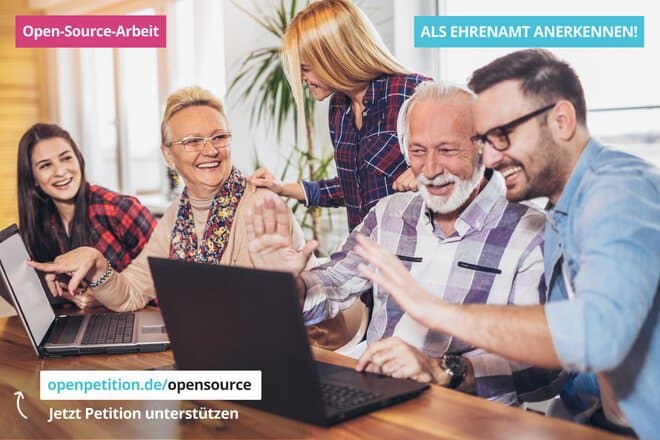
A petition launched in Germany seeks to grant open-source contributors the same legal status and tax benefits as traditional volunteers, arguing that unpaid software development is essential infrastructure work.
A new petition in Germany is calling for open-source software development to be legally recognized as volunteer work for the common good, arguing that thousands of unpaid contributors maintain critical digital infrastructure without receiving the same benefits as traditional volunteers.
The Digital Infrastructure Crisis
Open-source software forms the backbone of modern digital systems, from internet protocols and security libraries to healthcare IT and AI frameworks. Yet the thousands of volunteers who maintain this infrastructure receive no formal recognition or benefits, creating what the petition describes as a dangerous imbalance between societal dependence and legal status.
The petition, launched by Henning Lammert on November 27, 2025, has already gathered over 8,800 signatures toward a 30,000-signature quorum. It targets the German Bundestag and Petition Committee, arguing that open-source contributions deserve equal legal standing with traditional volunteer work like youth programs, ambulance services, and charitable associations.
Why Recognition Matters
Contributors to open-source projects spend countless hours developing, maintaining, and documenting software that powers everything from government systems to critical security infrastructure. The petition emphasizes that this work is fundamentally voluntary and unpaid, yet carries enormous responsibility for public safety and digital sovereignty.
Recent security vulnerabilities like "Heartbleed" and "Log4Shell" have demonstrated how dependent society has become on these volunteer maintainers. When critical security flaws emerge in widely-used open-source libraries, it's often unpaid developers who must respond quickly to protect millions of users.
The Legal and Financial Implications
Formal recognition as volunteer work would unlock several important benefits for open-source contributors:
- Tax-exempt compensation through existing volunteer payment schemes (Ehrenamtspauschale/Übungsleiterpauschale)
- Easier access to non-profit status under §52 AO for open-source projects serving the public good
- Better liability protection similar to §31a BGB for association board members
- Ability to legally reimburse expenses and issue donation receipts
These changes would create much-needed transparency and sustainability in digital volunteer work, allowing projects to operate more professionally while maintaining their volunteer-driven nature.
International Competition and Digital Sovereignty
Germany risks falling behind other nations that already provide institutional support for open-source contributors. The petition points out that while the German government invests billions in digital transformation, it ignores the volunteer developers who maintain the technological foundation upon which these investments depend.
Other countries have already implemented tax benefits and institutional recognition for software development serving the public good. Without similar measures, Germany may struggle to compete in the global digital economy while relying on an increasingly strained volunteer workforce.
The Technical Reality
Open-source contribution requires high technical competence, with volunteer developers performing work that companies would otherwise need to purchase at premium rates. This creates an unusual situation where the state benefits from sophisticated technical labor without providing the support structures typically available to other forms of volunteer work.
The petition argues that recognizing open-source development as volunteering would be a cost-efficient way to strengthen Germany's digital sovereignty while supporting the skilled professionals who maintain critical infrastructure.
Next Steps
The petition remains open for signatures until May 23, 2026, with over three months remaining to reach the 30,000-signature threshold required for formal parliamentary consideration. Supporters can sign online or download paper collection sheets to gather signatures in their communities.
As digital infrastructure becomes increasingly critical to every aspect of modern life, the question of how to support those who maintain it without compensation becomes more urgent. This petition represents an attempt to align Germany's legal framework with the reality of how digital infrastructure actually functions in the 21st century.
Comments
Please log in or register to join the discussion