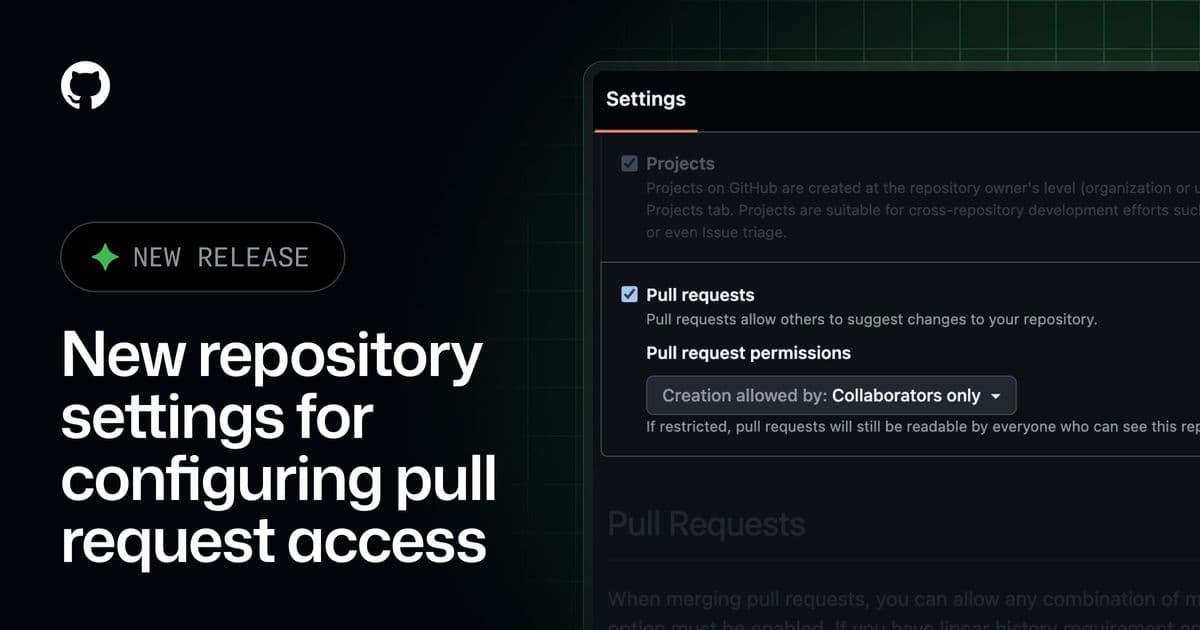
GitHub has launched two new repository settings that give maintainers unprecedented control over how contributions are managed, allowing them to disable pull requests entirely or restrict them to collaborators only.
GitHub has unveiled two powerful new repository settings that fundamentally change how maintainers can control contribution workflows. These settings, now available across all public and private repositories, provide maintainers with granular control over pull request access, addressing long-standing needs for projects that require different levels of contribution management.
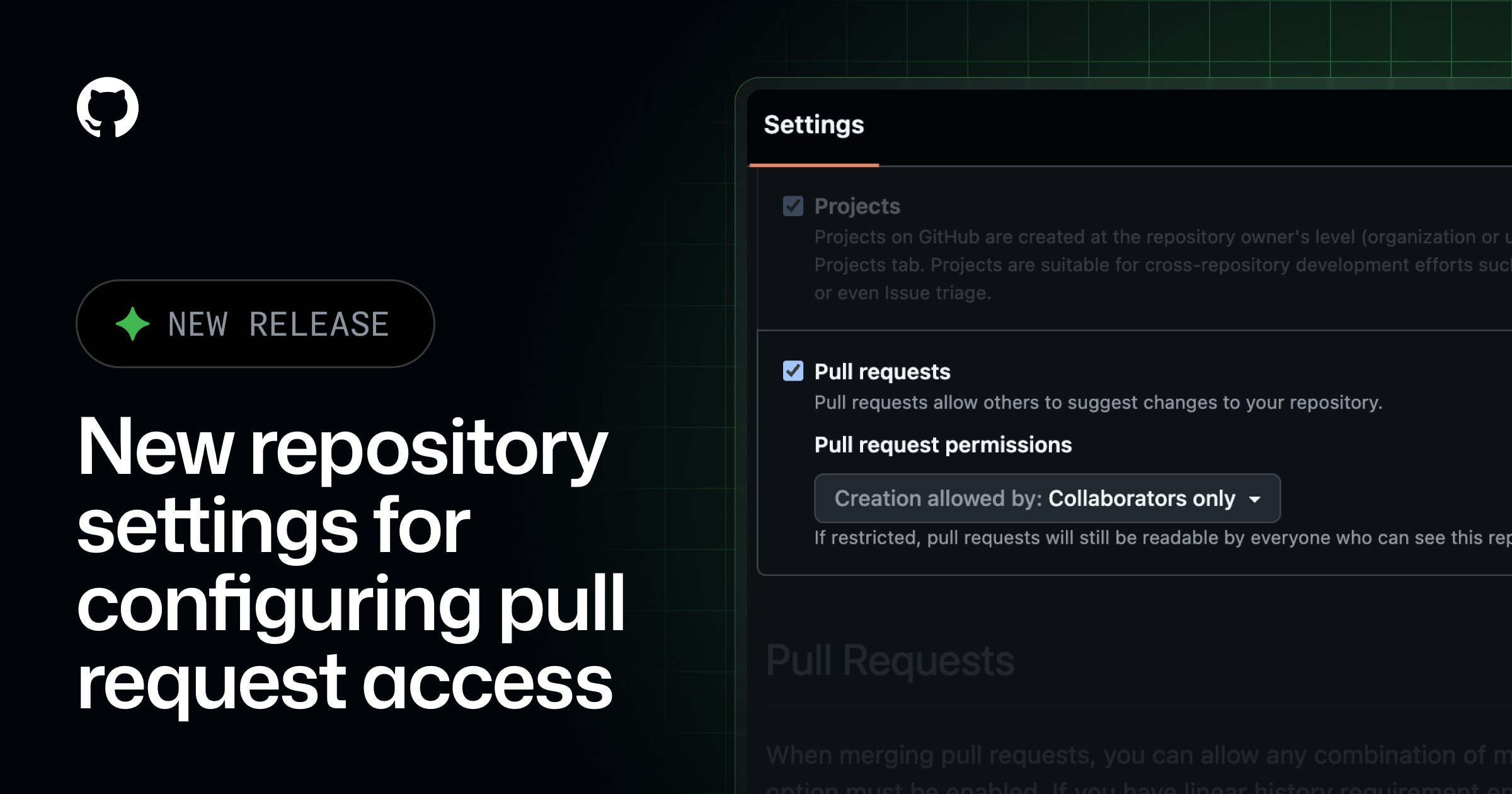
The first new setting allows maintainers to disable pull requests entirely from their repository's Settings page. This functionality mirrors existing controls for wikis, issues, discussions, and projects, creating a consistent administrative experience across repository features. When pull requests are disabled, the pull requests tab disappears completely from the repository interface, preventing anyone from viewing existing pull requests or opening new ones.
This capability proves particularly valuable for several use cases. Mirror repositories, which exist primarily to reflect code from other sources, can now prevent any accidental contribution attempts. Read-only codebases—such as documentation sites, sample code repositories, or reference implementations—can be shared publicly without the overhead of managing pull requests. Projects that simply want to showcase their work without accepting external contributions now have a clean, straightforward way to communicate that intent.
The second setting takes a more nuanced approach by restricting pull request creation to collaborators only while maintaining visibility for all users. This creates a hybrid model where the pull requests tab remains visible and accessible, allowing anyone to browse existing pull requests and participate in discussions through comments. However, only users with write access—those designated as collaborators—can actually create new pull requests.
This collaborator-only restriction serves multiple strategic purposes. During critical development phases, maintainers can ensure that only trusted contributors can submit changes, reducing the risk of low-quality or potentially harmful contributions. Projects working through sensitive architectural decisions or security-related changes can maintain tighter control over their codebase while still benefiting from community visibility and feedback. The setting also helps manage contribution quality by creating a natural barrier that encourages potential contributors to establish trust and demonstrate their commitment before being granted pull request privileges.
Adding or removing collaborators remains straightforward through the Collaborators tab in repository settings, giving maintainers flexible control over who can contribute. This creates a clear pathway for onboarding trusted community members while maintaining security and quality standards.
Both settings are accessible through the repository Settings > General > Features configuration page, providing a centralized location for managing these access controls. The implementation represents GitHub's ongoing commitment to giving maintainers the tools they need to shape their project workflows according to their specific requirements and community dynamics.
Mobile app support for these new settings is currently in progress, with full user interface changes planned for upcoming releases. In the interim, repositories with disabled pull requests will still display the pull requests tab in the mobile app, though the functionality to create new pull requests remains disabled. All other settings and features maintain consistent behavior across both desktop and mobile platforms.
For repositories dealing with problematic user behavior, GitHub continues to offer temporary interaction limits as a complementary tool. These limits can be applied to public repositories to restrict certain activities from specific users for defined periods, providing an additional layer of control for maintainers facing harassment, spam, or other disruptive behavior.
The introduction of these settings reflects GitHub's broader strategy of empowering maintainers with more sophisticated tools for managing their projects. By providing options that range from completely open contribution models to highly restricted ones, GitHub acknowledges that different projects have vastly different needs, community structures, and risk tolerances.
These new controls also signal GitHub's recognition that the traditional open contribution model, while powerful, doesn't suit every project or maintainer. Some maintainers prefer to curate their contributor base carefully, while others need to protect their projects during vulnerable development periods. The ability to disable pull requests entirely or restrict them to collaborators provides maintainers with the flexibility to adapt their contribution workflows to their specific circumstances.
For the broader open source ecosystem, these settings could influence how projects structure their communities and contribution processes. Projects might adopt more tiered approaches to contribution, where initial engagement happens through issues and discussions before contributors earn the privilege of submitting pull requests. This could lead to more intentional community building and potentially higher-quality contributions as maintainers have more control over who can directly modify the codebase.
The rollout of these features across all repository types—public and private—ensures that organizations and individual maintainers alike can benefit from the enhanced control. Private repositories, which often have more stringent security and compliance requirements, gain additional tools for managing their development workflows, while public repositories can better balance openness with maintainability.
As GitHub continues to evolve its platform, these settings represent a significant step toward more customizable and maintainable development workflows. By giving maintainers the ability to precisely control how their repositories accept contributions, GitHub is acknowledging the diverse needs of its user base and providing the tools necessary to support a wide range of development practices and community structures.


The new pull request access settings are available immediately, and maintainers are encouraged to explore how these options might enhance their project management strategies. Whether seeking to create read-only repositories, manage contribution quality, or protect development during critical phases, these tools provide the flexibility needed to maintain healthy, productive development environments.
Comments
Please log in or register to join the discussion