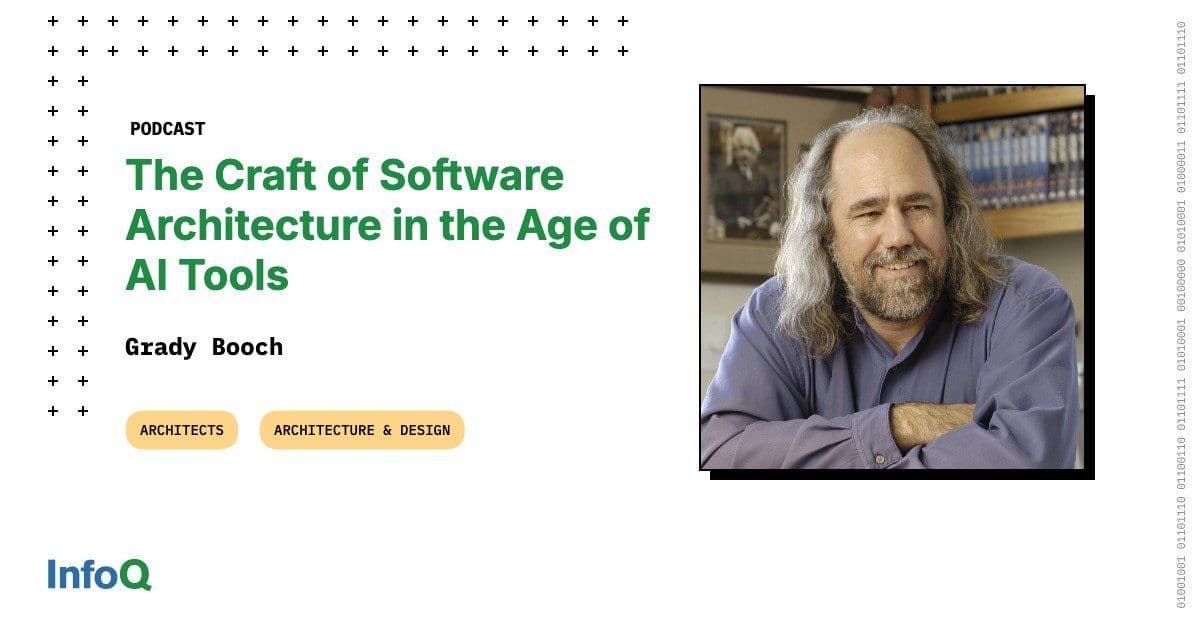
Grady Booch discusses how AI tools are transforming software development while emphasizing that architecture remains fundamentally about human judgment and responsibility. He explores the third golden age of software engineering, the risks of de-skilling, and why architects must maintain their creative agency even as AI handles routine tasks.
We are already in the third golden age of software, and AI is a component of it, not the cause. The industry has moved from algorithms to objects to platforms and globally distributed systems. AI tools now sit inside this platform era as another layer of abstraction, accelerating how architects compose and weave systems they do not fully control.
Architecture still means expensive to change decisions, even when design is automated. AI can generate designs, patterns, and code quickly, but architecture remains the set of load bearing choices that determine long term cost, resilience, and evolution. Those decisions still require human judgement about trade offs, constraints, and risk.
AI increases leverage by raising abstraction, not by replacing thinking. Like compilers once did, LLMs move low level work to machines and free humans to operate at higher conceptual layers. The real gains come when experienced practitioners direct, challenge, and validate the outputs rather than treating them as authoritative.
The biggest risks are de skilling, convergence, and false confidence. LLMs tend to push teams toward common, safe patterns and can quietly erode apprenticeship paths for junior engineers. Over reliance also creates the illusion of correctness, even when systems drift toward mediocrity or fail in novel situations.
Human accountability is non negotiable in AI augmented engineering. When AI generates or reviews code, responsibility for quality, safety, and outcomes still sits with the human architect and engineer. This is where we have to stay awake, set clear boundaries, and take ownership instead of hiding behind the tool.
The Third Golden Age of Software Engineering
Grady Booch positions our current moment as the third golden age of software engineering, following the algorithmic era of the 1940s-60s and the object oriented revolution of the 1970s-80s. The current platform era, characterized by globally distributed systems and service oriented architectures, has been building for about a decade. AI tools like Claude represent another layer of abstraction within this existing transformation, not its cause.
This historical perspective matters because it shows that today's AI revolution follows predictable patterns of abstraction and automation that have repeatedly transformed software development. Just as compilers moved assembly language work to machines, allowing humans to think at higher levels, AI tools handle routine coding tasks while humans focus on architectural decisions.
Architecture Versus Design in an AI World
The fundamental distinction between architecture and design remains unchanged even as AI accelerates the design process. Architecture represents the set of significant design decisions that shape the form and function of a system, where significant is measured by cost of change. Design patterns, variable naming conventions, and implementation details fall below this threshold.
What changes with AI is the speed at which designs can be generated and iterated. An experienced architect can now prototype multiple approaches rapidly, but the responsibility for choosing which patterns to use, which trade offs to accept, and which constraints to honor remains human. The architect's role shifts from manual implementation to strategic direction and quality control.
The Creativity Gap
Booch draws a crucial distinction between the search capabilities of AI systems and genuine creativity. While tools like AlphaGo can explore vast state spaces and make unexpected moves, they lack the human capacity to bring together unexpected elements within meaningful contexts. AI systems are excellent at pattern matching and optimization within their training data, but they cannot reason abductively or build new theories.
This creativity gap means that experienced architects remain essential for novel problems, unconventional solutions, and situations outside standard patterns. The architect's ability to sense when something "smells wrong" or to envision approaches that don't exist in training data cannot be automated.
The De Skilling Risk
One of Booch's primary concerns is the potential erosion of apprenticeship paths in software development. If junior engineers rely entirely on AI tools to generate code without understanding the underlying principles, they miss crucial learning opportunities. The legal profession faced similar challenges when research tools automated document review, potentially depriving young lawyers of foundational experience.
This risk extends beyond individual careers to organizational capability. Teams that lose their ability to think critically about architecture become dependent on tools and patterns, converging toward mediocrity rather than innovation. The architect's role includes preserving and transmitting architectural thinking even as tools change.
Human Machine Boundaries
Clear boundaries between human and machine responsibility are essential for maintaining architectural integrity. Booch advocates for a director actor model where humans provide strategic direction while AI handles implementation details. This requires architects to maintain their creative agency and not surrender architectural judgment to automated tools.
The trust but verify principle becomes even more critical with AI generated code. Architects must develop "theories of mind" about different AI tools, understanding their strengths, weaknesses, and blind spots. Just as a carpenter learns the characteristics of different hammers, architects must learn to work effectively with various AI assistants while maintaining ultimate responsibility.
Accountability in AI Augmented Development
When AI generates code that fails in production, accountability rests entirely with the human architect and engineer who directed its use. This mirrors Tom Watson's principle that machines should never be held responsible for mistakes—the human who directed the machine bears responsibility. The temptation to blame AI tools for failures represents a dangerous abdication of professional responsibility.
This accountability extends to architectural decisions about when and how to use AI tools. Architects must establish clear guidelines for AI use, including review processes, testing requirements, and boundaries between automated and human generated work. The goal is not to eliminate AI but to integrate it responsibly while preserving human judgment.
What Architects Should Lean Into and Resist
Booch recommends that architects actively engage with AI tools to understand their capabilities and limitations. Playing with these tools provides valuable insights into how they can augment architectural work without replacing human judgment. At the same time, architects must resist the temptation to become "astronaut architects" who make decisions without experiencing their consequences.
Continuous learning remains essential. Architects should study code from outside their domain, read original implementations of influential systems, and maintain broad architectural knowledge. The best architects combine deep expertise with curiosity about different approaches and patterns.
The Privilege and Responsibility of Software Architecture
Booch emphasizes that software architecture represents both extraordinary privilege and profound responsibility. Few professions can claim to be changing civilization itself through their daily work. This power requires architects to maintain high standards, think beyond immediate requirements, and consider the long-term implications of their decisions.
The joy of creating systems that matter should not be lost amid the pressures of delivery and the distractions of new tools. Architects who maintain their passion for building meaningful systems while responsibly integrating AI capabilities will find themselves well positioned for the future of software development.
Looking Forward
The future of software architecture lies not in choosing between human and machine capabilities, but in thoughtfully combining them. AI tools will continue to improve at routine tasks while humans focus on the creative, strategic, and ethical dimensions of architecture. Success requires maintaining architectural thinking skills even as the tools change, preserving apprenticeship paths for junior engineers, and establishing clear accountability for AI augmented work.
Architects who embrace this balanced approach—leveraging AI for productivity while maintaining human judgment for quality—will find themselves at the forefront of the next evolution in software development. The craft of architecture remains as vital as ever, even as the tools we use to practice it continue to transform.
Comments
Please log in or register to join the discussion