A large-scale field experiment reveals that following news accounts on Instagram and WhatsApp significantly increases factual knowledge, improves discernment of true vs. false news, and boosts trust in media—without increasing polarization. The findings challenge assumptions about social media's role in misinformation and suggest platforms could foster informed societies by promoting quality news sources.
For years, social media platforms have been accused of degrading public discourse through toxic content, algorithmic amplification of misinformation, and political polarization. But a groundbreaking study published in Nature Human Behaviour offers a counterintuitive solution: encouraging users to follow news organizations directly on these very platforms.
The Experiment: News in the Wild
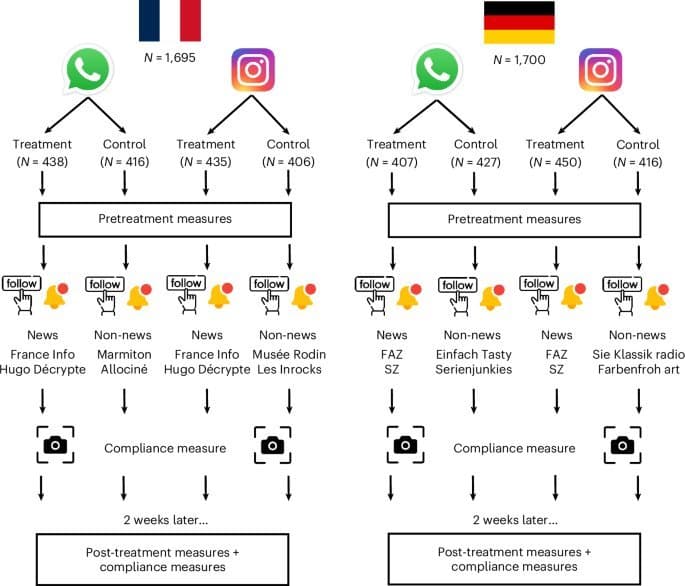
Researchers from the University of Zurich and UC Davis conducted a meticulously designed field experiment with 3,395 participants in France and Germany. Participants were randomly assigned to either:
- Treatment Group: Follow two trusted, politically balanced news accounts (e.g., France Info/Hugo Décrypte in France, FAZ/SZ in Germany) on Instagram or WhatsApp for two weeks and enable notifications.
- Control Group: Follow non-news accounts (cooking, cinema, art).
Crucially, exposure wasn't forced. Participants used platforms naturally amidst their regular feeds. Compliance was verified via screenshot submissions and surveys.
Key Findings: Knowledge, Accuracy, and Trust
- Enhanced Current Affairs Knowledge: Treatment participants scored 12% higher on quizzes about events occurring during the study period compared to controls (β = 0.07, P = 0.024). Effects were strongest among full compliers.
- Improved Belief Accuracy: The treatment group became significantly better at discerning true from false news stories (e.g., about Ukraine, Gaza, EU elections), with accuracy gains 0.70 points higher than controls (β = 0.06, P = 0.004). This stemmed primarily from increased belief in true news, not reduced belief in false news.
- Increased Awareness & Trust: Participants exposed to news accounts showed greater awareness of true news stories (β = 0.08, P = 0.006) and reported significantly higher trust in news media overall (increase of 0.13 points on a 6-point scale, β = 0.13, P < 0.001). Trust in the specific news outlets they followed also rose.
- The 'Feeling Informed' Paradox: Despite measurable gains in actual knowledge, participants did not report feeling more informed than controls. This challenges theories suggesting social media creates illusory knowledge.
Notable Null Effects: What Didn't Change
Critically, the intervention showed no significant effects on:
- Affective polarization (feelings towards political parties or polarized countries like Israel/Palestine, Ukraine/Russia)
- Political efficacy
- Interest in news or politics
- Awareness of/belief in false news stories
Why This Matters: A Path Forward
This research flips the script on combating misinformation:
- Beyond Debunking: Instead of solely focusing on reducing exposure to 'bad' content (e.g., fact-checking), proactively increasing exposure to verified news from reliable sources proves highly effective.
- Platform Responsibility: Findings directly challenge platforms like Meta (owner of Instagram and WhatsApp) that have downranked news content, claiming users aren't interested or news is "highly substitutable." The study shows demand exists (51% of treatment participants planned to keep following news accounts) and yields societal benefits.
- Scalable Solutions: The intervention is simple and low-cost. Platforms could algorithmically promote diverse, reliable news sources. News organizations could increase visibility of their social presence. Non-profits could run campaigns encouraging users to follow quality news.
- Cognitive Pathways: Researchers suggest concise, visually-driven platform news formats may enhance information retention by reducing cognitive load compared to traditional long-form content, though mechanisms warrant further study.
"While it is feared that social media facilitate the spread of clickbait, misinformative and low-quality content... users are willing to engage with news media when encouraged to do so, and this engagement increases current affairs knowledge, awareness of true news stories, belief accuracy and enhances trust," the authors concluded. "This means that, with the right incentives, social media can be a powerful tool for promoting informed and engaged citizenship."
Source: Altay, S., Hoes, E. & Wojcieszak, M. Following news on social media boosts knowledge, belief accuracy and trust. Nat Hum Behav (2025). https://doi.org/10.1038/s41562-025-02205-6 (European Research Council funded).
Comments
Please log in or register to join the discussion