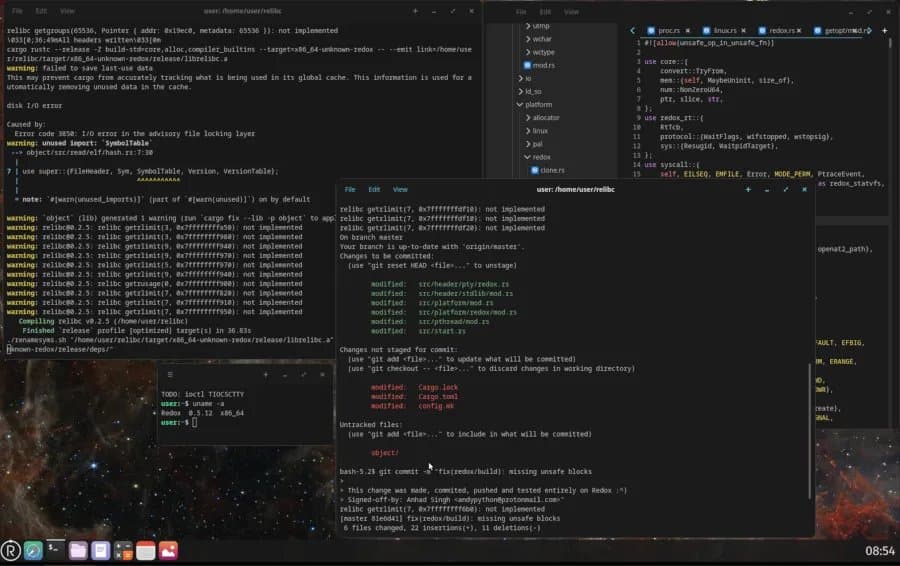
Redox OS, the Rust-written operating system, has successfully run Cargo and the Rust compiler natively, marking a significant step toward self-hosting and ecosystem maturity.
Redox OS, the ambitious Rust-written operating system, has reached a critical milestone in its development journey. After three attempts and addressing numerous technical challenges, the Redox team has successfully made Cargo and the Rust compiler (rustc) run natively on the platform itself. This achievement, announced in a January 2026 status update, represents a significant leap forward for this independent OS project.
The Technical Achievement
Getting Cargo and rustc working on Redox OS required overcoming substantial hurdles. The development team had to address a variety of kernel-level issues, signal handling problems, and networking complications. These aren't trivial fixes - they represent fundamental work on the operating system's core infrastructure.
As Anhad Singh demonstrated, this milestone enables developers to compile their favorite Rust command-line tools and text user interface (TUI) programs directly on Redox. This capability is essential for any operating system that aims to be self-sufficient and developer-friendly. The ability to build software natively means the ecosystem can grow organically without requiring constant cross-compilation from other platforms.
A Historic First: The First Merge Request
The achievement became even more significant when Anhad Singh submitted the first merge request entirely from within Redox OS itself. Running under QEMU virtualization with COSMIC Edit as the code editor, Singh submitted a fix for Relibc - the C library implementation used by Redox. This moment represents more than just a technical milestone; it's a symbolic achievement showing that Redox has reached a level of maturity where its own developers can work entirely within the environment they're building.
Beyond the Compiler: January's Improvements
While the Cargo and rustc milestone grabbed headlines, Redox OS saw substantial progress across multiple fronts during January:
Security Infrastructure
The team has been working on capability-based security infrastructure, a modern approach to system security that provides fine-grained control over what processes can access. This work positions Redox as a forward-thinking OS in terms of security architecture.
Networking and SSH
Proper OpenSSH support has been implemented, bringing Redox closer to being a viable server platform. This is crucial for anyone considering Redox for hosting services or running in production environments.
VPS Support
Redox now runs on a Vultr VM, demonstrating its viability as a cloud platform. Virtual Private Server support is essential for modern operating systems, and this achievement shows Redox can compete in the cloud computing space.
Input Latency Reduction
One of the more tangible improvements for end users is the dramatic reduction in USB input latency. The team managed to drop latency from approximately 100 milliseconds to just 30 milliseconds - a 70% improvement that makes the user experience noticeably more responsive. For anyone who has experienced laggy input devices, this improvement is substantial.
Additional Features and Fixes
The January update also brought:
- Debugging improvements for developers
- A boot environment text editor for adjusting boot environment variables
- Various kernel and driver improvements
- Support for PS/2 touchpads and additional PS/2 devices
The Road Ahead
These achievements in January 2026 represent more than just incremental progress - they demonstrate that Redox OS is maturing into a legitimate alternative operating system. The ability to self-host development tools, combined with improvements in security, networking, and user experience, positions Redox as an increasingly viable platform for both developers and users.
The project's progress is particularly impressive given that Redox is written entirely in Rust, a relatively young systems programming language. Building an entire operating system from scratch in a new language presents unique challenges, and the Redox team has shown remarkable persistence in overcoming them.
For developers interested in exploring Redox, the operating system is available for download and testing. The project welcomes contributions, and with the new native development capabilities, contributing to Redox has become more accessible than ever.
Learn more about Redox OS and its January 2026 progress on the official Redox-OS.org blog.
Comments
Please log in or register to join the discussion