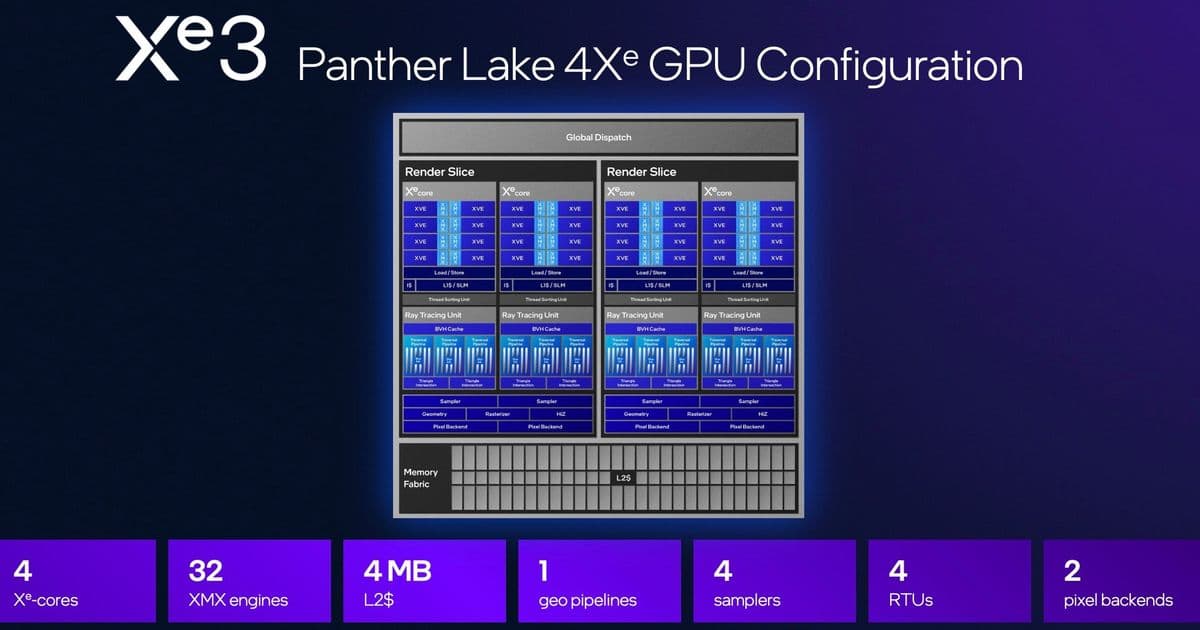
Early benchmarks reveal Intel's new Panther Lake integrated graphics underperform significantly compared to previous Arc GPUs, with the Core Ultra 7 355 showing up to 60% lower gaming performance than the Arc B390.
Intel's latest Panther Lake processors have begun shipping after their CES 2026 debut, but early benchmarks suggest the new integrated graphics may disappoint users expecting significant performance gains. The Core Ultra 7 355 with Intel 4 Xe3 GPU shows notably weaker gaming performance compared to both its predecessor and competing solutions.
Performance Gap Between U and H Series
Testing reveals substantial performance differences between Panther Lake-U and Panther Lake-H variants. The Core Ultra 7 355 (U series) can be up to 60% slower than the Core Ultra X7 358H (H series) in gaming scenarios according to 3DMark benchmarks. This performance delta is wider than many users might expect when choosing between the two CPU options.
Underwhelming Gaming Performance
The Intel 4 Xe3 GPU in the Core Ultra 7 355 struggles to match last year's Arc 140V/140T integrated graphics, performing between the older Xe 96 EUs and two-year-old Arc 8 graphics. In actual gaming tests with the Dell XPS 14 Core Ultra 7 test unit, the GPU consistently trails behind the Arc 140V in GPU-bound scenarios while staying within 10% of the Arc 8 performance.
For demanding titles like Cyberpunk 2077, the GPU can handle 900p or 1080p on low settings, but users seeking better gaming performance should consider the Core Ultra X7 or competing Radeon 890M solutions for more GPU-intensive tasks.
Power Efficiency Concerns
Despite being built on a newer architecture, the Core Ultra 7 355 doesn't deliver the power savings one might expect. When running Cyberpunk 2077 on the Dell XPS 14 Core Ultra 7, XPS 14 Core Ultra X7, and Lenovo ThinkPad T14 Gen 6, power consumption remains within just a few watts of each other despite the massive performance differences between these systems.
Benchmark Results Summary
3DMark Performance ratings show the Core Ultra X7 358H with Arc B390 12 Xe3 GPU leading at 100 points, while the Core Ultra 7 355 with Intel Graphics 4 Xe3 GPU scores only 41.1 points - over 50% slower than the flagship. The Arc 140V scores 59.9 points and the Arc 8 scores 51.8 points, both significantly outperforming the new integrated solution.
In Blender rendering tests, the performance gap widens further. The Core Ultra X7 358H completes the Classroom benchmark in 335 seconds, while the Core Ultra 7 355 takes 512 seconds - a 52% difference. Similar gaps appear in the Barbershop benchmark where the H series completes the task in 1,711 seconds versus 2,687 seconds for the U series.
Gaming Performance at Various Settings
Cyberpunk 2077 benchmarks at 1080p show the Core Ultra X7 358H achieving 68.6 FPS on low settings, while the Core Ultra 7 355 manages only 32.7 FPS - less than half the performance. Even at ultra settings, the H series maintains 40.9 FPS compared to 17.7 FPS for the U series.
The performance gap remains consistent across different games and settings, with the Core Ultra X7 maintaining a 40-60% advantage over the Core Ultra 7 in most scenarios.
Recommendations for Buyers
Based on these early benchmarks, users should carefully consider their needs when choosing between Panther Lake variants. For gaming and GPU-intensive tasks, the Core Ultra X7 or competing solutions like the Radeon 890M offer significantly better performance. The Core Ultra 7 355 appears better suited for general productivity and light gaming rather than demanding graphical workloads.
The results suggest Intel's integrated graphics improvements with Panther Lake may not be as substantial as hoped, particularly for the U series chips targeting thin and light laptops where gaming performance often matters to users.
Comments
Please log in or register to join the discussion