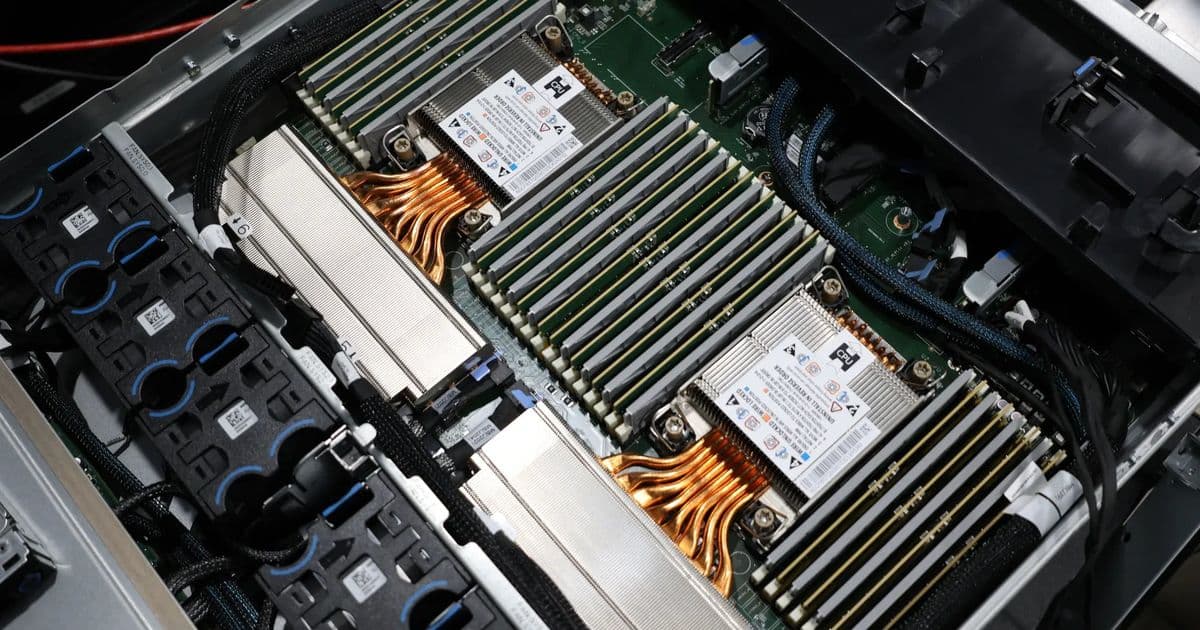
Intel's Xeon 6780E Sierra Forest and AMD's EPYC 9965 Turin Dense flagship go head-to-head on Ubuntu 25.10 with Linux 6.18 LTS, revealing how Intel's E-core strategy stacks up against AMD's Zen 5 density play.
The server CPU landscape continues to evolve rapidly, with Intel's Xeon 6700E series facing off against AMD's EPYC 9005 series in a battle of architectural philosophies. While Intel has largely abandoned the Xeon 6900E series in favor of Clearwater Forest, the Xeon 6700E remains their top-end E-core offering. This comprehensive benchmark comparison pits the Xeon 6780E "Sierra Forest" against the AMD EPYC 9965 "Turin Dense" flagship, both running on the latest Ubuntu 25.10 with Linux 6.18 LTS kernel.
Hardware Specifications and Platform Differences
The Intel Xeon 6780E represents Intel's density-focused approach with 144 E-cores per socket, operating without SMT/Hyper Threading. The processor features a 2.2GHz base frequency with 3.0GHz maximum turbo, 108MB cache, and a 330W TDP. In contrast, AMD's EPYC 9965 packs 192 Zen 5 cores with SMT enabled, delivering 384 threads. The AMD chip runs at 2.25GHz base with 3.7GHz boost, includes 384MB L3 cache, AVX-512 support, and a higher 500W TDP.
Platform differences extend beyond the CPUs themselves. The Xeon 6780E systems utilized the Quanta Cloud QuantaGrid D55Q-2U reference server with eight DDR5-6400 memory channels per socket. AMD's EPYC 9965 ran on the AMD Volcano reference server with twelve DDR5-6400 channels per socket, giving AMD a memory bandwidth advantage that could influence certain workloads.
Software Stack and Testing Methodology
Both systems ran Ubuntu 25.10 with manual upgrades to Linux 6.18 LTS kernel and GCC 15.2 compiler. Storage was standardized using KIOXIA KCD8XPUG1T92 NVMe SSDs. The testing focused on workloads that scale well to high core counts, with CPU power consumption monitored per test to provide a complete performance-per-watt picture.
This testing follows Intel's recent software improvements that delivered approximately 14% performance gains for Sierra Forest since launch, highlighting how rapidly server performance can evolve through software optimization.
Performance Analysis
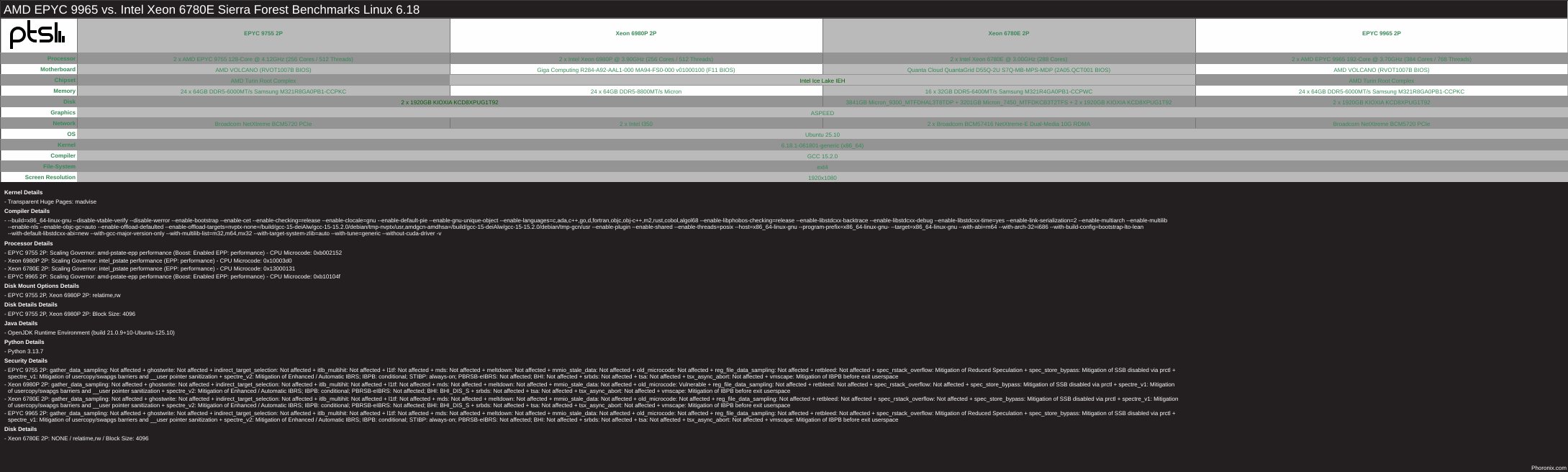
The benchmark results reveal interesting patterns in how these two architectural approaches perform across different workloads. Intel's E-core strategy emphasizes efficiency and density, while AMD's Zen 5 approach balances single-threaded performance with multi-threaded throughput.
In memory-intensive workloads, AMD's additional memory channels provide a noticeable advantage. The twelve channels per socket on the EPYC platform deliver higher aggregate memory bandwidth compared to Intel's eight channels, benefiting applications that stress memory subsystems.
Single-threaded performance shows AMD's strength, with the EPYC 9965's higher boost clocks and Zen 5 architecture delivering superior per-core performance. This advantage manifests in workloads that don't scale perfectly across all available cores or in scenarios where thread migration and scheduling overhead become factors.
However, Intel's E-core design excels in highly parallel, throughput-oriented workloads where the additional cores can be fully utilized. The 144 cores per socket, while lacking SMT, provide substantial parallel processing capability for suitable workloads.
Power Efficiency Considerations
The power consumption monitoring reveals important efficiency trade-offs. Intel's lower 330W TDP per socket contrasts with AMD's 500W rating, but the actual power efficiency depends heavily on workload characteristics. In scenarios where Intel's E-cores can be fully utilized, the efficiency advantage becomes more pronounced. Conversely, workloads that don't scale well to 144 cores may see AMD's higher power consumption justified by better per-thread performance and overall completion times.
Market Context and Strategic Implications
Intel's apparent abandonment of the Xeon 6900P series in favor of Clearwater Forest suggests strategic uncertainty about their high-end server CPU roadmap. The continued focus on the Xeon 6700E series indicates Intel sees value in the E-core density play, particularly for cloud service providers and hyperscale deployments where core count per socket and power efficiency are paramount.
AMD's EPYC 9965 represents a more traditional high-performance server CPU approach, combining high core counts with strong single-threaded performance and AVX-512 support. This positions AMD well for a broader range of enterprise workloads beyond pure density scenarios.
Conclusion
The Xeon 6780E Sierra Forest and EPYC 9965 Turin Dense represent two valid but different approaches to modern server computing. Intel's E-core density strategy offers compelling efficiency for suitable workloads, while AMD's Zen 5 approach provides more balanced performance across a wider range of scenarios.
The approximately 14% performance improvement for Sierra Forest through software optimization demonstrates how critical the software ecosystem remains for server CPU success. As both platforms continue to mature, we can expect further performance gains through kernel improvements, compiler optimizations, and application tuning.
For organizations evaluating these platforms, the decision ultimately depends on workload characteristics, power efficiency requirements, and software stack compatibility. The memory bandwidth advantage of AMD's platform, combined with stronger single-threaded performance, makes it attractive for diverse enterprise workloads. Intel's density-focused approach may prove more compelling for cloud-native applications and scenarios where core count per socket is the primary optimization target.
As the server CPU market continues to evolve, these architectural trade-offs will remain central to platform selection decisions, with both Intel and AMD refining their approaches based on real-world deployment feedback and emerging workload patterns.
Comments
Please log in or register to join the discussion