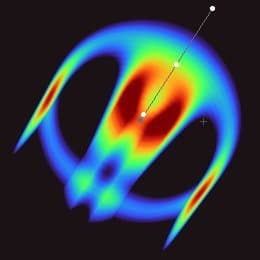
Lenia reimagines cellular automata like Conway's Game of Life by introducing continuous states, space, and time, enabling the emergence of intricate, self-sustaining 'lifeforms' with unprecedented geometric complexity and resilience. Developed by Bert Wang-Chak Chan, this mathematical universe has garnered significant recognition for its ability to model lifelike behaviors far beyond discrete predecessors. Its framework of convolution kernels and growth mappings offers a fertile ground for explo
For decades, Conway's Game of Life captivated mathematicians, computer scientists, and enthusiasts with its simple rules yielding complex emergent behaviors within a rigid grid of discrete cells. Now, Lenia, conceived by researcher Bert Wang-Chak Chan, pushes this concept into the continuous realm, creating a universe teeming with intricate, fuzzy, and resilient artificial lifeforms that defy the limitations of their discrete ancestors. Awarded top honors at the 2018 Virtual Creatures Contest and recognized by the International Society for Artificial Life (ISAL), Lenia represents a significant leap in simulating lifelike complexity.
Breaking Free from the Grid: Continuous States, Space, and Time
Unlike traditional cellular automata confined to discrete on/off states, fixed grid positions, and stepwise updates, Lenia operates in a high-resolution continuum:
- States: Values exist on a continuous spectrum
[0, 1], derived from a high-resolution discrete set{0, Δp, 2Δp, ..., 1}whereΔp = 1/P(e.g., P=4 yields states{0, 0.25, 0.5, 0.75, 1}). - Space: The neighborhood
Nsurrounding any pointxis a continuous ball of radiusR(||n||₂ ≤ R), not a fixed grid like the Moore neighborhood. - Time: Updates occur in small, continuous time steps
Δt, with a time resolutionT = 1/Δt. The state evolves viaA^{t+Δt}(x) = clip( A^t(x) + Δt * G^t(x), 0, 1).
This continuous foundation allows for smooth, high-resolution patterns and movements impossible in discrete CA.
The Engine of Emergence: Convolution Kernels and Growth Mappings
Lenia's local update rule, applied across the space, drives the formation of complex patterns. It involves two key stages:
Potential Field Calculation (
U^t(x)): A convolution kernelKis applied to the current stateA^taround pointx.U^t(x) = ∫_{n ∈ N} K(n) A^t(x + n) dn² (Continuous Lenia) U^t(x) = Σ_{n ∈ N} K(n) A^t(x + n) Δx² (Discrete Lenia)The kernel
Kis crucial. It's constructed by:- Choosing a radial shell function
K_C(r)(e.g., exponential, polynomial, rectangular) that peaks atr=0.5and is zero atr=0andr=1. - Defining a skeleton
K_S(r; β)using a parameter vectorβto create concentric rings:K_S(r; β) = β_{floor(Br)} * K_C(Br mod 1). - Normalizing:
K(n) = K_S(||n||₂) / |K_S|to ensure mass conservation (K * A ∈ [0,1]).
- Choosing a radial shell function
Growth Calculation (
G^t(x)): The potentialU^t(x)is fed into a unimodal, non-monotonic growth mappingG: [0,1] → [-1,1], parameterized by centerμand widthσ:G(u; μ, σ) = 2 * exp(-(u-μ)²/(2σ²)) - 1 (Exponential) G(u; μ, σ) = 2 * 1_{[μ±3σ]}(u) * (1 - (u-μ)²/(9σ²))⁴ - 1 (Polynomial, α=4) G(u; μ, σ) = 2 * 1_{[μ±σ]}(u) - 1 (Rectangular)This function determines if a location grows (
G>0), decays (G<0), or remains stable (G≈0) based on its local environment's potential.
The growth G^t(x) is then scaled by Δt and added to the current state A^t(x), clipped to stay within [0,1].
A Universe of "Life": From Gliders to Novel Taxonomies
By varying the kernel parameters (K_C type, β, R), the growth function (G type, μ, σ), and initial conditions, Lenia generates an astonishing diversity of self-organizing, persistent patterns Chan terms "lifeforms" or "species". Over 400 distinct types have been cataloged, exhibiting characteristics rarely seen in discrete CA:
- Geometric & Metameric: Complex, often symmetrical shapes built from repeated segments.
- Fuzzy: Smooth, non-binary boundaries thanks to continuous states.
- Resilient & Adaptive: Capable of self-repair and maintaining integrity.
- Locomotive: Many exhibit glider-like movement or more complex dynamics.
- Rule-Generic: Patterns often persist across ranges of parameters.
These emergent "organisms" are so diverse that Chan has developed a taxonomy to classify them, highlighting Lenia's power as a platform for studying artificial life principles like morphogenesis and self-replication.
Relation to Game of Life and Neural Networks
Lenia explicitly generalizes Conway's Game of Life (GoL). Using a rectangular K_C and G with specific R=T=P=1, μ=0.35, σ=0.07, Lenia replicates GoL dynamics. However, its continuous framework allows for vastly more complex and lifelike behaviors.
Lenia's update rule (convolution + nonlinear growth function) also bears a striking resemblance to a single layer in a Convolutional Neural Network (CNN). While CNNs are typically trained via gradient descent on specific tasks, Lenia's kernels and growth functions are hand-crafted or discovered through search to foster open-ended emergence. It demonstrates how CA can be viewed as a specific, often untrained, type of recurrent CNN focused on generative pattern formation.
Beyond a Mathematical Curiosity: Implications and Potential
Lenia is more than a mesmerizing digital aquarium. It provides a powerful, flexible mathematical framework for exploring:
- The Fundamentals of Emergence: How do simple, localized rules give rise to global complexity and lifelike behaviors?
- Artificial Life and Complexity Theory: What are the minimal requirements for generating persistent, adaptive structures? Can we discover principles applicable to biological systems?
- Generative Systems: How can continuous CA inspire new approaches to generative art, dynamic simulations, or even unconventional computing paradigms?
The geometric elegance and resilience of Lenia's lifeforms challenge our notions of where mathematical structure ends and lifelike behavior begins. It stands as a testament to the untapped complexity lurking within continuous dynamical systems governed by simple, local interactions, offering a vibrant new frontier for exploration at the intersection of mathematics, computer science, and artificial life. As researchers continue to map this universe and probe its depths, Lenia promises to yield further insights into the very nature of complex systems.
Source: Adapted from the Wikipedia article "Lenia" (Retrieved 2024-07-19, CC BY-SA 3.0)
Comments
Please log in or register to join the discussion