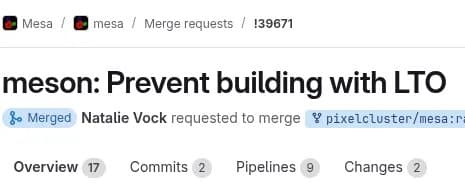
Mesa developers have added explicit LTO blocking to prevent impossible-to-debug bugs, marking a significant shift in the project's build system approach.
Mesa, the widely-used open-source graphics library, has taken a decisive step to prevent compilation with Link-Time Optimizations (LTO) due to persistent, hard-to-debug issues. In a recent merge to the Mesa Git repository, developers have implemented a hard block on LTO usage during Mesa builds, marking a significant shift in the project's approach to compiler optimizations.
The LTO Problem in Mesa
The decision comes after years of developers struggling with "random impossible-to-debug bugs" that were traced back to LTO-enabled builds. These bugs were particularly problematic because they often manifested as seemingly unrelated crashes or rendering issues that were nearly impossible to reproduce or diagnose. The Mesa team found that bug reports involving LTO were essentially "WONTFIX" cases, with the standard response being to disable LTO instead of attempting to fix the underlying issues.
Technical Implementation
The technical implementation of this change is straightforward but effective. The Meson build system integration now explicitly errors out if the compiler -flto flag is detected during configuration. The error message is clear and direct: "Building Mesa with LTO is not supported. Please disable LTO for building Mesa." This prevents users and packagers from accidentally creating LTO-optimized Mesa builds that could introduce subtle, hard-to-diagnose bugs.
The Override Option
Recognizing that some users might still want to experiment with LTO despite the risks, the Mesa team has added an allow-broken-lto option. This allows users to override the error and proceed with an LTO build at their own risk. However, the developers strongly caution against this approach, noting that any bugs encountered in such builds will likely be dismissed as "WONTFIX" cases.
Impact on the Mesa Ecosystem
This change has significant implications for the Mesa ecosystem. Many Linux distributions and package maintainers automatically enable LTO for performance reasons, so this change will require updates to build scripts and packaging guidelines. The Mesa team hopes this explicit blocking will prevent users from encountering mysterious bugs and reduce the number of unactionable bug reports.
Performance Trade-offs
While LTO can provide performance benefits by enabling the compiler to optimize across translation units, the Mesa team has determined that these benefits are outweighed by the debugging challenges and stability issues. This decision reflects a prioritization of reliability and maintainability over potential performance gains, which is particularly important for a graphics library that needs to work consistently across a wide range of hardware and software configurations.
Future Outlook
The Mesa developers expressed hope that compiler LTO support in both GCC and LLVM/Clang will improve over time, potentially allowing for a revision of this policy in the future. However, for now, the stance is clear: LTO and Mesa don't mix well, and users are better off building without it.
Community Response
The Mesa community has largely supported this decision, with many developers sharing their own experiences with LTO-related bugs in the graphics stack. The change represents a pragmatic approach to software development, acknowledging that some optimizations, while potentially beneficial, can introduce more problems than they solve.
Broader Implications
This decision by the Mesa team highlights a broader challenge in systems programming: the tension between aggressive compiler optimizations and debuggability. As compilers become more sophisticated and offer more optimization options, projects must carefully weigh the benefits against the potential for introducing subtle, hard-to-diagnose bugs. Mesa's approach of explicitly blocking problematic optimizations could serve as a model for other projects facing similar challenges.
Conclusion
Mesa's decision to block LTO compilation represents a significant shift in how the project approaches compiler optimizations. By prioritizing stability and debuggability over potential performance gains, the Mesa team is taking a pragmatic approach to software development that should benefit users and developers alike. While the door remains open for future reconsideration if compiler technology improves, for now, the message is clear: when building Mesa, leave LTO out of the equation.
For more information on Mesa and its development, visit the official Mesa project page.
Comments
Please log in or register to join the discussion