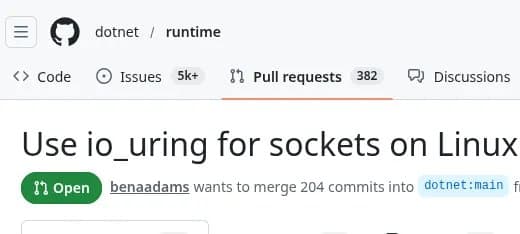
Microsoft's .NET Runtime is getting a major performance boost on Linux through IO_uring integration, with benchmarks showing 15-50% improvements across various workloads including HTTP servers, database connections, and high-concurrency scenarios.
Microsoft's .NET Runtime is set to receive a significant performance boost on Linux systems through the integration of IO_uring for socket operations. Ben Adams of Illyriad Games, a prominent .NET contributor, has opened a pull request that introduces a complete, production-grade IO_uring socket I/O engine for .NET's System.Net.Sockets layer.
This implementation serves as a replacement for the existing epoll-based system and is currently opt-in through the OTNET_SYSTEM_NET_SOCKETS_IO_URING=1 environment variable. The potential performance gains are substantial across multiple workload types.
Performance Benchmarks
The pull request includes comprehensive benchmark results demonstrating the impact of IO_uring integration:
HTTP Server Workloads
- Kestrel HTTP/1.1 Keep-Alive (TechEmpower Plaintext): Expected 15-40% reduction in per-request CPU cost
- Kestrel HTTPS/TLS Workload: Expected 10-25% reduction in socket-layer CPU usage
High Concurrency Scenarios
- High Connection Count Idle Servers (WebSocket/SignalR Hubs, 10K+): Expected 30-50% memory overhead reduction for idle connections, with 10-30% wake latency improvement
Microservices and Database Operations
- HttpClient Outbound Requests: Expected 10-20% per-request latency reduction for short-lived connections
- Database Drivers (Npgsql, MySQL Connector, Redis): Expected 5-15% latency reduction per query
Specialized Workloads
- UDP Workloads (DNS, Game Servers, Telemetry Collectors): Expected 20-40% increase in packets-per-second for high-rate UDP
- Accept-Heavy Workloads (Load Balancers, Proxies, Connection Bursts): Expected 20-50% improvement in connections-per-second under burst load
Technical Implementation
The IO_uring implementation represents a complete replacement of the existing epoll-based socket I/O engine. IO_uring, introduced in the Linux kernel, provides a more efficient asynchronous I/O interface that reduces the overhead associated with traditional system calls.
By batching operations and reducing the number of context switches required, IO_uring addresses the syscall-bound nature of many .NET workloads on Linux, particularly in scenarios like the TechEmpower plaintext benchmark where syscall overhead has historically been a limiting factor.
Future Optimization Potential
The current implementation already shows impressive results, but the pull request notes that additional gains may be possible through further optimizations. These could include leveraging IO_uring's zero-copy receive capabilities and other advanced features that weren't fully utilized in the initial implementation.
Impact on .NET Ecosystem
For developers running .NET applications on Linux, this change has the potential to deliver meaningful performance improvements across a wide range of scenarios. From web servers handling thousands of concurrent connections to microservices making outbound requests, the benefits span the entire .NET ecosystem.
The opt-in nature of the implementation allows developers to test and validate the improvements in their specific environments before fully adopting the new I/O engine.
Community Response
The pull request has generated significant interest in the .NET community, with developers eager to test the performance improvements in their own applications. The comprehensive benchmark data provides a clear picture of the potential benefits across different workload types.
As the pull request moves through the review process, developers can monitor its progress and begin planning for integration into their production environments once the implementation is finalized and merged into the main .NET Runtime codebase.
For those interested in diving deeper into the technical details, the full pull request is available for review, providing insight into the implementation approach and the specific optimizations being made to leverage IO_uring's capabilities.
Comments
Please log in or register to join the discussion