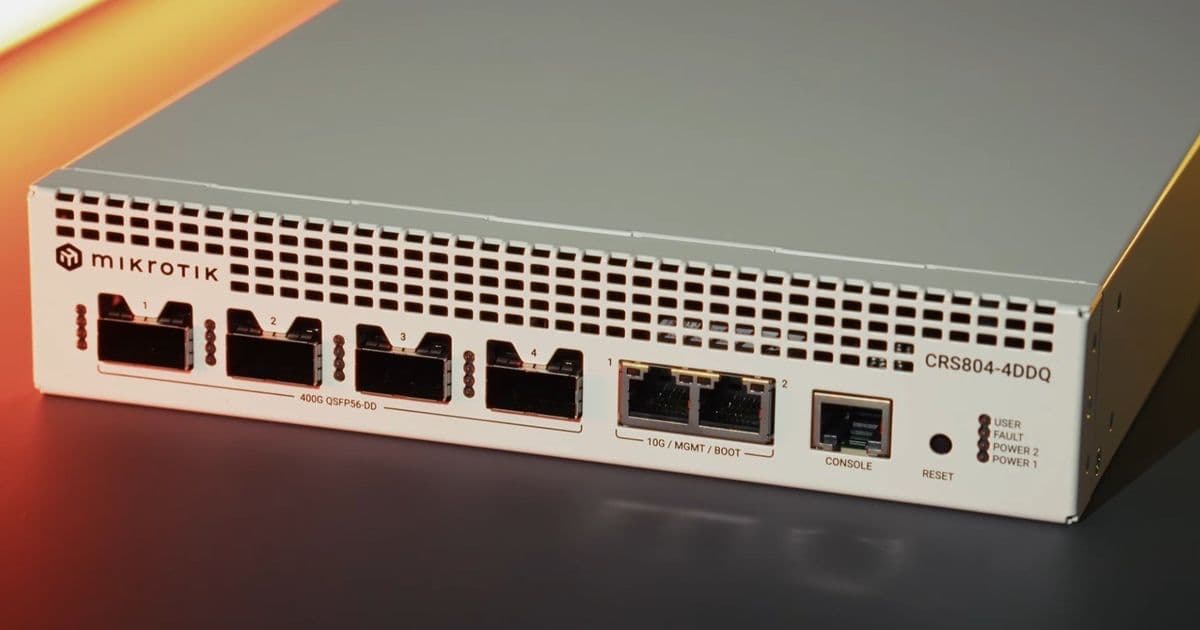
MikroTik's new CRS804 DDQ switch packs four 400GbE ports into a half-width chassis, targeting backhaul and cluster connectivity with a Marvell 98DX7335 switch chip and an Annapurna Labs quad-core Arm CPU. At a $1295 MSRP, it offers a low-cost entry into 400GbE networking with breakout capabilities, though physical layer complexity remains a challenge.
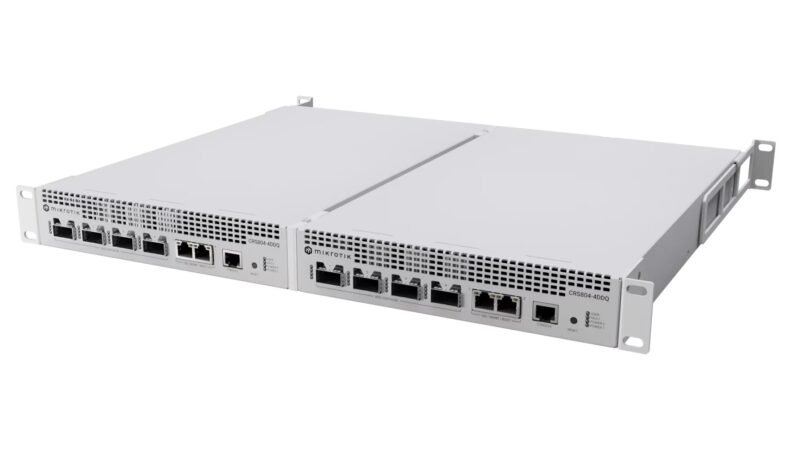
MikroTik has announced the CRS804 DDQ, a compact 4-port 400GbE switch that represents a significant expansion of the company's high-speed networking portfolio. The device measures half the width of a standard rack unit, allowing it to be mounted side-by-side in pairs, and is designed primarily for backhaul connectivity and high-performance computing clusters.
Hardware Specifications
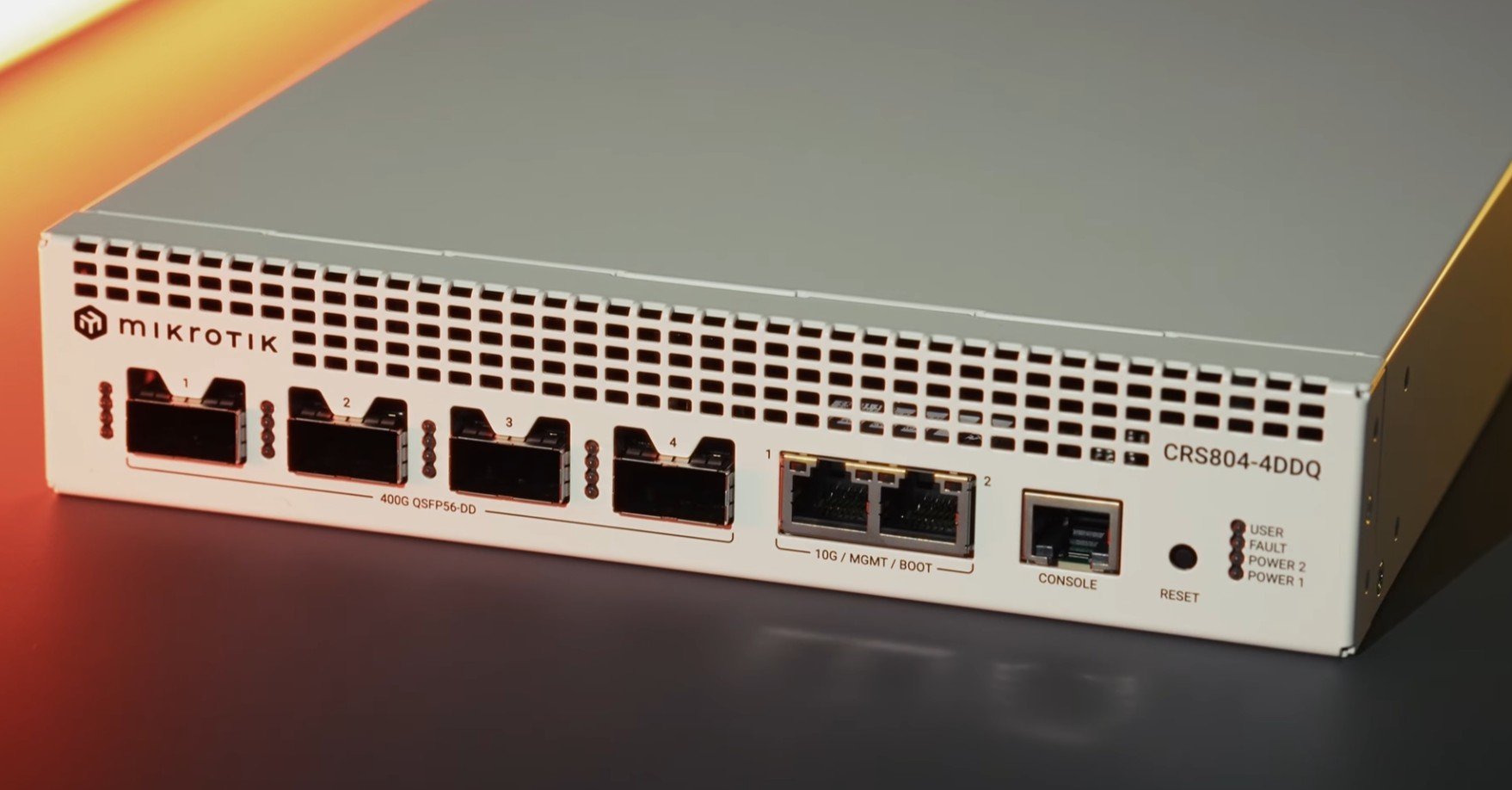
The switch features four QSFP56-DD ports on the front panel, delivering 400GbE connectivity. Two additional 10GbE ports from the management CPU provide out-of-band management and basic connectivity. The internal architecture is built around the Marvell 98DX7335 switch chip—the same silicon used in MikroTik's larger CRS812-8DS-2DQ-2DDQ-RM switch—paired with an Annapurna Labs AL52400 quad-core Arm CPU.
The Marvell 98DX7335 provides 56 lanes of SerDes, enabling a total switching capacity of 1.6Tbps. This matches the performance of the larger CRS812 DDQ model but in a significantly smaller form factor. The switch chip supports full 400GbE line-rate forwarding across all four ports simultaneously.
Power and Thermal Design
Power consumption is rated at 92W without attachments, increasing to 123W maximum with optics. This represents a relatively efficient W/bit ratio, particularly when compared to lower-speed switches. The power delta is primarily due to QSFP56-DD optics, which can consume substantial power—comparable to some 10GbE switches in their own right.
The chassis includes two hot-swap fans and redundant power supplies, providing basic redundancy for enterprise deployments. The half-width design does limit some expansion options but enables dense rack packing.
Connectivity and Breakout Capabilities
The QSFP56-DD interface uses 8x 56G PAM4 lanes per port, enabling theoretical breakout configurations such as 8x 50GbE from a single 400GbE port. However, practical implementation faces challenges with cabling and optics compatibility.
The transition from 4x 112G PAM4 lanes (used in newer 400GbE standards) to 8x 56G lanes creates interoperability issues. Many modern QSFP112 400Gbps DACs and optics are designed for 4x 112G PAM4 configurations, which don't directly map to the 8x 56G lane structure of QSFP56-DD. This physical layer complexity becomes increasingly significant at 400GbE speeds and above.
For breakout scenarios, the switch supports licensing to enable lower-speed port configurations. This allows administrators to configure ports as 100GbE, 50GbE, or other combinations, though the exact breakout options depend on the specific optics and cables used.
Deployment Considerations
The CRS804 DDQ is positioned as a cost-effective solution for connecting high-speed devices. With an MSRP of $1295 and expected street prices around $1100, it offers a relatively low-cost entry point into 400GbE networking. This pricing makes it attractive for:
- HPC cluster backhaul: Connecting multiple compute nodes or storage systems
- Data center spines: As part of a leaf-spine architecture for high-density compute
- AI/ML infrastructure: Supporting GPU clusters like NVIDIA GB10 configurations
- Research environments: Where high-speed connectivity is needed but budget constraints exist
The compact form factor also enables deployment in space-constrained environments or for building modular network segments.
Physical Layer Complexity
At 400GbE speeds, physical connectivity becomes significantly more complex than at lower speeds. The choice between 8x 56G PAM4 (QSFP56-DD) and 4x 112G PAM4 (QSFP112) affects cable selection, optics compatibility, and breakout capabilities. Administrators must carefully match transceivers, DACs, and AOCs to the specific interface standard supported by their devices.
This complexity is why the CRS804 DDQ's low cost is particularly valuable. It provides a platform for experimenting with 400GbE connectivity without the premium pricing of enterprise-grade switches, while still offering the performance needed for demanding workloads.
Market Positioning
MikroTik's expansion into 400GbE with the CRS804 DDQ and CRS812 DDQ represents a strategic move to capture the growing demand for high-speed networking in AI/ML clusters, HPC environments, and data center backhaul. By offering these capabilities at a fraction of the cost of traditional enterprise switches, MikroTik is making 400GbE accessible to smaller organizations and research institutions.
The switch's design reflects a pragmatic approach to high-speed networking—focusing on core functionality while maintaining cost efficiency. The half-width chassis and redundant power supplies provide basic reliability features, though the device lacks the extensive feature sets and support contracts of enterprise-grade alternatives.
For organizations building new high-performance clusters or upgrading existing infrastructure, the CRS804 DDQ offers a compelling balance of performance, density, and cost. However, the physical layer challenges at 400GbE speeds mean that careful planning around cabling and optics is essential for successful deployment.
The device is now available for ordering through MikroTik's distribution channels, with general availability expected in the coming weeks.
Comments
Please log in or register to join the discussion