OpenAI announced three concrete steps to make AI‑generated media more traceable: conforming its image generators to the C2PA standard, adding Google DeepMind’s SynthID invisible watermark to images, and releasing a preview verification service that checks for both signals. The moves improve durability of provenance data but still rely on cooperation from downstream platforms and cannot guarantee detection when signals are stripped.
OpenAI expands content provenance with C2PA compliance, SynthID watermarking, and a public verification tool
May 19 2026 – Safety
OpenAI’s latest announcement bundles three technical upgrades aimed at making AI‑generated images easier to identify and verify. The company says it is now a C2PA‑conforming generator, has begun embedding SynthID invisible watermarks in images produced by ChatGPT, Codex and the API, and is releasing a public verification tool that reads both signals. Below we unpack what each piece actually adds, why the combination matters, and where the approach still falls short.
1. What is claimed?
- C2PA conformance – OpenAI joins the Coalition for Content Provenance and Authenticity (C2PA) as a Conforming Generator Product. All images from DALL·E 3, ImageGen and Sora now carry C2PA‑compatible metadata and cryptographic signatures.
- SynthID watermarking – In partnership with Google DeepMind, an invisible pixel‑level watermark (SynthID) is embedded in every image generated via ChatGPT, Codex, or the OpenAI API.
- Public verification tool – A web‑based service lets anyone upload an image and see whether it contains C2PA metadata, a SynthID watermark, or both. The tool currently works only for OpenAI‑originated content.
2. What’s actually new?
C2PA metadata for OpenAI images
C2PA (formerly the C2PA standard) defines a JSON‑LD block that travels with a file, signed with a private key belonging to the creator. The block can include:
- Generation model name and version
- Timestamp and API key fingerprint
- Optional usage policy flags
OpenAI’s implementation follows the latest C2PA v1.2 spec, meaning platforms that already support C2PA (e.g., Adobe Photoshop, major social networks) can read the block without bespoke code. The metadata is cryptographically sealed, so any tampering invalidates the signature.
SynthID invisible watermark
SynthID is a spread‑spectrum watermark that modifies the least‑significant bits of the image in a way that survives typical transformations (resizing, compression, even screenshots). Google DeepMind provides an open‑source detection library that can recover a 128‑bit identifier and verify it against a public key list.
Key properties:
- Durability: survives JPEG recompression at quality ≥ 70 % and common social‑media thumbnailing.
- Low visual impact: no perceptible change to the image.
- Scalability: the same watermark is applied to all OpenAI‑generated images, allowing batch verification.
Link: SynthID project page
Public verification tool (preview)
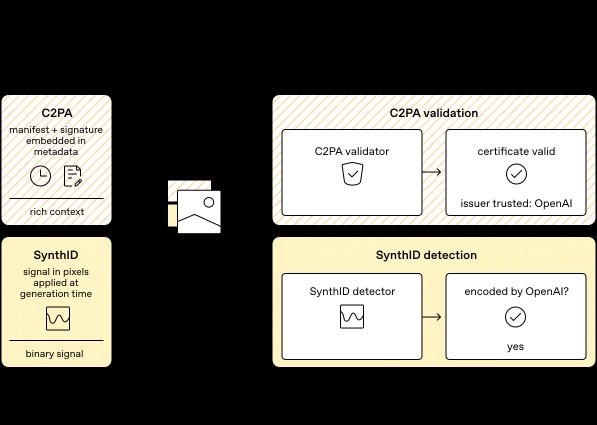
The tool is a simple web UI where users drag‑and‑drop an image. Under the hood it runs two checks:
- C2PA parser – extracts and validates the signed metadata.
- SynthID detector – runs the open‑source library to locate the hidden watermark.
If either signal is present, the UI shows a green badge with the model name and generation timestamp. If both are missing, the tool reports “No provenance signals detected – cannot confirm source.” The service is hosted on OpenAI’s infrastructure and currently only accepts PNG/JPEG inputs up to 10 MB.
3. Why does this matter?
Resilience through layering
Metadata alone is fragile: uploading to Instagram, converting to WebP, or taking a screenshot strips the C2PA block. SynthID fills that gap by persisting a signal even when metadata is lost. Conversely, metadata carries richer context (model version, policy flags) that a watermark cannot convey. By combining both, OpenAI raises the bar for accidental loss of provenance.
Interoperability
C2PA is already adopted by Adobe, Microsoft and several news organizations. Conformance means a news outlet can ingest an OpenAI image, retain the provenance block, and later surface it to readers. The watermark adds a fallback for platforms that drop metadata entirely (e.g., many mobile messaging apps).
Public verification democratizes detection
Previously, only partners with access to OpenAI’s internal detection models could reliably flag generated images. The preview tool puts a basic check in the hands of journalists, fact‑checkers, and end users, reducing reliance on opaque platform policies.
4. Limitations and open challenges
| Aspect | Current capability | Remaining gap |
|---|---|---|
| Scope | Images from DALL·E 3, ImageGen, Sora, ChatGPT, Codex, API | No video, audio, or text provenance yet |
| Platform support | Works where C2PA is preserved; SynthID survives most common edits | Platforms that aggressively recompress (e.g., TikTok) can still degrade the watermark |
| Detection accuracy | SynthID detection > 99 % on JPEG ≥ 70 % quality; C2PA validation is binary | False negatives when both signals are stripped; no false‑positive guarantee |
| Open‑source verification | SynthID library is public; C2PA parsers are open | OpenAI’s verification UI is closed‑source; no API for bulk verification |
| Adversarial removal | Watermark can be deliberately erased with targeted noise or deep‑learning attacks | Research on robust watermarking is ongoing; no guarantee against motivated attackers |
In short, the system improves average‑case traceability but does not provide a cryptographic guarantee that a malicious actor cannot hide the origin of a generated image.
5. How it fits into the broader provenance effort
OpenAI’s move aligns with a multi‑year push across the industry:
- 2024 – OpenAI added Content Credentials to DALL·E 3 outputs.
- 2025 – Google released SynthID for its own generative models.
- 2025‑26 – Several newsrooms began rejecting images lacking C2PA metadata.
By adopting both a standard (C2PA) and a proprietary‑yet‑open watermark (SynthID), OpenAI is hedging against the risk that any single technique becomes obsolete. The public verification preview is a modest first step toward the “trust‑layer” APIs that some regulators are beginning to discuss.
6. Practical steps for developers and platforms
- Integrate a C2PA parser – libraries exist for Python (
c2pa), JavaScript (@c2pa/client) and Go. Store the extracted provenance block in your media database. - Run SynthID detection on upload – the open‑source
synthidpackage can be added to image‑processing pipelines to flag watermarked content. - Expose provenance to end users – UI elements that show a small badge with the model name and timestamp increase transparency without clutter.
- Plan for fallback – if both signals are missing, consider prompting users to verify the source manually or flag the content for review.
7. Bottom line
OpenAI’s announcement is less about a single breakthrough and more about stitching together existing standards and tools into a coherent workflow. C2PA compliance ensures that detailed provenance travels with the file when platforms cooperate; SynthID provides a resilient fallback when metadata is stripped; the verification preview gives the public a concrete way to check for either signal. The approach is technically sound, but its effectiveness will ultimately depend on widespread adoption by downstream services and on continued research into watermark robustness.
For more details, see the official OpenAI blog post and the linked specifications.
Comments
Please log in or register to join the discussion