The latest Redis 8.6 release brings significant performance improvements and memory reductions alongside new features like TLS certificate-based authentication and enhanced time series capabilities.
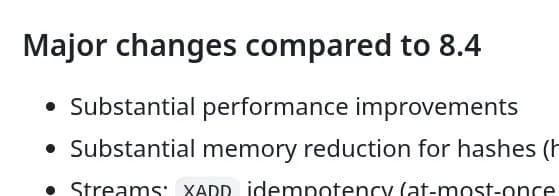
Redis 8.6 has been released with what the developers are calling "substantial" performance improvements and memory reductions. The open-source in-memory data structure store, widely used for caching, real-time analytics, and message brokering, continues to evolve with this latest general availability release.
Performance Optimizations
The Redis 8.6 release focuses heavily on performance enhancements across multiple areas. Key optimizations include:
- Prefetching improvements: Better data prefetching strategies to reduce latency
- ZRANK optimizations: Faster sorted set operations for common use cases
- Hardware block utilization: Now using hardware block by default on AArch64 architectures
- ACL verification: Optimized user access control list permission checks
- Memory metric collection: More efficient peak memory tracking
- System call reduction: Fewer per-command system calls for better throughput
- Vector optimizations: Enhanced performance for Intel and AMD CPUs
While the release notes describe these improvements as "substantial," the Redis team hasn't yet published comprehensive benchmark comparisons. This is notable, as the Redis community typically relies on concrete performance data to evaluate releases.
Memory Reduction
Alongside performance gains, Redis 8.6 delivers memory usage improvements. The exact percentage of memory reduction isn't specified in the release notes, but the developers emphasize this as a key enhancement. For large-scale deployments where memory costs are significant, even modest reductions can translate to substantial savings.
New Features
Redis 8.6 introduces several new capabilities:
TLS Certificate-Based Authentication: Automatic client authentication using TLS certificates provides enhanced security for enterprise deployments. This feature simplifies secure connections without requiring manual certificate management.
Time Series Enhancements: The time series module receives updates that improve query performance and add new aggregation functions, making Redis even more competitive for time-series workloads.
New Eviction Policies: Additional memory eviction strategies give administrators more control over how Redis handles memory pressure, particularly useful for caching scenarios with varying data access patterns.
Architecture-Specific Improvements
The release includes architecture-specific optimizations that demonstrate Redis's commitment to performance across different platforms:
- AArch64: Hardware block optimization by default
- x86/x86-64: Vector optimizations targeting both Intel and AMD processors
These platform-specific enhancements ensure that Redis performs optimally regardless of the underlying hardware, a critical consideration for cloud deployments where instance types vary widely.
Enterprise Implications
For organizations running Redis in production, version 8.6 offers compelling reasons to upgrade:
- Performance gains without code changes
- Memory efficiency improvements that can reduce infrastructure costs
- Enhanced security through TLS certificate authentication
- Better time series capabilities for analytics workloads
However, as with any major version upgrade, thorough testing in staging environments is recommended before production deployment, especially for mission-critical applications.
Availability
Redis 8.6 is available now through the official GitHub repository. The release follows Redis's typical development cycle, with the community edition remaining open source under the BSD license.
Looking Ahead
The "substantial" performance claims for Redis 8.6 set high expectations. As the community begins testing and benchmarking this release, we'll likely see detailed performance comparisons emerge. These will be particularly interesting for use cases like caching layers, session stores, and real-time analytics where Redis's performance characteristics directly impact application responsiveness.
For now, Redis 8.6 represents another step forward in the evolution of this essential open-source data store, continuing its tradition of balancing performance, features, and memory efficiency.
Comments
Please log in or register to join the discussion