
Discover how Rust's generativity pattern uses lifetime branding to enforce complex data invariants at compile time, eliminating runtime checks while maintaining safety. We explore practical applications in permutation groups and innovative crates pushing Rust's type system to its limits.
Rust's type system offers powerful tools for enforcing program invariants, but some constraints require advanced techniques. The generativity pattern—a blend of typestate and GhostCell concepts—enables compile-time enforcement of relationships that traditionally require runtime checks. Let's examine this through a practical example: permutation composition in mathematical groups.
The Permutation Problem
Consider a library handling permutation groups, where compositions must only operate on permutations from the same group. Our initial implementation uses runtime checks:
pub fn compose_into(a: &[usize], b: &[usize], result: &mut [usize]) -> Result<(), &'static str> {
    if a.len() != b.len() { /* error handling */ }
    // ... expensive validation ...
}
While functional, these checks incur runtime costs. The newtype pattern helps but can't enforce group membership invariants. We explore three solutions:
1. The Unsafe Approach
Marking methods unsafe shifts responsibility to callers but compromises safety guarantees:
/// # Safety: Permutations must be from same group
unsafe fn compose_into(&self, b: &Self, result: &mut Self) { ... }
2. Atomic IDs
Runtime checks are replaced with cheap integer comparisons using unique group IDs:
if self.group_id != b.group_id {
    return Err("Different groups");
}
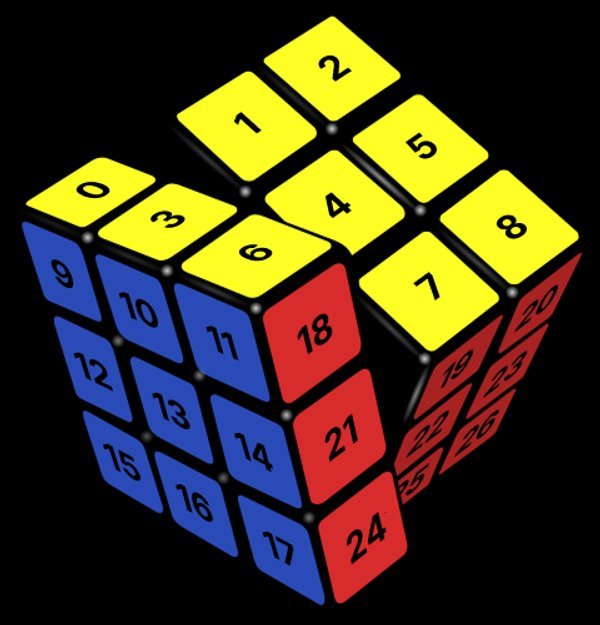 Permutation groups model transformations like Rubik's Cube moves
3. Generativity Pattern
Here's where compile-time magic happens. Crystal Durham's generativity crate uses lifetime branding:
make_guard!(guard);
let group = PermGroup::new(perms, guard);

impl<'id> Permutation<'id> {
    // No runtime checks needed!
    fn compose_into(&self, b: &Self, result: &mut Self) { ... }
}
How Generativity Works
The crate leverages three key components:
- Invariant Lifetimes:
Id<'id>usesPhantomData<fn(&'id ()) -> &'id ()>to disable subtyping - Guard Types:
Guard<'id>prevents duplicate branding - Drop-Based Scoping: A hidden
LifetimeBrandties lifetimes to lexical scope
// Simplified min_generativity implementation
make_guard! { $name:ident } => {
    let _brand = LifetimeBrand::new(&PhantomData);
    let $name = Guard(PhantomData);
}
 Drop-check semantics ensure lifetime uniqueness
Real-World Impact
Benchmarks show generativity's zero-cost abstraction:
| Approach | Time (ns) |
|---|---|
| Runtime Validation | 14.8 |
| Atomic ID | 3.94 |
| Generativity | 3.60 |
| Unsafe | 3.60 |
The Future of Generativity
While powerful, the pattern has ergonomic challenges:
- Lifetime parameters proliferate through APIs
- Guard lifetimes can't escape defining scopes
- Compiler errors can be opaque
Innovations like super let (nightly Rust) may improve usability. First-class #[nonunifiable] lifetimes could provide cleaner compiler support.
Generativity exemplifies Rust's unique ability to shift complex invariants to compile time. As Crystal Durham notes: "It's effectively a stronger form of ownership"—one that enables novel safety guarantees without runtime penalties.
This article is based on The Generativity Pattern in Rust by Arhan.
Comments
Please log in or register to join the discussion