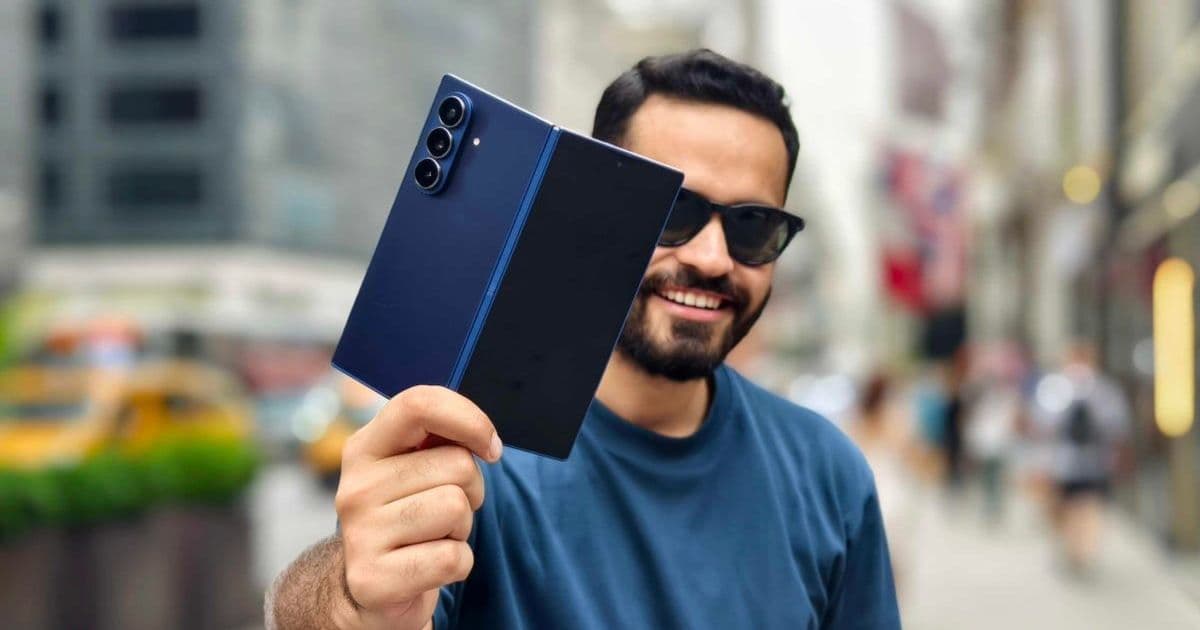
Samsung's latest foldable smartphone slims down while eliminating the notorious display crease, pairing premium hardware with potent AI to challenge competitors. Despite a steep $2,000 price and battery trade-offs, it sets a new benchmark for productivity-focused devices.
For years, Samsung's foldable phones iterated incrementally, leaving enthusiasts yearning for a leap forward. The Galaxy Z Fold 7 delivers precisely that—transforming from a niche novelty into a mainstream contender. ZDNET's Prakhar Khanna spent 10 days testing the device, revealing how its radical design overhaul and AI integration create Samsung's most compelling foldable yet, even as charging speeds and camera limitations remind us that perfection remains elusive.
The Thinnest, Lightest Foldable Yet Feels Revolutionary in Hand
At just 4.2mm thin when unfolded and 215 grams, the Z Fold 7 is now the lightest book-style foldable on the market—outpacing rivals like the Oppo Find N5 and Honor Magic V3. This isn't just a spec-sheet victory. In daily use, the slimmer profile and refined hinge make it more comfortable than Samsung's own Galaxy S25 Ultra for right-handed users, though left-handers may find the hinge corners uncomfortably sharp. Durability sees upgrades too, with Gorilla Glass Victus Ceramic 2 on the cover screen, a titanium plate reinforcing the inner display, and an IP48 rating for dust and water resistance. As Khanna notes:
"Samsung has made some damn near-perfect hardware. You get an easy-to-hold form factor, virtually no crease, and a cover screen that's close to a regular phone in itself."
The cover screen finally abandons its narrow aspect ratio for a 6.5-inch 21:9 display, making apps feel native rather than cramped—a subtle but critical shift for usability.
A Near-Invisible Crease and Display Trade-Offs
Samsung's new butterfly hinge mechanism achieves what once seemed impossible: a foldable screen with virtually no crease. This leap forward minimizes visual distractions and glare, outperforming competitors like Vivo and Honor. The 8-inch inner LTPO AMOLED panel remains vivid and responsive with a 120Hz refresh rate, but Samsung sacrificed the under-display camera for a punch-hole 10MP sensor. While this improves video call quality, it breaks immersion for media consumption. Khanna observes:
"If I had to choose between a subjectively more immersive Fold 6 screen with UDC and deep crease or Fold 7's punch-hole-clad screen with lesser crease, I'd pick the latter."
Flagship Camera and AI: Powerful but Imperfect
For the first time, Samsung equips its foldable with the same 200MP main camera as the Galaxy S25 Ultra, capturing vibrant, detailed photos even in challenging lighting. Paired with a 12MP ultra-wide and 10MP 3x telephoto lens, it's a capable system—yet the telephoto struggles with detail at full zoom, and switching between lenses in 200MP mode feels clunky. Generative AI features shine practically, though:
- Live Translate handles multilingual conversations seamlessly but requires manual activation via the quick panel.
- Generative Edit intelligently removes photo-bombers with impressive precision.
- Audio Eraser suppresses background noise in videos, albeit with occasional robotic artifacts.
Khanna found these tools genuinely useful: "From transcribing interview recordings to removing unwanted objects in my photos, there are plenty of useful AI tools that actually work."
Battery Life Holds Back an Otherwise Elite Experience
The Z Fold 7's 4,400mAh battery—unchanged since the Fold 3—is its Achilles' heel. While sufficient for moderate users (5-6 hours screen time), heavy usage demands a recharge by late afternoon. Combined with sluggish 25W wired charging, it lags behind rivals with larger silicon-carbon batteries. In testing, Khanna reported: "I average about nine hours on my phone daily and had to charge my Z Fold 7 every evening around 6 PM." This oversight feels stark in a device otherwise brimming with innovation.
Why Samsung Just Won the Foldable Wars (For Now)
Priced from $2,000, the Z Fold 7 isn't for the frugal, but it justifies its cost with unparalleled polish. The thinner chassis, vanished crease, and robust AI suite create a device that feels futuristic yet practical—especially for professionals juggling productivity and creativity. As competitors chase specs, Samsung focuses on refinement, proving that in foldables, execution trumps raw power. With U.S. availability and extended software support, it sets a bar others must clear. As Khanna concludes: "This is the most polished folding phone experience, in my opinion."
Source: ZDNET review by Prakhar Khanna
Comments
Please log in or register to join the discussion